

FIT Taxable Wages: What Is FIT on My Paycheck Stub?
 By
James Wilson
By
James Wilson One of the most common questions employees ask is, "What is FIT on my paycheck stub?" Most people starting new jobs are often surprised that their take-home pay is lower than expected. They may want to know why that is and where those unexpected tax deductions come from.
FIT is simply an acronym for "Federal Income Tax". On your paycheck, it is the amount of federal income tax your employer withholds from your earnings and sends to the IRS on your behalf.
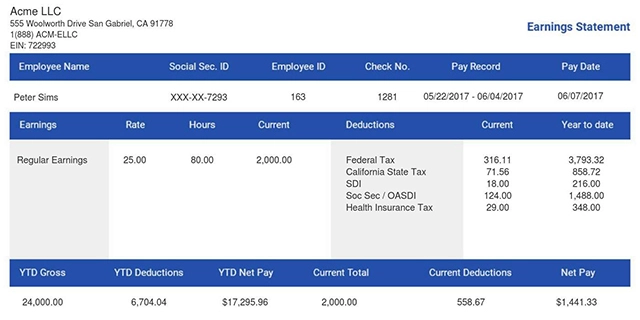
Understanding how FIT works is key to clearing up any confusion about your paycheck and your overall tax bill. If you create paystub records yourself, most especially with a check stub generator, you’ll usually see FIT listed with your other tax withholdings and deductions.
This guide will break down everything you need to know about FIT taxes, including what they mean on your paystub.
- Understanding Federal Income Tax
- What Is FIT on My Paycheck Stub?
- Employee-Related Information That Affects FIT Taxable Wages
- How To Calculate Your Federal Income Tax Withholding
- How Much Federal Income Tax Is Withheld?
- Why Your Federal Taxable Wages Matter
- Who Is Exempt from FIT Taxable Wages?
- Common Employer Mistakes With FIT and How To Correct Them
- Final Thoughts
Understanding Federal Income Tax
FIT is the federal income tax U.S. government collects on taxable income. FIT on paycheck is the amount withheld from an employee and sent to the IRS.
Most employees also ask, "What is FIT taxable wages?" They are the portion of an employee's earnings that are subject to deduction for FIT for a pay period. Employee's FIT withholdings are calculated by their FIT taxable wage.
Employers calculate withholding tax based on Internal Revenue Service rules using information from your Form W-4. This includes your filing status, income level, dependents, and any additional income you ask them to withhold.
What Is FIT on My Paycheck Stub?
If you ever wonder, "What is FIT on paycheck stub?" The FIT withholding you see on your pay stub is the amount deducted from your gross pay for FIT. It is a percentage of your income going to the federal government for various national services.
The FIT taxable wage on your paystub includes most of your taxable compensations, such as:
-
Regular wages and salaries
-
Over time, commissions and bonuses
-
Severance pay
-
Taxable fringe benefits, such as those benefits the IRS treats as income.
Employee-Related Information That Affects FIT Taxable Wages
There are certain employee details that an employer must consider to calculate FIT accurately. These include:
-
Taxable Income: The FIT taxable income from the employee's paycheck stub must be considered.
-
Pay Frequency: Check how often they are paid. For instance, paid biweekly, weekly, semi-monthly, or monthly.
-
Employee’s Filing Status: Check whether the employee is single, married, filing jointly, or separately.
-
Pre-Tax Deductions: Search for any contributions to employer-sponsored benefits. This includes health insurance and retirement plans. HSA contributions and certain commuter benefits are also examples of pre-tax deductions. These pre-taxes can reduce the employee’s taxable income.
-
Other Information Requested from the Employee's W-4: This includes any additional withholding requests and W-4 allowances. Also, check the number of dependents for the employee, any extra income, and tax deductions.
Employers are responsible for calculating the amount of FIT deducted from the employees' paycheck stubs. They should use the IRS withholding tables, the employee’s Form W-4, and employee paystub software to calculate accurate withholdings.
How To Calculate Your Federal Income Tax Withholding

Employers must ensure compliance with IRS requirements when making the FIT paycheck deductions. To do this, they must correctly calculate the employees' FIT tax. To determine the correct amount, employers can use IRS tax tables. They also need to take into account factors specific to the employee.
Also, if the employer is underwithholding tax, the employee may owe taxes at the end of the year. However, if too much is withheld, the employee loses too much of their take-home pay till the next tax refund season.
Here are the methods used to calculate FIT tax withholdings:
1. Percentage Method
Employers can use the IRS formulas and tables to apply different percentages to parts of the employee’s taxable wages. This is similar to federal tax brackets. It is one of the standard methods in IRS Publication 15-T for calculating FIT withholding.
2. Federal Income Tax Brackets Method
In this method, the IRS-provided tax tables are used to calculate the FIT taxes. The tables group earnings into brackets. This way, the appropriate withholding amount is determined based on the employee's income and filing status.
Here is an example to help you understand how FIT is calculated on pay stub:
Imagine an employee earns $1,800 every two weeks. The employer deducts $150 for health insurance premiums on health stubs and $50 for a traditional 401(k). These pre-tax amounts must be deducted before calculating the FIT.
-
The first step is to subtract pre-tax deductions.
$1,800 - $150 -$50 = $1,600 in FIT taxable wage.
-
Next, apply IRS withholding guidelines
Use the IRS withholding tables and the employee's Form W-4. For example, if the IRS withholding table shows that $148. 00 should be withheld for FIT on $1,600 taxable wages. This means that the amount deducted for Federal Income tax is $148. 00.
Want to see how your federal income taxes and tax return are calculated? Generate an accurate pay stub in just three steps with the 123 paystub approach. It can help you to see what exactly your federal tax deductions look like.
How Much Federal Income Tax Is Withheld?
Unlike most taxes with fixed rates, the federal income withholding tax varies. The federal income tax is progressive. This means the higher your earnings, the higher the FIT that is deducted.
For example, using the tax bracket method, if an employee's taxable income for the tax year is $65,000. Imagine the tax brackets are:
-
10%: $0-10,000
-
12%: $10,001-$40,000
-
22%: $40,001-$80,000
-
24%: 80,001- $ 120,000
The employee will not owe 24% of the entire $65,000. Instead, the employee will owe 10% on the first $10,000, 12% on the next $20,000, and 22% on the next $35,000. This will result in $1,000 + $2,400 + $7,700, which gives a total of $ 11,100.
Why Your Federal Taxable Wages Matter
To understand the concept of FIT taxable wages, you have to know its practical meaning. Here's why every employee needs to understand them:
Tax Liability
FIT taxable wages help determine how much federal income tax you are going to pay each tax year. This happens especially if wages are your main source of income.
Financial Planning
Knowing your taxable wages helps you manage your expenses. It enables you to know how much take-home pay you have after taxes and other applicable deductions. Then you can plan and factor your costs better.
Tax Optimization
You can make better decisions if you know which factors affect the taxable wages. This includes decisions regarding pre-tax deductions and benefits. This way, you can minimize it.
Avoiding Surprises
By tracking your taxable wages for the year, you can avoid any tax-related surprises. For instance, unexpected tax bills.
Retirement Planning
Pre-tax retirement contributions can help reduce your taxable wages. This can help you balance current tax savings with long-term financial goals.
If you want to understand every dollar deducted from your pay stub, you can use a real check stubs template to track your FIT taxable wages and deductions.
Who Is Exempt from FIT Taxable Wages?
Some people may owe little or no federal income tax because their taxable income is low. It could also be because certain benefits are non-taxable. Here are some reasons why some people do not pay federal income taxes:
Low Employee's Income Level
People with very low taxable income might not owe any FIT once the standard deduction and credits are applied. This means little or no FIT may be withheld from their paycheck. However, whether or not they owe FIT depends on the filing thresholds, and this can change every year.
Retirees With Low Income
Usually, people aged 65 and older who receive only Social Security income might not pay FIT taxes.
Non-Profit Organizations
Registered 501(c)(3) organizations are usually exempt from federal income taxes. However, employees of these organizations still pay Federal Income Taxes.
Some Individuals With Disability
Specific disability benefits may be partially or fully non-taxable. This depends on the type of benefit and the person’s overall income. This can reduce or eliminate their federal income tax. However, it does not automatically exempt all people with disabilities from FIT.
Review the IRS form for guidelines or consult a tax professional. The tax advisor can help determine whether you are eligible for the tax deduction. It is also necessary for employers to verify employees' claims of exemptions from FIT deductions.
Furthermore, being "exempt" on your W-4 only means your employer does not withhold federal income tax from your paycheck. It does not automatically mean you do not owe FIT. You must meet the IRS criteria to claim an exemption.
Common Employer Mistakes With FIT and How To Correct Them
Here are some common employer mistakes and how to fix them:
-
Using an outdated payroll system: Payroll systems that have not been updated may still use old IRS tax tables and rates. Since FIT rate changes, using outdated IRS tables can lead to incorrect deductions. Update your payroll software when the IRS publishes new withholding tax tables and guidelines.
-
Failing to subtract pre-tax deductions: Forgetting to subtract pre-tax benefits will make the FIT amount higher than it should be. Ensure you make accurate pre-tax deductions before calculating FIT.
-
Using old employee W-4: An employee may submit a new W-4, but it may not be updated in your system. This can lead to wrong FIT withholding until you update the new W-4. To avoid this, ensure to update any new W-4 as soon as possible.
-
Using an invalid W-4: Another common mistake is using a W-4 that has been altered or is clearly invalid. The IRS considers such a form invalid, and this can lead to withholding based on assumptions. Ensure you review every W-4 for validity. If it is invalid, ask your employee to submit a new one.
-
Labeling every tax as “tax": Grouping all taxes together can confuse employees. Listing FIT separately on the pay stub can make things clearer and help build employees' trust.
-
Correcting withholding errors improperly: Some employers do not correct withholding mistakes properly when they are found. This can cause further issues. Ensure you use the correct IRS form to report and correct withholding errors. Also, reimburse or adjust for over-withholding when needed.
Final Thoughts
Answering the question, "What is FIT on my paycheck stub?" puts you in control of your annual earnings. Once you know your tax obligations and how taxable wages are calculated, the numbers on your pay stub start making sense. It becomes easier to plan your finances and make smarter decisions about benefits and taxes. With the proper knowledge, FIT stops being confusing. It becomes just another part of managing your money responsibly.
Need a more precise breakdown of your annual earnings? Generate a detailed paystub now and see how your federal income taxes are calculated with our paystub generator. Get accurate, professional paystubs in minutes and stay on top of your finances with confidence.
- 1. Enter Your Information

- 2. Select Your Favorite Theme

- 3. Download Your Stub!

 By
By