

How to Pay the IRS with EFTPS
 By
By
Most people don't go looking for EFTPS out of curiosity. They land on it because a federal tax deposit is due and the clock is already running. It's the government system that moves those payments, and it's less complicated than the name suggests. The figures come straight off your payroll records, so accurate pay stub templates matter as much as the payment. Here's what it is, who has to use it in 2026, how to enroll and log in, and how to submit a deposit on time.
Key Takeaways
- EFTPS is the federal tax payment system run by the U.S. Department of the Treasury, and it costs nothing to use.
- As of 2026, individuals can no longer create new accounts, but businesses with an EIN still can.
- Enrollment takes up to five business days to process, and your PIN then arrives by mail.
- Schedule deposits by 8:00 p.m. ET the day before they are due.
- You can reset your internet password online, but a lost PIN requires a phone call.
- What Is EFTPS?
- Who Has to Use EFTPS in 2026?
- EFTPS Enrollment: How to Set Up Your Account
- Logging In at the EFTPS Website
- What You Can Pay Through EFTPS
- How to Make an EFTPS Payment
- Federal Tax Deposit Schedules: When Are Deposits Due?
- EFTPS vs. IRS Direct Pay
- EFTPS Customer Service and Troubleshooting
What Is EFTPS?
EFTPS is the Electronic Federal Tax Payment System, a no-cost service from the U.S. Department of the Treasury for paying federal taxes online at EFTPS.gov. It debits your bank account directly and runs 24 hours a day. You get 15 months of payment history and can schedule payments up to 365 days ahead.
You'll often see it written as EFTP, one letter short, but it's the same system. Behind the scenes, each payment moves as an ACH debit from your bank through the Federal Reserve network to the IRS. Most settle within one business day.
Who Has to Use EFTPS in 2026?

Businesses that deposit federal payroll taxes use EFTPS, and corporations must deposit federal taxes electronically. As of 2026, individual taxpayers can no longer create new EFTPS accounts, though existing individual users may continue. New individual filers should use IRS Direct Pay or an IRS Online Account instead. Household employers with an EIN still enroll normally.
That middle point catches people out, since plenty of older guides still tell individuals to sign up. The IRS states plainly that individuals can no longer open new accounts. Hire a nanny or home caregiver, though, and you're an employer with an EIN, which puts you back in scope.
EFTPS Enrollment: How to Set Up Your Account
Start your EFTPS registration at EFTPS.gov:
- Gather your details. You'll need your Employer Identification Number (EIN) or taxpayer identification number. Also have your business name and address as they appear on IRS filings, a phone number, and your bank account and routing number.
- Submit the enrollment form. Click ENROLL on the home screen and fill in those details.
- Wait for your PIN. The IRS takes up to five business days to process a new enrollment, then mails your PIN to your address of record. That paper step blocks identity theft.
- Activate your EFTPS account. Log in with the PIN, then create your own internet password.
Your EFTPS set up is finished there, and you won't have to re-enroll. If you got your EIN through Express Enrollment for New Businesses, you may already be enrolled. Check before starting over.
Logging In at the EFTPS Website

Three separate credentials get you in, and confusing them is why people lock themselves out:
- Your EIN (or SSN on older individual accounts)
- Your EFTPS PIN, mailed to you and not changeable online
- Your internet password, which you can reset yourself
The EFTPS.gov login page asks for all three on the "Welcome to EFTPS online" screen. There's no separate company portal, so an EFTPS business login uses that same screen.
If you searched for an EFTPS IRS login, you may want your IRS Online Account instead. They're different systems with different credentials. One moves deposits; the other shows balances and notices.
What You Can Pay Through EFTPS
Federal obligations only. The common ones:
- Form 941, quarterly employment taxes
- Form 940, federal unemployment tax (FUTA)
- Form 943, Form 944, and Form 945, for agricultural, small-employer, and non-payroll withholding
- Form 720 excise taxes and Form 1120 corporate income tax
- Estimated taxes for businesses
State income tax and unemployment insurance don't run through here; those go to your state's own portal.
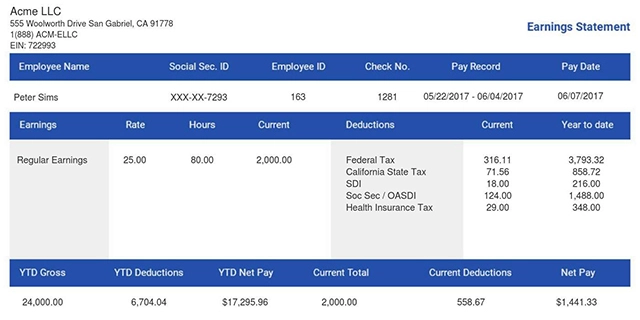
Your EFTPS payroll deposit equals the federal income tax you withheld plus both halves of Social Security and Medicare. Those figures come straight off your employees' pay stubs. Clean records turn a quarterly Form 941 reconciliation into a five-minute job.
Need professional pay records for your team or yourself? Our check stub maker handles the math for you.
How to Make an EFTPS Payment
Once you're in, paying the IRS with EFTPS takes about two minutes:
- Choose the tax form and the tax period you're paying for.
- Enter the amount and pick the settlement date.
- Save the confirmation number the system returns.
Schedule payments up to 365 days ahead. You can modify or cancel one up to two business days before its date. Your last 15 months of payment history stay online, the fastest way to reconcile deposits at quarter close.
Federal Tax Deposit Schedules: When Are Deposits Due?
Monthly depositors pay by the 15th of the following month. Semiweekly depositors pay by the following Wednesday for Wednesday-to-Friday payrolls, or the following Friday for Saturday-to-Tuesday payrolls. Any single federal tax deposit reaching $100,000 is due the next business day. Schedule in EFTPS by 8:00 p.m. ET the day before it is due.
Your schedule depends on your lookback period liability, which the IRS reviews annually and explains in Topic 757. It tracks the tax you withhold, not what you earn. If a deadline is about to slip and enrollment isn't finished, ask your bank about a same-day wire; IRS Publication 966 covers it.
EFTPS vs. IRS Direct Pay
| EFTPS | IRS Direct Pay | |
|---|---|---|
| Who it's for | Businesses with an EIN | Individuals only |
| Registration | Required, up to 5 business days | None |
| Business taxes | Yes | No |
| Scheduling window | 365 days | 30 days |
| Payment limits | None | 2 per 24 hours, under $10 million |
Running payroll or paying corporate tax? You need EFTPS. Paying your own 1040 balance or personal estimated taxes? Direct Pay or your IRS Online Account handles it without any signup. Keep your bank details current with the IRS.
EFTPS Customer Service and Troubleshooting
You can reset your internet password yourself. You cannot reset an assigned PIN. If yours is lost, call EFTPS customer service at 1-800-555-4477 and verify your identity. Have these ready before you dial:
- Your EIN and bank account information
- Your total payroll tax deposit for the quarter
- Social Security and Medicare withholding amounts for the quarter
Two other numbers: 800-733-4829 for TDD and 800-244-4829 for Spanish. If a payroll provider deposits for you, request an Inquiry PIN to watch those payments without handing over account control.
One security note: Treasury contacts taxpayers by mail, so any email urging you to reset your password is phishing.
You Might Also Like
- Payroll Tax vs. Income Tax: What's the Difference?
- Payroll Codes Explained
- FIT Taxable Wages on Your Pay Stub
- How to Calculate W-2 Wages From a Pay Stub
- Employment Verification and Proof of Income Documents
Conclusion
EFTPS rewards preparation more than anything else. Enroll before you need it. Keep your EIN, PIN, and password straight, and schedule each deposit the moment payroll closes rather than the night it's due.
Accurate deposits start with accurate pay records. Create clean, professional documentation for your team or your own self-employed income with our paystub generator.
- 1. Enter Your Information

- 2. Select Your Favorite Theme

- 3. Download Your Stub!

 By
By