

How To Write Proof Of Income Letter For Apartments?
 By
James Wilson
By
James Wilson Applying for an apartment is stressful enough without getting tripped up on paperwork. Most landlords and property managers ask for a proof of income letter for apartment applications alongside your pay stubs, bank statements, or tax returns. If you are short on recent pay records, you can put together a clean set with a pay stub template before you apply. Getting this letter right can mean the difference between a quick approval and a frustrating back-and-forth with leasing offices.
This guide covers exactly what goes in a proof of income letter for apartment rental applications, who should write it, a sample proof of income letter for apartment template you can use today, and tips for renters in every situation, including the self-employed and those with non-traditional income. If you want to see how pay stubs fit into the bigger picture, our guide to pay stubs for rental applications walks through exactly when landlords ask for them.
Key Takeaways
- A proof of income letter confirms your earnings to a landlord and typically accompanies supporting documents like pay stubs or bank statements.
- Employed renters should ask their employer or HR department to write the letter; self-employed applicants write their own.
- The letter must state your name, position, income amount, and employment status clearly and factually.
- Use a downloadable template, customize it accurately, and attach current pay stubs or a recent tax return to strengthen your application.
- Landlords typically require proof that your monthly income is 2.5 to 3 times the monthly rent.
What Is a Proof of Income Letter for an Apartment?
A proof of income letter for an apartment is a written statement confirming that a rental applicant earns enough income to meet monthly rent obligations. Sometimes called an income verification letter or employment verification letter, it is one of the most requested documents in any apartment application. Landlords use it to reduce the risk of non-payment before signing a lease.
The letter is usually one page. It states who you are, where you work or where your income comes from, and how much you earn. Most property managers want to see your gross monthly income rather than your take-home pay, because rent-to-income ratios are calculated before taxes.
Why landlords ask for it: A standard benchmark is that your monthly gross income should be at least 2.5 to 3 times the monthly rent. A $1,500 apartment typically requires gross monthly income of $3,750 to $4,500. The letter, combined with pay stubs or bank statements, gives a landlord confidence before approving a lease.
Who needs one: Nearly every renter applying for a market-rate apartment, but it is especially important for:
- Self-employed individuals who do not have a traditional employer
- Freelancers and gig workers with variable income
- Employees who recently changed jobs and lack a long pay history at their current employer
- Renters relying on non-wage income such as Social Security, pension, alimony, or rental income from other properties
Who Should Write the Letter?
Employed Renters
If you work for a company, your letter should come from your employer. That means your direct manager, HR department, or payroll administrator. An employer-written letter carries more weight with landlords because it comes from a verifiable third party.
Ask your employer to put the letter on company letterhead. Many HR departments have a standard template for employment verification. Give them enough lead time before your application deadline and let them know what information the landlord needs, typically your job title, start date, and current annual or monthly salary.
If your employer uses an external payroll service like ADP or Paychex, you can often request an employment verification letter directly through that provider's self-service portal. Check with HR first to understand the fastest path.
Self-Employed Renters and Freelancers
If you are self-employed, you write the letter yourself. This is completely normal, and landlords who rent to contractors or small business owners expect it. A self-written letter is perfectly acceptable as long as it is specific, accurate, and supported by documentation.
Because you cannot have a third party verify your income, your supporting documents matter more. Attach your most recent two years of tax returns (Schedule C for sole proprietors), your most recent three months of bank statements, and any signed client contracts that show ongoing income. A profit and loss statement for the current year also helps.
For proof of income documentation specifically in cash-based or non-traditional situations, see our guide on proof of income if paid in cash.
What to Include in the Letter

Whether an employer is writing the letter or you are writing it yourself, these elements must be present:
Contact Information and Date
Start with the date at the top of the page, then list the sender's name, title, company name, phone number, and email address. A clear block like this lets the property manager quickly follow up if they need verbal verification. Self-employed applicants use their own business name and details here.
A Clear Subject Line
A single line such as "Re: Income Verification for [Your Name]" or "Re: Rental Application Income Confirmation" tells the property manager at a glance what the letter is about. This is a small detail that makes a professional impression.
Your Full Name and Role
The body of the letter should open by identifying you clearly: your legal name as it appears on your application, your job title (or "self-employed consultant" or similar), and your hire date or the length of time you have been self-employed.
Your Income, Stated Clearly
State your gross annual salary and, separately, your gross monthly income. Both figures help landlords do the math quickly. If you earn a base salary plus regular bonuses or commissions, state the base salary and note that bonuses are supplemental.
For renters with non-wage income, list each source separately. For example: Social Security benefit of $1,400 per month, plus rental income from a second property of $900 per month, totaling $2,300 per month gross.
Employment Status and Stability
Include whether the position is full-time, part-time, or contract. Landlords want to know the arrangement is ongoing, not temporary. A line like "This is a permanent full-time position" or "This contract has been renewed annually for three years and is currently active through December 2026" gives confidence.
Signature
Renters forget this step more than any other, and skipping it makes the whole document read like a rough draft. An employer letter gets signed by the manager or HR contact named at the top; if you wrote it yourself, you sign it. Even a simple printed name plus a handwritten or digital sign-off adds credibility and shows the document is official.
Proof of Income Letter for Apartment Rental: Sample Template
Here is a clean, usable proof of income letter for apartment rental that you can copy and adapt. The proof of income letter for apartment template below covers the employer-written format; a self-employed variation follows. Customize every bracketed field with your actual details.
[Date]
[Sender Name]
[Sender Title]
[Company Name]
[Company Phone]
[Sender Email]
To Whom It May Concern,
I am writing to confirm the employment and income details of [Applicant Full Name], who is applying for a rental property at [Property Address].
[Applicant Full Name] has been employed with [Company Name] since [Start Date] and currently holds the position of [Job Title]. This is a permanent, full-time position.
The applicant's current compensation is as follows:
- Annual gross salary: $[Annual Amount]
- Monthly gross income: $[Monthly Amount]
This employment is ongoing with no scheduled end date. If you have any questions or require additional verification, please do not hesitate to contact me at the information above.
Sincerely,
[Authorized Signature]
[Printed Name]
[Title]
[Company Name]
For a self-employed version, replace the employer-authored intro with your own statement: "I, [Your Full Name], am self-employed as a [describe your business or profession]. My average monthly gross income for the past 12 months has been $[Amount], as evidenced by the attached tax returns and bank statements."
You can also find a proof of income letter for apartment PDF on many legal document sites. Once you have one, customize it with your real figures and have it notarized if your landlord requires additional verification. Whichever format you choose, accuracy is more important than the exact layout of the proof of income letter for apartment you submit.
If you want the employer's side of this document, our guide to writing an employment verification letter breaks down the format HR teams typically use and how it differs from one you write yourself.
Proof of Income Letter for Apartment: Supporting Documents to Attach

A proof of income letter for apartment applications is rarely enough on its own. Landlords almost always ask for supporting documents to confirm what the letter states. The most commonly accepted are:
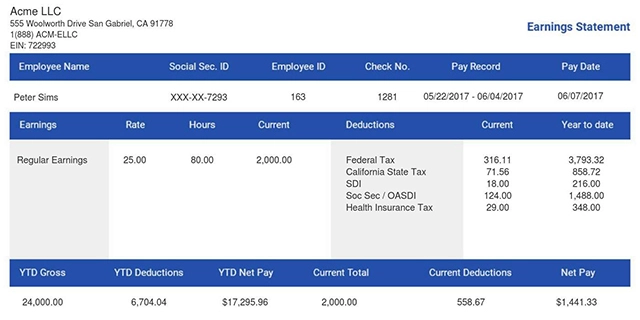
Pay stubs: The most straightforward option for employees. Most landlords ask for two to three consecutive recent pay stubs. They verify employer, pay frequency, gross earnings, and YTD totals. If your employer uses a digital payroll system, you can download them directly from your employee portal. If you have switched jobs recently or lost older copies, gather a complete, consecutive set so your pay history reads consistently across every stub.
Tax returns: The IRS Form 1040, especially with attached schedules, is strong income proof because it is a government-verified document. Landlords may ask for the past one to two years of returns. Self-employed renters almost always need to provide these.
Bank statements: Two to three months of bank statements showing regular deposits support both the letter and any pay stubs you provide. They are especially useful when income comes from multiple sources or when deposits are irregular.
Offer letter: If you just started a new job, an official offer letter on company letterhead stating your start date and salary can substitute for pay stubs in many cases.
Signed client contracts: Freelancers and contractors can use active contracts that specify payment terms as additional proof of ongoing income.
For a closer look at the specific situations where landlords and others want a pay stub and similar paperwork, see our guide to the proof of income documents you'll need.
Tips for Special Situations
Recently Started a New Job
Lead with your offer letter and include your first pay stub if you have received one. Explain the situation briefly in the letter or in a cover note. Some landlords will accept a conditional approval while you build a pay history.
Multiple Income Streams
List each source in the letter with a separate line for the amount and frequency. Attach documentation for each stream. A combined total at the bottom helps the landlord do the math quickly without needing a calculator.
Income Below the 3x Threshold
Falling short of the standard rent-to-income ratio does not automatically disqualify you. Adding a co-signer or guarantor is the most common workaround. Their income verification letter follows the same format outlined above, but their name and earnings appear instead of yours. Some landlords also accept a larger upfront security deposit in place of hitting that ratio.
Seasonal or Variable Income
Average your monthly income over the past 12 months and state that average in the letter. Use a line like: "Monthly income varies seasonally; the 12-month average gross income is $[Amount] per month, as documented in the attached bank statements and tax return."
If your earnings swing from month to month, pairing your letter with a current-year profit and loss statement and your 12-month average gives a landlord a much clearer picture of what you actually bring in.
You Might Also Like
- Best Rent Reporting Services
- Self-Employed? Here's How to Show Proof of Income
- How to Get a Pay Stub From Direct Deposit
- Employment Verification and Proof of Income Documents
- What Is Annual Income?
Conclusion
Writing a solid proof of income letter for apartment applications comes down to clarity, accuracy, and supporting documentation. Whether you are submitting one for the first time or updating an old letter for a new place, the core formula stays the same: clearly state your name, income amount, and employment status, then back it up with real documentation like pay stubs, tax returns, or bank statements.
If you need clean, professional pay documentation to attach to your application, create a pay stub in minutes at ThePayStubs.com, with accurate records for employees and self-employed renters alike. Get your documentation ready and submit a complete, organized application to give yourself the best shot at approval.
- 1. Enter Your Information

- 2. Select Your Favorite Theme

- 3. Download Your Stub!

 By
By