Are There Any Sanctions For Falsifying Pay Stubs?
 By
Just this month, a court sentenced a 55-year-old man in New Jersey to 15 months behind bars after being found guilty of bank fraud. For three years, the man provided fraudulent documents, including employment verification and pay stubs, to enable unqualified borrowers to purchase real estate. He had managed to earn tens of thousands of dollars from this illicit act.
This is by no means an isolated case. Using machine learning, a study last year identified that one in 12 pay stubs issued nationwide is fake to an extent. This alarming statistic contributed to an even worse one: one in five loan applications having inflated incomes of as much as 15%.
Pay stubs are essential documents for both the consumer and business. Having them falsified for whatever reason sets up a dangerous precedent for the economy as a whole. To answer if one can get in trouble for falsifying pay stubs, it’s a big yes. The more important question is how much in trouble a person found guilty of it will be.
How Pay Stub Fraud Happens
Pay stub fraud means handing over a pay stub with false information as proof of income. Most often the pay is inflated to pass an income test: many landlords, for example, look for a gross monthly income of two to three times the rent. Sometimes the stub is for a job that does not exist at all.

The paper itself is only part of the problem. The fraud is using it to get a loan, a lease or benefits that your real income would not get you. The next sections cover what the law says and how often people are caught.
What Does the Law Say?
Section 1344 of the U.S. criminal code (18 USC 1344) details the requirements for bank fraud to occur and the penalty. According to this:
Whoever knowingly executes, or attempts to execute, a scheme or artifice—
(1) to defraud a financial institution; or
(2) to obtain any of the moneys, funds, credits, assets, securities, or other property owned by, or under the custody or control of, a financial institution, by means of false or fraudulent pretenses, representations, or promises;
shall be fined not more than USD$1,000,000 or imprisoned not more than 30 years, or both.
Investigating bank fraud is one of the key responsibilities of the U.S. Secret Service. Yes, it’s the same agency that protects the President of the United States (and other national and international dignitaries). In fact, it was originally established to root out counterfeit money in circulation after the Civil War; protecting presidents didn’t happen until the beginning of the 20th century.
The heavy fines and jail time signify how serious the federal government is in rooting out bank fraud. Industries from real estate to telecommunications can suffer losses by the billions if they allow bank fraud to run rampant.
Something as seemingly minor as a fake pay stub can quickly add up to an industry’s losses. The same study also linked fake pay stubs to the auto lending industry’s USD$7.3-billion loss in the first year of the COVID pandemic.
Law aside, there’s also the moral implication of falsifying such documents, especially in this day and age. The USD$900-billion relief by the CARES Act was supposed to help families rendered jobless by the pandemic get through these challenging times. Sadly, fraud took away over USD$36 billion, meaning thousands of families being denied sufficient financial aid, if at all.
Also read: How Can You Tell If Someone Is Using A Counterfeit Pay Stub

How Lenders and Landlords Catch Fake Pay Stubs
Lenders, landlords and employers have several ways to check a pay stub.
Employment and income verification is a hot market in the private sector, with the industry size poised to grow by around 7.5% between 2017 and 2023. Ease of access to big data means these relevant services can receive crucial information about employment status and income. Some of the most well-known names in the industry are already in use by Fortune 500 companies.
Speed is one of the most significant advantages of such a service. Landlords and other creditors no longer have to wait for days or weeks from the concerned person’s employer (namely their human resource department) for employment and salary data. Everything they need to know is already in a fully integrated and secure database.
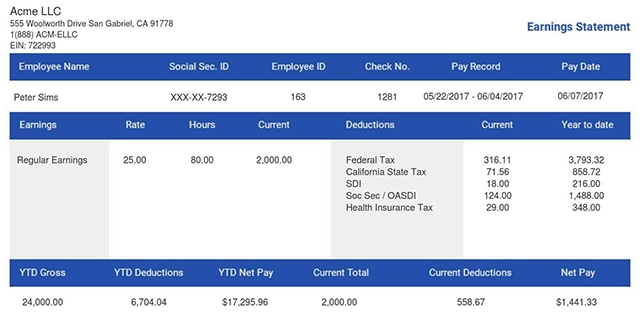
Apart from state-of-the-art solutions, business owners themselves are honing their skills in spotting fraudulent financial documentation. For instance, landlords can get by with a pair of keen eyes by being on the lookout for as many fake pay stubs feature glaring errors like:
-
Using the letter ‘O’ in place of zeroes
-
Figures rounded off to the nearest digit
-
Watermarks still present in the pay stub
-
The math doesn’t check out in the calculator
-
Missing, duplicate, or oddly consecutive check numbers
-
Individual and employer information don’t stack up
In some cases, they ask for more documentation to make sure the details check out. Aside from pay stubs, creditors can require any or all of the following:
-
W2 Tax Form – contains details on taxes withheld from one’s salary in a given tax year
-
Form 4506 – a taxpayer’s true copy of previous tax returns filed with the IRS
-
Bank Statement – summary of a person’s transactions in a period (usually three months)
-
Form 1099-R – a report on a retired person’s pension distribution, IRA, and 401(k)
-
Credit Report – outlines a person’s creditworthiness via a credit score
Federal legislation is also catching up with the unscrupulous forgery. The Wage Theft Prevention and Wage Recovery Act, introduced in July 2019 and pending reading as of this writing, would amend the existing Fair Labor Standards Act (FLSA) to require employers to produce pay stubs, among others.
Right now, the FLSA only requires employers to maintain accurate records of hours rendered and wages paid. The bill can help mitigate instances of fraud by mitigating the need to self-produce pay stubs since their workplace will provide one for their employees.
Also read: What are the Secure Electronic Delivery Methods Of W2 and 1099 Forms?

Are Generating Pay Stubs Legal?
Some people misuse pay stub generators to make false pay stubs, so it is fair to ask whether these services are legal.
However, the fault should lie not with pay stub generation but the misrepresentation that people input on these documents. As mentioned earlier, this service exists for those who can’t produce or acquire pay stubs by conventional means (for example, the self-employed and freelancers).
The user is ultimately responsible for the accuracy of the information presented in their pay stub. Going back to 18 USC 1344, committing bank fraud requires a person to be aware that they’re engaging in a scheme to gain assets through pretenses. The system may afford leniency if you’re unaware of irregularities in your information, but it won’t show mercy if you knowingly decide to falsify your details.
A pay stub you make for your own pay is legal only when every number on it is true. Using one with false numbers to get a loan is bank fraud.
Also read: 7 Advantages Of Creating Custom Check Stubs

Conclusion
Fake pay stubs can cost people dearly once the law catches up with them. With the industry honing its craft in thwarting pay stub fraud and creditors getting better at spotting it, the risk of being caught keeps growing. Stick to the legal way, be honest about your finances, and you’ll be fine.
- 1. Enter Your Information

- 2. Select Your Favorite Theme

- 3. Download Your Stub!

 By