

How To Calculate W2 Wages and Taxes From Paystub
 By
James Wilson
By
James Wilson Filing your taxes in the tax season can be a tedious chore if you're not familiar with the process. However, most of the basic information you need for your W-2 is located directly on your pay stub. You can easily locate this information to know approximately how much your tax return will be.
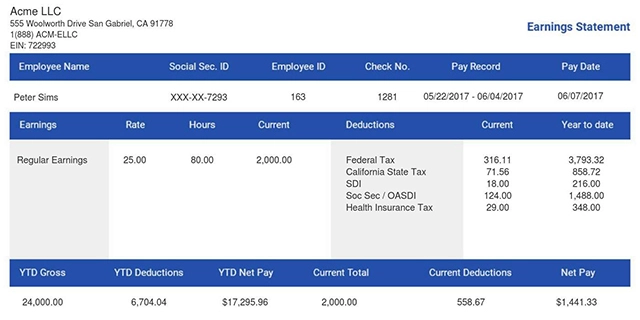
When you create a pay stub, it contains Year-to-Date (YTD) figures for gross pay, deductions, and taxes withheld. By using these YTD values, you can estimate your W-2 form online even before your official W‑2 arrives. In this guide, we'll show how to use your final pay stub to estimate each W‑2 value.
You'll learn how to calculate federal and state taxable income and federal income tax withheld. You'll also gain a better understanding of how your Social Security wages and Medicare wages are computed.
Form W-2 vs Pay Stub: What’s the Difference?
A Form W‑2 is a Wage and Tax Statement. It is the annual summary your employer sends to you and the IRS, reporting your total wages and taxes withheld. On the other hand, a pay stub is a periodic statement showing earnings and deductions up to that pay date.
The final pay stub will have Year-to-Date (YTD) totals that sum all paychecks for the tax year. These YTD totals are the key to calculating your W‑2 figures.
-
Gross pay vs taxable wages: Your pay stub’s gross pay includes all earnings before deductions. However, the W‑2 Box 1 federal wages exclude certain pre-tax amounts like 401(k) or HSA contributions.
-
Pre-tax deductions: Items like these are deducted before taxes. They include retirement plan contributions, health insurance premiums, and flexible spending. These reduce taxable wages on the W‑2.
For example, if your gross YTD pay is $50,000 and you contributed $5,000 to a pre-tax 401(k), your Box 1 taxable wages on the W‑2 would be $45,000.
-
W‑2 boxes: A W‑2 has boxes 1 to 6 for FICA and federal taxes, and boxes 16 to 20 for state and local taxes. Your pay stub may not label them the same way, but the YTD totals can be reconciled.
Your final pay stub’s YTD column for gross pay minus YTD pre-tax contributions and deductions should equal the W‑2 Box 1 federal taxable wages. Likewise, the pay stub’s YTD Social Security wages and Medicare wages help you verify Box 3 and Box 5 on the W‑2. Remember that all nontaxable income should also be excluded, as it doesn’t appear on the W‑2.
How To Calculate W2 Taxes From Your Pay Stub
The best way to calculate W2 wages is to compute them in sections. Your W2 form has multiple boxes representing several figures that contribute to your W2 wages. Here is a breakdown on how to calculate each one.
Box 1: How To Calculate Federal Taxable Wages
To calculate my W2 Box 1 wages, start with your YTD gross earnings and subtract all pre-tax deductions. Your pay stub's YTD gross income is typically listed on the earnings section. Once you have that, here are the next steps to follow:
-
Subtract retirement contributions based on retirement accounts and other pre-tax savings. These will help you reduce your federal taxable wages.
-
Subtract health benefits. Health, dental, and vision premiums are usually pretax if your employer uses a Section 125 plan. Life insurance is not fully pretax, and only the cost of employer-provided coverage exceeding $50,000 is taxable.
-
Subtract FSA/HSA contributions. Flexible Spending Account or HSA contributions for healthcare will also be subtracted.
-
Subtract any other pretax items. These include your commuter benefits, group-term life insurance of over $50,000. It also covers your health savings account contributions.
Your remaining figure equals Box 1 wages. Box 2 is your federal income tax withheld, not wages. If what you have does not match the figure, check through every deduction again for errors or contact your payroll department. If your final result doesn’t equal Box 1 on the W‑2, double-check each deduction or ask payroll for help.
Common pre-tax items include
-
Employee 401(k) or 403(b) contributions
-
Pre-tax health insurance premiums
-
HSA and FSA contributions
-
Commuter benefits and any other compensation.
Employee 401(k)/403(b) contributions reduce Box 1 wages. Employer contributions do not affect Box 1 and do not appear in taxable wages.
Here is an example of how the deductions can go:
Assuming your gross YTD is $50,000, you minus
-
401(k): $5,000
-
Health insurance premiums: $3,600
-
HSA contributions: $1,200
The final number on your Federal Taxable Wages would be $40,200
These same steps may apply to some other boxes, like your box 16. Pay attention to specific state income tax regulations, as they might have different requirements.
Box 2: How To Calculate Federal Income Tax Withholding
Box 2 of your W‑2 shows the total federal income tax withheld for the tax year. On your pay stub, your federal income tax may be depicted as “Federal Tax” or “FED Withholding” YTD. You will need to multiply one pay period's federal withholding by your total number of pay periods.
It differs by pay period: 24 for semi-monthly and 26 for biweekly, to annualize. You can also read the YTD federal tax withheld if your pay stub provides it. For instance, if you earn $100 semi-monthly or every two weeks, then it will be 100 × 26 = $2,600 annually.
So how does this work for hourly employees? Earning $16.50 an hour is how much a week after taxes? If work hours run for a period of 40 hours per week, you earn $660 gross. After typical taxes, including FICA, federal, and state taxes, totaling about 21.7%. You'll take home about $517 per week. Keep in mind that federal tax rates vary based on filing status, state and local taxes vary, and your pretax benefits change your take-home pay.
Your actual tax liability depends largely on your Form W-2 wages, deductions, credits, and filing status. However, Box 2 is purely what was taken out of your pay as federal income tax, and it is determined by your W-4 withholding elections. In plain terms, Box 2 is the sum of all federal income tax withheld each pay period.
Box 3 to 6: How To Calculate Social Security and Medicare Wages
Calculating your Social Security and Medicare wages from a pay stub is similar but slightly different from Box 1. By law, most pretax retirement contributions do not reduce Social Security or Medicare wages. However, those taxes apply to your full wages up to certain limits.
-
Social Security wages (Box 3): This is your total wages subject to Social Security taxes. It includes your pre-tax 401(k) contributions, employer-paid benefits, and any other income before FICA. You can use the same gross YTD as a starting point, subtract only pretax items not subject to FICA.
Your Social Security is capped at the annual wage base. Above that cap, your wages are not taxed for Social Security.
-
Medicare wages (Box 5): To calculate Medicare wages, you need details of all wages subject to Medicare taxes. All dollar amounts earned are subject to Medicare.
To calculate W2, take the YTD gross pay and subtract only the FICA-exempt pretax items. These are your:
-
HSA and FSA contributions
-
Health/dental/vision insurance premiums (employee portion)
-
Some types of group-term life insurance premiums. This does not include the first $50,000 of coverage.
Note that Health, dental, and vision premiums are not subject to FICA only if offered through a Section 125 plan. Otherwise, they are subject to Social Security & Medicare.
For example:
Let us say your YTD gross is $60,000, and you had $2,000 HSA contributions and $3,000 in pretax insurance. That would mean;
-
Social security and Medicare taxable wages would be $60,000 − ($2,000 + $3,000) = $55,000.
-
If $60,000 is below the Social Security cap, then Box 3 = $55,000 and Box 5 = $55,000.
For single filers, if you have multiple jobs, remember the Social Security limit applies across all employers. If your combined wages exceed the annual cap, you may have had too much Social Security tax withheld. You can easily reclaim this by filing for a tax return.
Box 16 to 20: State and Local Tax Withholding
If you pay state and local taxes, the W‑2 will include Box 16 for state wages and Box 17 for state tax withheld. Box 18 is your local wages, and Box 19 is the local taxes withheld. Your pay stub's YTD state wages and YTD state and local taxes should match these details correctly.
If your state has no income tax, these boxes will be blank. Keep in mind that the state taxes and local taxable wages may differ from the federal Box 1 amount if your state doesn't tax certain pre-tax benefits. Always confirm the rules with your state and local government tax authorities.
Gross Income vs Taxable Income on Form W-2

The gross income from your W‑2 contributes to your total income on your tax return. Box 1 wages count as "wages" in gross income. After Adjusted Gross Income (AGI), you subtract either the standard or itemized deductions to arrive at taxable income.
The standard deduction is a flat amount that lowers your income. Itemized deductions reduce your income dollar-for-dollar. However, you can only itemize if the total exceeds the standard deduction. For most people, the standard deduction is simpler, but taxpayers with large expenses may save more by itemizing.
You can keep this in mind after calculating your W‑2 wages, as it affects your final tax bill or tax refund.
How W-2 Wages Flow Into Adjusted Gross Income (AGI)
Your W‑2 income feeds into Adjusted Gross Income (AGI) on Form 1040. This AGI is total income minus specific adjustments like IRA contributions or student loan interest. From AGI, you subtract either the standard deduction or itemized deductions to get taxable income.
You may also be eligible for certain tax credits that reduce your tax bill. For example, the Child Tax Credit is one of the tax credits worth up to $2,000 per qualifying child under 17. There are other tax credits aside Child Tax Credit that directly reduce taxes owed.
When comparing your withheld tax to your post-tax credits, you’ll see whether you get a tax refund or you owe more.
Itemized Deductions and Net Income
Remember that what goes into your bank is not the same as what is on your W‑2 Box 1. Net income is the amount remaining after federal and state taxes, as well as pretax deductions. Your net income is your take-home pay and shows your actual income level post-tax.
Box 1 wages ignore pretax deductions. For example, health insurance, 401(k) contributions and charitable contributions all lower your take-home pay. However, Box 1 shows those deducted amounts as it reflects taxable income after them.
When filing, after reporting W‑2 income on Form 1040, you can choose the standard deduction or itemize deductions. The standard deduction may be easier for most, and itemizing can be beneficial if you have large business expenses.
According to the IRS, the standard deduction is a fixed amount that reduces your taxable income, but it is unavailable if you itemize. Always choose whichever option gives you a lower tax.
Using Your Pay Stub To Estimate Your Tax Return
Do you know you can make a W2 from last pay stub? Do you want to know how to calculate Social Security wages from paystub? Yes, you can do all of these once you have access to your pay stub.
Are you wondering, “Can I file taxes with last pay stub”? You cannot file your tax return using a pay stub unless you use Form 4852 because your W-2 is missing. If your employer withheld more than your tax owed, you’ll get a tax refund. If less, you may owe money.
You can also calculate Social Security wages from pay stub. With all YTD figures from your final pay stub, you can roughly predict whether you will owe taxes or get a tax refund.
Here is how to calculate taxable income from pay stub:
Compare taxes withheld against your estimated tax liability for the year. Now, what about how to calculate Medicare wages from paystub? It’s a good idea to reconcile pay stub numbers with your W‑2 when you receive it.
If they don’t match, check for missed deductions or reporting errors. Tools like the IRS Tax Withholding Estimator or online income tax calculators can help verify your situation.
You can also create your stub using the 123 Paystub approach. It’s simple and straightforward. With just a few steps 1,2,3, you can have your professional paystub ready to download.
Using an Income Tax Calculator for W2
You can use an income tax calculator to calculate taxable wages. Modern tax tools can make these calculations a lot easier, faster, and error-free. With an online form W-2 calculator, you can simply input your hourly rate or annual salary, withholding, and other details to get your W-2 wages.
Similarly, pay stub generators can estimate W-2 values from your inputs. These calculators use the rules above to help verify your values. The IRS also offers a Tax Withholding Estimator and Tax Refund Calculator to check how much tax refund or tax you can expect based on the entered W-2 data.
Special Situations
How To Calculate W-2 for Multiple Jobs
If you have multiple jobs, calculating your W‑2 and taxes requires careful attention to avoid miscalculations and errors. Each employer issues a separate W‑2, which should be added up to give you your total wages. For FICA, remember the Social Security cap applies across jobs, so if you exceeded the cap, reclaim excess withholding.
Also, your additional withholdings at one job might need adjustment if you have a new job income. Your filing status also matters when calculating W-2 wages. For instance, married taxpayers filing jointly report the sum of both spouses' wages on one return.
This way, they enjoy higher tax brackets and a higher standard deduction. Always confirm and correct the marital status before filing to avoid errors. Major life changes, such as changing employers, may prompt revisiting your W‑4 withholding so that taxes withheld align with your new job situation.
What To Do If You're a Missing W-2 (Form 4852)
What if your W‑2 is lost or your employer won’t provide one? You cannot legally e-file your taxes with just a pay stub. However, the IRS allows you to use Form 4852, a substitute for Form W-2, to estimate your wages and taxes.
On Form 4852, you can enter the employer's info and use your final pay stub to fill in wages and withholding as if it were a W‑2.
Form 4852 line 7a asks for total wages, which is your gross YTD. 7b is for Social Security wages, 7c for Medicare wages, etc., and line 7e for federal income tax withheld. All of these details are obtainable from your pay stub.
It's best to get the actual W‑2 if possible, as Form 4852 is only a backup. If you file with Form 4852 and later receive a W‑2 with different figures, you must amend the error using Form 1040-X. If you are still unable to access your W-2 form from your employer, you can create a W2 online in minutes to estimate your W2 values.
Wrapping Up
Tax time can be a bit confusing for the average American. Each tax return will depend on your personal exemptions and expenses throughout the year. You should note that when calculating W2 wages, you need to avoid errors. This can help you stay compliant and avoid paying less or more for your taxes.
You could either do it manually or use a W2 maker to estimate your values in a matter of minutes. All you need to do is insert your information; it will then calculate your taxes and generate a Form W-2 for you.
- 1. Enter Your Information

- 2. Select Your Favorite Theme

- 3. Download Your Stub!


 By
By