

Understanding Health Stubs and the ER Cost of Medical on Your Pay Stub
 By
By
Ever stared at your pay stub and wondered, "What is Med ER on my paycheck stub?" Or why does ER keep showing up? You’re not alone. Many employees see these health stubs every payday but have no idea what they actually mean.
ER on your pay stub stands for “Employer" responsible health contributions. It is the portion of your health expenses your employer pays for.
This blog post gives you a detailed breakdown of everything you should know about health stubs in simple terms. And if you use a paystub maker to create your stubs, you’ll know exactly how these deductions should appear.
- What Do Health Stubs Really Mean?
- ER Health: What Is ER Medical on My Pay Stub?
- How Is ER Health Different From EE Health?
- How Does Health Insurance Show Up on Your Pay Stub?
- What Is a Health Savings Account (HSA) and What Does It Mean for You?
- What Is a Flexible Spending Account (FSA)?
- How ER Health Contributions Affect Your Health Plan
- How Health Contributions Affect Federal Income Taxes
- Understanding Medicare and How Much Tax You Pay
- Common Mistakes To Avoid on Health Stubs
- Final Thoughts
What Do Health Stubs Really Mean?
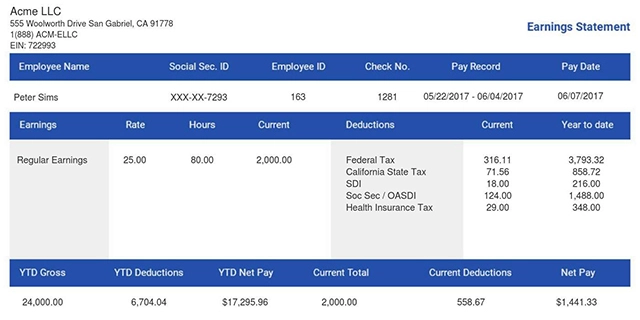
Health stubs are simply the sections of your pay stub that relate to your health benefits. They show how your medical benefits are handled each pay period. This includes what you pay and what your employer pays toward your health insurance.
Most people assume every line on their health stub is a deduction from their gross income. However, that’s not always the case. Your employer covers your ER health costs on pay stub. Understanding these lines can help you see exactly how much your employer is investing in your health benefits.
Generally, your health stubs include deductions for any health-related expenses. Some include disability insurance and other deductions, such as:
-
Deductions for the health and dental insurance plans
-
Amounts deducted for contributions to accounts like Health Savings Accounts
-
And employer-paid benefits like ER health
ER health is one of the most common terms you’ll see. This may leave you wondering, “What is ER medical on my pay stub?”. You'll find the answer to this as you read on.
ER Health: What Is ER Medical on My Pay Stub?
ER medical refers to employer-responsible health contributions. It shows the significant portion your employer contributes to your health insurance. This contribution is made as part of your employee benefits and not as a legal patient protection responsibility.
ER health can also be referred to by a few other names. This includes: ER cost of medical on pay stub, or even medical ER on paycheck. Regardless of the label, they all mean the same thing. What makes the medical ER on paycheck stub beneficial to employees is that it doesn’t reduce their take-home pay.
How Is ER Health Different From EE Health?
While ER health stands for employer contribution, EE health is employee-paid health coverage. They both give you a picture of your total benefits.
EE health shows how much of your gross pay actually goes towards health-related deductions. Your employee contribution depends on the type of health plan you select and the coverage you choose. For instance, you could choose individual or family coverage.
Meanwhile, the ER health shows how much your employer contributes to your health premiums. This is an important part of your total compensation, even though it doesn't appear as direct wages.
When they are properly separated, you can easily confirm that your employer is actually taking care of their part of your health coverage. This means that they are actually contributing to your health insurance or savings accounts. You can also see how much you're paying compared to how much your employer pays.
How Does Health Insurance Show Up on Your Pay Stub?

One common misconception about health stubs is health insurance. When reviewing your pay stub, your health insurance information is listed in several sections. Each part shows the portion of benefits the employee receives and the portion covered by the employer.
The first thing you'll see is what you pay your insurance provider each payday. It is generally labeled as a medical premium or health premium. Most of the time, this amount is deducted from your gross income. This means that you pay less in taxable income as your pre-tax deductions lower your taxable income.
You may also notice that the timing of these deductions lines up with your actual pay date, not the pay period worked. This can help you track health-related paycheck deductions.
After the medical premium, the ER medical on pay stub comes next. Together, your health insurance premium plus that of your employer make up the total ER cost of medical on pay stub.
Many pay stubs also display year-to-date totals for both your medical premiums and your employer’s contributions. This can help you track how much has been paid for your health insurance throughout the year.
You can create accurate pay stubs in just minutes with our easy 123 Paystub process. Simply enter your personal details, review the preview, and download immediately. With this, you can know how your health insurance appears on your stub.
At the end of the year, you will see the total cost of employer-sponsored coverage on your W-2 form, under Box 12, code DD. Here, you will see how much was spent on health coverage throughout the year.
What Is a Health Savings Account (HSA) and What Does It Mean for You?
An HSA is a unique savings account that helps you cover your medical expenses while providing tax advantages. Also, you can use your HSA for things like deductibles, coinsurance, and copayments.
Health Savings Accounts give you tax advantages in three main ways, called the “three tax benefits";
Tax-Free Contributions
Money added through payroll reduces your taxable income. If you add money yourself, you can claim it as a tax deduction. However, you cannot contribute to an HSA once you're on Medicare.
Tax-Free Growth
You get interest on any money you invest in your HSA. Also, you don't pay any taxes on your interest.
Tax-Free Withdrawals for Medical Costs
You don't pay taxes when you use your HSA money for qualified medical expenses. This includes doctor visits, dental work and prescriptions. However, most insurance premiums are not considered qualified expenses.
Also, to open an HSA account, you need to be enrolled in a High-Deductible Health Plan (HDHP). You can fund your account through payroll processes or make a direct deposit. Your employer may also contribute to your HSA account.
Your account remains yours even if you switch jobs or insurance. After age 65, you can use the funds for any purpose without penalty, both medical or otherwise.
What Is a Flexible Spending Account (FSA)?
FSA is an account offered through your employer. With FSA, you can save pre-tax money to pay for medical, dental, and vision expenses. However, your taxable income is usually lower because the money is deducted from your gross income. This helps to reduce your overall tax bill.
You can use FSA funds for many common healthcare costs, such as prescriptions, eyeglasses, and certain over-the-counter items. Some employers offer Dependent Care FSAs. This is to help you pay for family coverage, such as childcare or adult day care expenses.
The most significant difference between an HSA and an FSA is that FSA funds are “use it or lose it”. Any unused money expires at the end of the year, unless your employer offers one of the following:
-
A grace period of up to 2.5 months
-
A small allowed carryover amount (the IRS adjusts this annually).
FSAs work differently from HSAs when you leave a job:
-
Health FSAs may be eligible for limited COBRA continuation. This allows you to continue coverage temporarily if you choose to do so.
-
Dependent Care FSAs typically end immediately upon employment termination.
-
You may still be able to submit claims for eligible expenses incurred before termination, depending on employer rules.
This makes FSAs less portable than HSAs, which always remain yours even if you change jobs. You can review your employer-issued pay stub or use a paystub template to create your own for personal budgeting.
How ER Health Contributions Affect Your Health Plan
ER health doesn’t appear as a deduction on your stub, but it lowers the total amount you personally pay for your health insurance. This means you’re responsible only for the remaining part of the total premium.
For example, if your health plan costs $450 a month and your employer covers $300, your share is the remaining $150. Additionally, employer contributions receive favorable tax treatment. This means that you don’t pay federal income taxes on this money.
Contribution amounts can vary depending on the plan you choose. Hence, it is important that you review your pay stub and ask HR any questions you may have.
How Health Contributions Affect Federal Income Taxes
Health contributions from your paycheck can reduce how much federal tax you owe. Here’s how:
Pre-Tax Premiums
Your taxable income is reduced if money for your health insurance comes out of your paycheck before taxes. Insurance premiums are usually taken out before federal taxes through a Section 125 “cafeteria plan”. This will lower the income and payroll taxes that you owe. It also reduces your overall paycheck deductions.
Self-Employed Deduction
If you’re a 1099 contractor, you can subtract the money you pay for health insurance from your income when figuring your taxes. You can do this on Schedule 1 of Form 1040. You can only do this if you weren’t eligible for another employer plan.
Itemized Medical Expenses
If you spend a lot of money on health and dental costs, you can subtract the extra cash from a certain amount of your income. This will lower your taxes. However, you can only do this if you itemize your deductions.
Understanding Medicare and How Much Tax You Pay
The taxes you pay are federal taxes. Sometimes, you also pay state income tax or local income taxes, as well as payroll taxes, such as Social Security and Medicare. The tax you pay depends on your annual income, filing status, and where you live.
Additionally, the federal income tax system employs a progressive tax structure. This means that different portions of your gross income are taxed at different rates. This could be from 10% to 37%.
Medicare taxes and Social Security taxes fall under the Federal Insurance Contributions Act (FICA). Employees pay 1.45% of their wages, and employers also pay 1.45%, for a total of 2.9%. Unlike the Social Security deductions, there is no wage cap; your total earnings are taxed.
If you earn above the set limit, there’s an additional Medicare Tax of 0.9% on the income over that limit. Currently, the set limits are $200,000 for single filers, $250,000 for married filing jointly, and $125,000 for married filing separately. This extra tax applies only to employees, not employers.
This means that high earners pay the standard Medicare taxes on all wages. Then, they pay an additional 0.9% on amounts exceeding the limit, thereby increasing their overall payroll tax.
Common Mistakes To Avoid on Health Stubs
Even with clear labels, health stubs are easy to misunderstand. Here are the most common issues people often encounter with health stubs:
1. Incorrect Employer Contribution Amounts
One of the most frequent payroll errors is having the wrong ER health contribution listed. Mistakes can happen when payroll or HR misinputs the exact amount your employer is paying toward your coverage.
When this number is off, it can raise questions about how much your employer is really investing in your health benefits.
2. Using Outdated Health Plan Information
Employers sometimes forget to update their payroll systems when health plans change. In such cases, the ER health line on your pay stub could reflect an old or incorrect plan rate.
3. Payroll Process Errors
Sometimes, the problem isn’t with the health plan. It’s with how payroll is processed. Inefficient or outdated payroll workflows could lead to incorrect ER health entries.
5. Assuming ER Medical Affects Your Take-Home Pay
A major misconception is that “ER Medical” reduces your net pay when it doesn't. It's rather an employer’s contribution to your health premium benefits. It’s purely informational. It shows what your company is paying on top of your wages, not a deduction from your earnings.
Final Thoughts
When you get to understand frequently used terms like ER and EE, you'll realize that health stubs are not as overwhelming as they seem. This will help you to clearly see what you're paying for and what your employer pays for. The proper health insurance knowledge can help you make informed decisions about your healthcare. You also get to plan better for future medical expenses.
Create a professional pay stub in minutes using our Pay Stub Creator. All you need to do is enter your personal details and download instantly. It’s the easiest way to understand your health stubs and keep them organized.
- 1. Enter Your Information

- 2. Select Your Favorite Theme

- 3. Download Your Stub!

 By
By