

What Qualifies As Proof Of Income? - The Ultimate Guide
 By
James Wilson
By
James Wilson Pay stubs, tax returns, and bank statements are the documents most often used to prove income. Whether you're getting approved for an auto loan, a home rental, or a government benefit, you'll usually be asked for proof of income documents in one of these forms. This guide walks through every accepted document, organized by where your income comes from.
If you need a pay stub as proof of income for any of these situations, we cover that too.
This is the definitive guide to proof of income documents. It explains what proof of income is, lists every accepted document organized by income source, goes through scenarios and explains which documents qualify for each situation, and covers what to do when standard documents are not an option.
Key Takeaways
- Pay stubs, tax returns, and bank statements are the most universally accepted proof of income documents
- What documents qualify depends on your employment type: employees, self-employed individuals, and gig workers each have different options
- Documents must typically be recent (within 30, 90 days) for standard applications; tax returns are the exception
- Self-employed workers can use IRS Form 1040 with Schedule C, profit and loss statements, and bank statements
- Most landlords require income of at least 3x the monthly rent before approving an application
What Is Proof of Income?
What is proof of income? Proof of income refers to any official documentation that shows the amount of money a person earns, the source of that income, and the period it covers. Such documents are used by lenders, landlords, employers, and government agencies to determine whether a person can afford a loan repayment, pay rent on time, or qualify for government benefits.
What does proof of income mean in practice? In practice, a valid proof of income document is one issued by a third party, your employer, the IRS, a bank, or a government agency. Self-reported numbers are not sufficient because they cannot be independently verified.
What is a proof of income requirement really asking for? Three things: (1) the amount the person earns, (2) the source of that income, and (3) the time period covered. Any document that satisfies all three will generally be accepted.
Proof of income meaning is sometimes confused with proof of funds. They are different: proof of income shows ongoing earnings, while proof of funds shows available savings or assets. Lenders and landlords want income proof specifically to assess your ability to make recurring payments.
Complete List of Proof of Income Documents

There are many ways to show proof of income, and the right one depends on how you earn. The list below is organized by income type, so you can quickly find the document that fits your employment situation.
For Employees (W-2 Workers)
Salaried and hourly employees have the most straightforward proof of income examples:
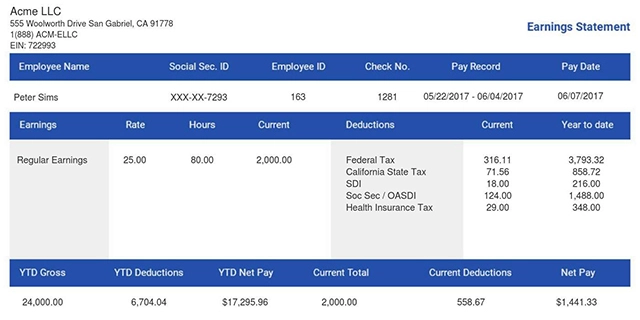
- Pay stubs: The most commonly requested proof of income document for employees. Most applications ask for the last 2, 3 pay stubs. Each stub should show gross pay, net pay, deductions, the employer's name, and the pay period dates. Pay stubs for proof of income are accepted by virtually every landlord, lender, and agency.
- W-2 form: Your annual wage statement from your employer. It summarizes total earnings and tax withholdings for the year. It is one of the strongest proof of income documents for mortgage and loan applications.
- Employment verification letter: Issued by HR on company letterhead. It confirms your job title, start date, and annual salary. Most lenders accept these within 30, 60 days of the letter's issue date.
- Offer letter: Useful for newly hired employees. Most institutions accept an offer letter within 30, 60 days of your start date as a temporary substitute for pay stubs.
- Earnings statement from your payroll system: Year-to-date figures printed from ADP, Paychex, or Gusto. These serve the same function as a pay stub.
What to check: All employee proof of income documents should include the issuer's name, exact dollar amounts, and a date within the last 30, 90 days. Most can be downloaded or saved as a proof of income PDF, which is the format online applications usually prefer.
For Self-Employed and Freelancers
As a self-employed individual or freelancer, you have several documents you can use as proof of income.
Accepted documents include:
- IRS Form 1040 with Schedule C: The gold standard for self-employed proof of income. Most lenders want two years of returns to account for income variability.
- Profit and loss statement (P&L): Created by you or your accountant. Shows revenue minus expenses over a set period. A 12-month P&L is the standard request.
- Bank statements: 3, 12 months of statements showing consistent income deposits. Most lenders want to see regular, recurring deposit patterns.
- 1099 forms: Issued by clients who paid you $600 or more in a calendar year. These are strong third-party proof of income documents.
- Invoices and contracts: Demonstrate ongoing client relationships and expected future income.
- Self-employed pay stub: Many lenders and landlords accept a professional pay stub generated through a service like ThePayStubs.com, especially when paired with tax returns or bank statements.
For Gig Workers
Platform workers (DoorDash, Uber, Lyft, Instacart, Amazon Flex) can use:
- Annual earnings summaries downloaded from their platform app or online portal
- 1099-NEC or 1099-K forms (since 2026, platforms must issue 1099-Ks for earnings above $600)
- Bank statements showing regular platform deposits
Additional Income Sources
The following proof of income documents are widely accepted for income outside regular employment:
| Income Type | Accepted Document |
|---|---|
| Social Security | Official benefit award letter from SSA |
| Pension | Distribution statement from plan administrator |
| Disability | Official letter from the issuing agency |
| Child Support / Alimony | Court order and record of payments received |
| Unemployment | State unemployment benefit determination letter |
| Rental Income | Lease agreements plus bank statements showing rent received |
| Investment Income | Brokerage statements or dividend records |
What Counts as Proof of Income?
What is considered proof of income can vary by institution, but most lenders require three key elements: verifiability, recency, and sufficiency. The strongest examples of proof of income (pay stubs, tax returns, W-2s, and bank statements) satisfy all three.
Verifiable: All documentation must be verifiable by a third party. Items which are verifiable include pay stubs, W-2s, 1099s, tax returns, and bank statements. Items which are NOT verifiable include handwritten notes, informal emails, and screenshots from Cash App or Venmo.
Recent: Typically documents that are less than 30, 90 days old are acceptable. Tax returns are an exception, since lenders always use the most recently filed return regardless of age.
Sufficient: The income shown must meet the institution's minimum threshold. For rentals, gross monthly income must be at least three times the monthly rent. For mortgage programs, debt-to-income ratios are calculated. For auto loans, monthly income typically must be at least 1.5, 2x the monthly payment.
What qualifies as proof of income also depends on your employment status. W-2 employees typically need 2, 3 recent pay stubs plus a W-2, which satisfies most institutions. Self-employed applicants face more scrutiny and usually need two years of tax returns plus bank statements and a profit and loss statement.
Proof of Income Documents by Situation

What do I need for proof of income changes depending on why you're being asked. Here's where to go for situation-specific guidance:
Renting an Apartment
When proving income for an apartment rental, what to provide for proof of income typically means 2, 3 recent pay stubs (employees) or 2 years of tax returns plus 3 months of bank statements (self-employed). Most landlords also accept an employment verification letter. For a complete breakdown of what apartment applications require, see our guide: Proof of Income Documents for Renting an Apartment.
When You're Self-Employed
Self-employed individuals face the most complex documentation requirements. Tax returns, bank statements, profit and loss statements, and 1099 forms all play a role. A professional self-employed pay stub can strengthen your application. Full step-by-step guidance here: Proof of Income for the Self-Employed.
If You're Paid in Cash
Cash income is the hardest to document. Your best options are federal tax returns (Schedule C), bank statements showing regular cash deposits, or an affidavit for proof of income notarized by a licensed notary. For complete methods of verifying cash income, see: Proof of Income If Paid in Cash.
For an Auto Loan
What to send for proof of income for a car loan depends on the lender. Most dealerships and banks want recent pay stubs (employees) or tax returns (self-employed). Learn exactly what auto lenders check and how to prepare: How Banks Verify Income for an Auto Loan.
Writing a Proof of Income Letter
A proof of income letter, a signed statement confirming your income, is commonly required for informal employment arrangements, freelancers, and contractors. If you don't know where to start, a template for proof of income makes the letter easy to draft. Full templates and requirements here: How to Write a Proof of Income Letter for an Apartment.
What Doesn't Count as Proof of Income
Knowing what won't work saves you time. These are the most common rejections:
- Handwritten notes or informal letters: No third-party verification.
- Photos of cash or cash in hand: Not accepted by any financial institution.
- Unofficial spreadsheets: Even detailed ones, without supporting documentation.
- Documents older than 90 days: Outdated pay stubs and bank statements are typically rejected.
- Venmo, Cash App, or PayPal screenshots: Peer-to-peer transfers do not demonstrate employment income.
- Future income projections: Job offers are rarely sufficient without a confirmed start date and signed offer letter.
- Unsigned letters or emails: Documents must be on official letterhead with a verifiable signature.
In short, any figures that cannot be verified by a third party will not be accepted by most institutions.
You Might Also Like
- Employment Verification and Proof of Income Documents
- Do Banks Verify Pay Stubs?
- W-2 vs. Pay Stub: What's the Difference?
- Do 1099 Employees Get Pay Stubs? Full Guide
- What Is Annual Income?
Conclusion
The right proof of income document is the one that matches your income type and meets the reviewer's minimum standards. Employees should lead with recent pay stubs. Self-employed workers need tax returns and bank statements. Everyone benefits from having their proof of income documents organized and accessible before they apply.
If you're self-employed, a freelancer, or a gig worker and need a professional pay stub that lenders and landlords accept, create a pay stub as proof of income in minutes. Our generator produces IRS-consistent, pay-period-accurate documents that support your application.
- 1. Enter Your Information

- 2. Select Your Favorite Theme

- 3. Download Your Stub!

 By
By