

1099 Calculator: How To Calculate Taxes for 1099 Income
 By
By
An undeniable fact of life? Paying taxes! We've all been there, and there's just no way to avoid it. When you're a self-employed individual, knowing how to calculate taxes for 1099 income becomes even more important.
If you're a self-employed individual, it's your prerogative to ensure your tax obligations are in check. This includes your self-employment taxes, federal income taxes, and estimated tax payments. It's also important that you know how to track your taxable income throughout the year.
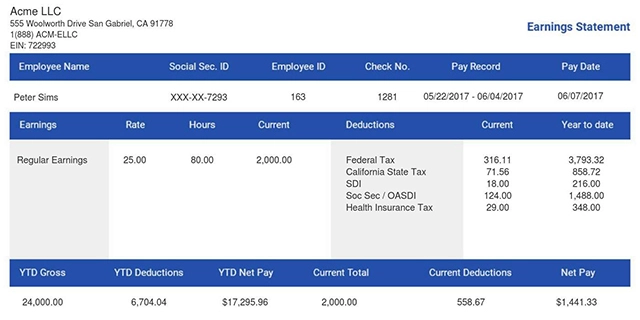
As a 1099 income earner, you'll be required to show proof of income. You need them for loans, insurance purposes, and, not to mention, U.S. taxation laws. One of the most common proofs of income is a pay stub. To create one easily, you can simply generate a pay stub online, using a check stub maker.
If you received a 1099 form this year, this article explains how to calculate 1099 taxes and determine your tax liability. Check out how tools like a 1099 tax calculator, self-employment tax calculator, or 1099 MISC tax calculator can simplify the process.
Understanding Your 1099 Income: What Is a 1099 Form?
All self-employed individuals who earn self-employment income must pay taxes directly to the IRS. They are responsible for paying their quarterly estimated taxes to the IRS. Businesses must issue Form 1099-NEC by January 31 for contractor payments. For 1099-MISC, it's used to report miscellaneous information.
If you worked for more than one organization, you can expect multiple 1099 forms. If you don't receive your 1099 forms, you still have to report the total income on your federal income tax return.
1099-MISC
This Form refers to the miscellaneous income you report. It reports your income outside nonemployee compensation. You'll have to file a 1099-MISC form if you pay at least $10 in royalties and $600 in:
-
Rent (box 1)
-
Prizes and awards (box 3)
-
Other income payments (box 3)
-
Cash paid from a notional principal contract to an individual, partnership, or estate (box 3)
-
Any fishing boat proceeds (box 5)
-
Medical and health care payments (box 6)
-
Crop insurance proceeds (box 9)
-
Payments to an attorney (box 10)
-
Section 409A deferrals (box 12)
-
Nonqualified deferred compensation (box 14)
Some MISC income counts as earned income for federal tax purposes. However, most categories are not subject to self-employment tax unless it's business income.
1099-NEC
This Form is known as nonemployee compensation. It is used for independent contractors, freelancers, and gig workers. This basically refers to anyone earning a business income through self-employment. This income typically triggers your:
-
Self-employment tax
-
Social Security and Medicare taxes
-
Estimated quarterly tax payments
-
Business deductions for qualifying business expenses
Between these two forms, you need to understand which 1099 form you received. Each 1099 form affects your tax rate, tax payments, and tax return.
1099 vs W-2
Understanding your status is the first step in managing your tax liability. If you are an independent contractor, you are self-employed. This means that your earnings are subject to the self-employment tax. Therefore, you must manage your own tax payments.
A self-employed 1099 worker has no taxes withheld from their payments. Instead, if you're one, you'll be responsible for paying your own taxes. However, you only need to make quarterly estimates if you expect to owe at least $1,000 in taxes for the year. This includes your self-employment tax and federal income tax. You generally won't receive any employer-provided benefits and can deduct from business expenses to lower your taxable income. A 1099 form is simply a record of what your clients paid. You'll use this Form to report your income.
W-2 employees, on the other hand, have taxes withheld. Their taxes will automatically be withheld from each paycheck. This includes federal income tax, Social Security, and Medicare taxes. They can receive benefits like health insurance, retirement plans, and paid leave. W-2 employees usually receive a Form W-2 from their employer. It shows their wages and taxes withheld. Then they use the information on their Form W-2 when filing their individual or income tax return.
This can also be created for personal records with a W-2 form creator easily. The process is easy and simple.
How To Calculate Taxes for 1099 Income
If you're new to receiving 1099 income, you might not be too familiar with the ins and outs of the form. You need to understand how 1099 taxes are calculated. You need to find your taxable income to calculate your final tax liability. Let's break the navigation down:
1. Calculate Your Total Income
Total the income amounts on each 1099 form. If you have more than one form, combine the total income from all of your forms. This gives you your gross income.
You can use your total income to calculate your:
-
Adjusted gross income
-
Federal income tax
-
Self-employment tax liability
2. Subtract Your Business Expenses
Total all your eligible business expenditures, which you have kept track of, and subtract that from your total income. This gives your net earnings from self-employment. This step is important for lowering your taxable income.
Non-business 1099-MISC income does not qualify for business expense deductions.
3. Calculate Your Self-Employment Tax
The self-employment tax rate is 15.3%. It covers Social Security and Medicare taxes. To calculate this, multiply your net earnings by 92.35% to get your taxable income for self-employment tax. Then, multiply that by 15.3%. This is your self-employment tax liability.
You can use a self-employment tax calculator, 1099 tax estimator, or employment tax calculator to check your numbers.
4. Calculate Your Federal Income Tax
Now, you need to calculate federal income taxes. You can deduct 50% of your self-employment tax from your net earnings. Deduct it as an adjustment to your income on Form 1040. Therefore, along with other adjustments, it gives you your adjusted gross income (AGI). From your AGI, you'll subtract your standard deduction or itemized deductions. It should be based on your filing status, whether you're single or married.
This can help you get your taxable income. The IRS uses this to calculate your federal income tax. Although the federal tax brackets are the same, keep in mind that tax schedules vary from state to state. This is especially true for state and local taxes. Therefore, check your state's rules to determine your tax schedule.
Using a 1099 Tax Calculator
When it comes to filing taxes as a freelancer, accurately calculating your income and taxes owed can be complex. Using a 1099-MISC tax calculator or a self-employment tax calculator can help simplify this process and ensure that you are paying the correct amount to the IRS.
A 1099 tax calculator considers your 1099 income or business income, allowable expenses, and deductions to determine your overall tax liability. It can estimate your:
-
1099-NEC taxes
-
1099-MISC taxes
-
Self-employment income
-
Self-employment taxes
-
Federal income taxes
-
Estimated tax needed
-
Expected tax refund or tax bill
Additionally, a self-employment tax calculator can help you plan for future tax payments. It does this by estimating your quarterly tax payments based on your income and expenses.
Using a 1099 tax calculator simply:
-
Helps you avoid penalties, especially for underpayment. It ensures you can pay the correct amount of taxes.
-
Allows you to plan your finances better. For example, knowing how much is for your estimated quarterly tax payments.
-
Saves time and reduces stress during tax season.
Understanding Quarterly Taxes & Estimated Taxes
As a self-employed individual, you are generally responsible for making estimated quarterly tax payments to the IRS. This is how you pay taxes throughout the year. This is because no taxes are withheld from your pay.
So, do you need to pay quarterly taxes? You must make estimated tax payments if you expect to owe at least $1,000 in taxes when you file your return. If you are a sole proprietor, partner, or S corporation shareholder, you generally have to make estimated tax payments, too. This is if you expect to owe the IRS tax of $1,000 or more as well.
Here's how you can calculate and pay your estimated taxes:
-
Calculate your adjusted gross income from self-employment for the year.
-
Use the IRS's Form 1040-ES as a worksheet to determine your estimated taxes. This form helps you calculate your expected adjusted gross income, taxable income, and income taxes. It also calculates your deductions and credits for the year.
The four estimated tax payments are typically due on: April 15, June 15, September 15, and January 15 of the following year. If you don't pay on time, you may have to pay a penalty.
A general rule is to set aside 25-35% of your income to cover your federal, state, and self-employment taxes. The exact amount you have to set aside depends on your deductions, credits, filing status, and state tax rate. You can use a Form 1040-ES or a tax estimator to estimate the amount you should pay. You can use a 1099 tax estimator to give you a more precise amount.
How To File Your 1099 Tax Return
To file your tax return reporting your 1099 income, you will need the following supporting documents:
-
Schedule C (Profit or Loss from Business): This is where you'll record your business income and business expenses to calculate your net profit or loss.
-
Schedule SE (Self-Employment Tax): This document calculates the Social Security and Medicare tax contributions you owe.
-
Form 1040 (U.S. Individual Income Tax Return): This is the main form where you report your total income. You also need it to claim your tax deductions and tax credits and calculate your final tax liability or income tax refund.
-
Schedule 1 (Other Income): This is used to report additional sources of income not listed on the main Form 1040, such as wages, standard interest, and dividends.
A self-employment tax return must include all forms of self-employed income. This even includes third-party network transactions.
Maximizing Tax Deductions To Lower Self-Employment Tax

To lower your tax bill, the easiest way is to claim all your eligible business expenses. The IRS only taxes your profits. So most of your deductions reduce your taxable income.
The common tax deductions for self-employed individuals include:
-
Home office deduction
-
Vehicle and mileage
-
Supplies and equipment
-
Software subscriptions
-
Marketing and advertising
-
Health insurance premiums
-
Retirement contributions. For example, contributions to SEP-IRAs or Solo 401(k)s could reduce your taxable income.
-
Interest. For example, your qualified student loan interest may be deductible.
This reduces your taxable income, self-employment tax liability, and tax bill. Note that the more tax deductions you have, the lower your taxable income will be. Then it reduces how much you'll owe to the IRS.
Understanding Your Tax Credits
Apart from your deductions, tax credits can also reduce your tax liability. While deductions reduce your taxable income, a tax credit reduces your income taxes. Tax credits could include:
1. Child Tax Credit:
This is a credit for taxpayers with children or dependents.
2. Earned Income Tax Credit
The earned income tax credit is a refundable tax credit. It is available to workers with lower- and middle-class incomes.
3. Education Credits
This is for qualified higher education expenses.
4. Saver's Credit
Saver's credit includes contributions to a retirement plan.
Do you know about our 123 Paystub method that gives you a simple way to generate your pay stubs in just three steps? Simply preview and download your pay stub. Then print and share immediately.
Bottom Line
You need to know how to calculate tax for 1099 income. It's important for any independent contractor, freelancer, or gig worker. This means understanding your 1099 taxes, deductions, and tax credits better. So, it's always best to consult with a tax professional. They'll help you identify all the credits and deductions you qualify for. Overall, it ensures you don't end up overpaying. Another tip for you is to use a 1099 income tax calculator or 1099 tax estimator. Instead of getting confused, you can use this to calculate taxes on 1099 income. This can make it easier for you.
Are you an independent contractor who needs proof of income? Or do you want a quick and simple way to generate pay stubs for your subcontractors? We can help you get set up in minutes. For hassle-free business paperwork, use our 1099 form generator. And if you or your contractors need pay stubs for income verification, try our pay stub creator.
- 1. Enter Your Information

- 2. Select Your Favorite Theme

- 3. Download Your Stub!

 By
By