

Self-Employed? Here's How To Show Proof Of Income
 By
James Wilson
By
James Wilson If you're a freelancer, independent contractor, or self-employed worker, proving your income is more complex than handing over a W-2. This guide covers the exact proof of income documents for self-employed individuals that lenders, landlords, and agencies actually accept, plus how to organize and present them.
We'll walk through tax returns, bank statements, P&L statements, 1099s, paid invoices, and self-generated pay stubs. For W-2 employees and general income verification, see our complete proof of income guide.
Need documentation fast? You can create a pay stub at ThePayStubs.com in under two minutes.
What Makes You Self-Employed?
Many people ask: how do you show proof of income for self employment when there is no employer? The answer lies in the documents you keep.
Self-employment, in the eyes of the IRS and a lender, simply means you run your own business with no employer withholding your taxes or handing you a W-2. Because of that, the most credible way to prove your income is usually your filed IRS tax returns from prior years.
If you're a sole proprietor, those returns include a Schedule C for each year, which reports your gross revenue, the business expenses you deduct, and the net profit that's left over. Lenders like to see at least two years of returns, since self-employed income can swing a lot from one year to the next.
If you've only been in business a year, expect more scrutiny; you'll likely need extra documentation showing your income has been consistent and strong.
If you earn less than $400 in net self-employment income for a tax year, you are not considered to be self-employed. However, if you earn $400 or more in net self-employment income for the year, you are considered to be self-employed and required to file Schedule SE (Form 1040) and pay self-employment tax.
Self-employment tax is 15.3% of the first $184,500 of net earnings from self-employment in 2026. In addition to paying this tax, you will not have the benefit of an employer withholding taxes on your behalf, so you will not receive a pay stub or W-2 for yourself.
The biggest challenge is providing proof of income for self employed individuals. Unlike salaried workers, you have no employer confirming your earnings, which means you need to self-assemble the documentation. Self-employment income has no withholding of income taxes as there is no employer.
Instead, self-employment tax is required to be paid by the self-employed individual on their net earnings from self-employment. Understanding what proof of income for self employed people is required starts with understanding your tax obligations. This self-employment tax is equal to 15.3% of net earnings from self-employment (12.4% for Social Security and 2.9% for Medicare).
Additionally, the self-employed individual must make estimated tax payments throughout the tax year to cover their taxes. At tax time, the self-employed individual must complete a Schedule SE (Social Security and Medicare Tax on Self-Employment Income) and attach it to their tax return as well as pay any remaining tax due.
The 6 Best Proof of Income Documents for Self-Employed Individuals

These proof of income examples for self employed individuals are the most widely accepted by lenders, landlords, and government agencies.
1. Your Filed Federal Tax Returns (Form 1040 + Schedule C)
For most self-employed individuals, nothing carries more weight with a lender than a filed federal tax return: your Form 1040 with a Schedule C (Profit or Loss from Business) attached. While you may complete your return yourself, it is highly recommended that it be reviewed by a Tax Professional or Accountant to ensure you are taking all of the correct deductions.
Most financial institutions will require two complete years of tax returns as proof of income for mortgage applications; however, if you are a new self-employed individual, some lenders may be willing to consider your request for a mortgage based on one year of returns and provide you with additional requirements to verify your income.
Most financial institutions require 2 years of returns completed and attached with Schedule C's. For instance, a freelance graphic designer would report the income he receives from graphic design on his tax returns in order to establish his self-employment income.
A financial institution would then be able to review the returns and gain insight into the history of the freelance graphic designer's income. Whether his income is increasing, staying the same or declining the financial institution can make lending decisions based on the data from the returns.
An individual who is self-employed for less than 2 years will typically have the most recent return completed and ready along with supporting documentation for his current and expected income in order to establish his earning history.
You can download your tax transcripts instantly by visiting your IRS Online Account at irs.gov. Most lenders will accept your tax transcripts in lieu of the original tax returns.
A freelancer graphic designer for example might list his self-employment income as follows on his loan application: $65,000 in gross revenue and after writing off $12,000 in business expenses he has $53,000 in net self-employment income to show the bank to obtain a loan.
2. Bank Statements
The problem that cash based income creates for lenders is that prior year tax returns are unable to prove current cash flow. Bank statements for a business currently can prove current cash flow for a lender.
The key here is to provide 2-3 months of bank statements from the business checking account for the business where client payments are deposited into and business expenses are paid out of. A clean business account and a personal account separate from the business account is crucial. For those with cash-based income, see our guide to proof of income when paid in cash.
If the lender has to search through the personal account for cash flow for the business it creates much doubt. A clean business checking account provides a clear picture.
2-3 months of bank statements (business checking account that is solely for business and NOT commingled with personal funds) will provide cash based income documenting to the lender. While last year's return documents the prior year's income the bank statements will document current year's cash based income earned by the borrower.
The lender is typically going to qualify you for a loan based off of past cash flow history from your business checking account. So the cash flow from your deposits can qualify you for a loan. However, this can be an issue if you have an irregular cash flow history.
So even though the lender is typically going to qualify you based on past cash flow history, there are many cases in which a cover letter can be used to explain to the lender any irregularities of your past cash flow history. For example, a freelancer would typically get paid by a client 30 days after the work has been completed.
So the cash flow from the payments of invoices would be considered to be irregular and not consistent with the regular salary of someone who is employed by a company. However, this irregularity of cash flow history can be explained in a cover letter that the freelancer would submit with the rest of his loan application.
For rental applications your lender or landlord will typically want to verify your most recent income in order to verify your ability to repay rent. Therefore 2 to 3 months of the most recent bank statements from a separate business checking account will typically be sufficient as proof of income to support a rental application.
Keep in mind that you must keep your personal and business funds separate in order to clearly show the source of the funds and their application.
3. Profit and Loss Statement
A Profit and Loss (P&L) statement is another solid way to document your income. In most loan underwriting, the most trusted proof is still a federal income tax return (Form 1040), and for the vast majority of self-employed business owners the Schedule C attached to that return is the main proof of their business's net earnings.
A P&L works differently: it shows your business's income and the deductions you've claimed from the start of the current year up to the date the statement was prepared. That makes it useful as supplemental proof, since pairing a current P&L with your prior years' returns lets a lender see your current cash flow alongside your previously reported net income.
This matters most for mortgage applications on a personal residence, where that extra documentation can tip an approval decision in your favor. You can generate a P&L in accounting software like QuickBooks or FreshBooks, or have your bookkeeper or accountant prepare it, and it will include your net income.
Just keep in mind that a current P&L is typically only accepted when it's submitted together with your prior years' tax returns.
The P&L is your best tool to prove profits to a lender. When you are preparing the numbers for the P&L for verification by a lender, it's best to set up the numbers in a format that best reflects your business. For example, instead of reporting all of your business expenses as a percent of sales, set up a separate line for each business expense.
Having a CPA or accountant prepare and sign your P&L for you is also recommended, as their seal of approval can go a long way with a lender.
As a final note, your P&L has value only if it can be verified with your bank statements. For example, if your Schedule C reflects that you have $6,000 per month in revenue but your bank statements reflect only $4,000 per month in deposits then you will have an opportunity to explain the discrepancy in your financial records.
Additional Documents That Strengthen Your Case
4. 1099 Forms (NEC and MISC)
The best type of proof of income is third party confirmation of income. As previously stated, clients are required to issue a 1099-NEC to all NEC recipients (including freelancers) paid $600 or more during the tax year. These 1099s provide a "stack of proof of income from various clients" as opposed to one large self reported income from one client.
This is in contrast to pulling most of your income from a few large clients. Why does that matter? First, a 1099 verifies the income you reported to the IRS (third-party confirmation). More importantly, multiple 1099s show you have a diverse income stream rather than being dependent on one or two big clients who could leave you high and dry at any moment.
Important: A 1099 form reports only the gross receipts paid to the recipient for the tax year; it does not report any deductions or expenses incurred by the recipient for services rendered. The self-employed would report their business income and expenses on their tax return with a Schedule C form.
For purposes of income verification, however, a 1099 from multiple clients is very powerful, especially when compared to verification of income from a single very large client. See our dedicated guide on 1099 proof of income for how contractors use these forms to verify earnings.
For example, 5 clients paying $10,000 per year in gross receipts each would be much more verification power than 1 client paying $50,000 per year in gross receipts.
5. Paid Invoices and Contracts
Completed work proves your active involvement in your business and establishes that you have client relationships. It can also show future potential.
Each completed project is evidence that you're actively working and earning. Paid invoices and signed contracts go a step further: they confirm your client base and point to future income, since ongoing client relationships suggest more work is on the way.
It's much better to use a professional invoice such as software like QuickBooks or FreshBooks instead of home made handwritten invoices that look very unprofessional. You can also use an online invoicing tool that can help to create a professional invoice for you. Such an example is Wave.
6. Self-Employed Pay Stubs
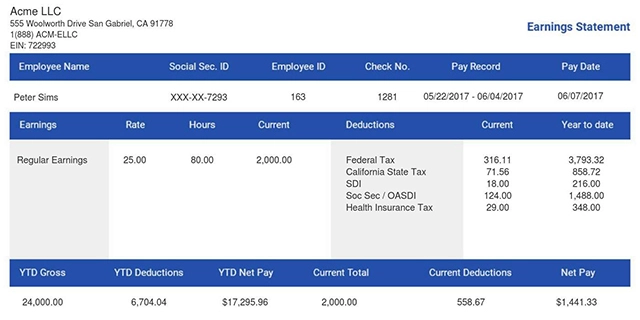
Many freelancers and independent contractors have found that generating pay stubs for themselves are the best way to prove their income. As a reminder, pay stubs are documents that are usually created for and distributed to employees by their employers to record the payments that they have made to them throughout the tax year.
Pay stubs are very familiar to most people and can be easily recognized by a reviewer. This is especially true for rental applications where a landlord may recognize the pay stubs and have confidence in the income of the potential renter.
Using a Self-Employed Pay Stub Generator to make proof of income is the way to go. These documents are easily created online by entering information about you and your business such as business name, pay frequency, and payment records into a template that looks just like a pay stub given to an employee.
QuickBooks, and other programs, have Self-Employed Pay Stub Generators within them as well as many online stub generators found on the web. Even a simple Free Online Pay Stub Generator can work well to provide such proof. These are great for the self-employed and can prove that you have a steady stream of income to service a loan.
For a proof of income sample for self-employed workers, see our paystub generator for the self-employed for a step-by-step walkthrough.
Self-generated paystubs for freelancers or solo entrepreneurs, Most of the gig economy work is paid out in small and frequent deposits to the business account of a solo worker. This type of payment is perfect for documenting all the payments received by the worker and can be generated as paystubs for self-employed.
Here's more information on how to make paystubs for self-employed workers such as Instacart shoppers or how to make a DoorDash pay stub or paystubs for Uber drivers.
How to Present Proof of Income Documents for Self-Employed Workers Effectively
Having the right paperwork is only half the battle; how you package and present it can make or break an application. Here's how to organize your documents for proof of income so a reviewer can verify your earnings quickly.
Decide What to Submit for Proof of Income. Lead with your strongest documents: tax returns first, then bank statements, then a P&L. Keep Everything Consistent. The numbers across your documents need to agree and reinforce each other; your tax returns, bank statements, company P&L, and invoices should all tell the same story.
Because discrepancies can crop up in any set of records, it's always better to err on the side of caution and come over-prepared when you present your financials.
Document Index: In cases where an individual has compiled a large amount of documentation to be used as proof of income for an application, the creation of a document index is highly recommended. Typically this would be a one page, typed document which includes a list of all of the included documents as well as a description of each document and what the individual is using that document to prove.
Write an explanation letter for irregular income. An explanation letter is wise when you consider yourself to be self-employed. Often self-employed individuals consider themselves to be self-employed because their income from time to time is not consistent. Perhaps you work on a seasonal basis or because you work on a project by project basis.
Perhaps you are just beginning a business and have not yet established a consistent income stream. In any case, you should write an explanation letter, which doubles as a proof of income letter for self employed workers, detailing why your income is irregular, and include a 12-month bank statement to show your average monthly cash flow.
This will allow a reviewer to see that although your income from time to time is not consistent that you do in fact have a consistent income stream.
Make Sure Your Business and Personal Finance Are Separate. The lender can request 2-3 months of business checking account statements.
By keeping your business payments going into a separate checking account for your business, it will be far easier for the reviewer to verify your average monthly business cash flow for qualifying purposes as opposed to reviewing mixed personal and business finance records for a long period of time.
Proof of Income for Specific Situations

For a Mortgage or Home Loan
Proof of income for small business owners seeking a mortgage is more document-heavy than for sole proprietors.
Typical documentation that a self-employed individual would provide to mortgage underwriting includes the following: for those that have formed a corporation, personal federal tax returns completed with a Schedule C for the two years prior to the mortgage application as well as the business tax returns for the same two years.
If the self-employed individual does not own 25% or more of said business then typical business tax returns will suffice. Also required will be a year-to-date prepared P&L (Profit & Loss) statement and 2-3 months of bank statements for the business account.
The lender's method of qualifying the self-employed borrower's income is Average of two years Schedule C net income less business losses reported on the tax returns. An upward trend in net income is viewed very positively; a decreasing trend would receive additional scrutiny.
For detailed information on proof of income for mortgage approval requirements, read our full guide on proof of income for a mortgage.
For Personal Loans with Irregular Income
Personal loan providers typically have less stringent income documentation requirements for self-employed borrowers and will typically accept more documentation than required for a mortgage application.
For proof of income for home loan or personal loan purposes, 6-12 months of bank statements along with tax returns are typically sufficient for lenders to calculate an average monthly cash flow for self-employed borrowers with irregular income.
Some lenders will even approve bank-statement loans that are based on 12-24 months of bank deposits rather than tax returns, as these types of loans are designed for self-employed individuals with large deductions that reduce their taxable income to a number that does not accurately reflect their actual cash flow.
These are sometimes called stated-income loans, and they exist for a reason: many self-employed people claim large deductions that shrink their taxable income, sometimes to the point of showing a loss, even while their actual cash flow stays strong. In those cases, bank deposits paint a far more accurate picture of what someone really earns than a tax return does.
The bottom line: even if you don't have traditional income documentation, you still have options. Plenty of lenders work with self-employed borrowers who have irregular cash flow, and some skip tax returns entirely. For a deeper walkthrough, see our guide to personal loans for self-employed with no proof of income.
A Note for Gig Workers
Gig workers often wonder: what do you need for proof of income as a delivery driver or rideshare contractor? The same core proof of income documents for self-employed workers apply.
When you apply for a loan based on freelance or platform work, such as gigs you complete through a company like Instacart, the IRS generally treats you as an independent contractor. That means the company will mail you a 1099-NEC by the end of January if it paid you more than $600 during the prior tax year.
Platforms like DoorDash, Uber, and Lyft usually issue a 1099-K instead, but only once your gross payments top $5,000. (The IRS raised that 1099-K reporting threshold from $600 to $5,000 starting with the 2024 tax year, and it counts all gross payments, including refunds.) Since a single 1099 often captures only part of what you actually earned, gather everything you can from every platform you worked for.
For most underwriting, bank statements that clearly show regular, expected deposits from those platforms, combined with your 1099s, are usually enough as proof of income for loan approval.
Whatever you receive, report all of it, cash included, on Schedule C of your Form 1040, and hang on to every record tied to those payments in case of a future audit.
In addition to using your tax returns, 1099s and bank statements as proof of income, for those earning income through Instacart, DoorDash, Uber, Lyft, or other similar platforms, generating your own pay stubs can also be of value to lenders and to landlords in helping to recognize the proof of income submitted.
Pay stubs are one of the most familiar forms of proof of income for employees, and ThePayStubs.com has found they work just as well for self-employed individuals. To generate your own pay stubs online in minutes, head to ThePayStubs.com.
Conclusion
Self-employed workers usually have more financial documentation to draw on than wage earners, and that's an advantage worth using. Together, your proof of income documents for self-employed work (Form 1040 tax returns, bank statements, and profit and loss statements) build a complete picture of your proof of income for self employment.
The most trusted proof of income documents for self employed contractors are tax returns and bank statements. These can be used in combination with 1099s and a current year-to-date Profit and Loss Statement as proof of income for self employment purposes for a freelancer or independent contractor.
The best proof of income for a lender or landlord is a complete financial history of the business as shown by tax returns and bank statements. If you need a quick and professional document, create a pay stub online in less than 2 minutes using your own information and company information at ThePayStubs.com.
You Might Also Like
- 1. Enter Your Information

- 2. Select Your Favorite Theme

- 3. Download Your Stub!

 By
By