

W2 Form: What It Is, How to Read It, and When You'll Get It
 By
By
A W2 form is an annual tax document usually provided by your employer. It reports how much you earn and how much tax was withheld during th year. If you're an employee in the United States, you'll receive a W2 form from each employer you worked for during the tax year
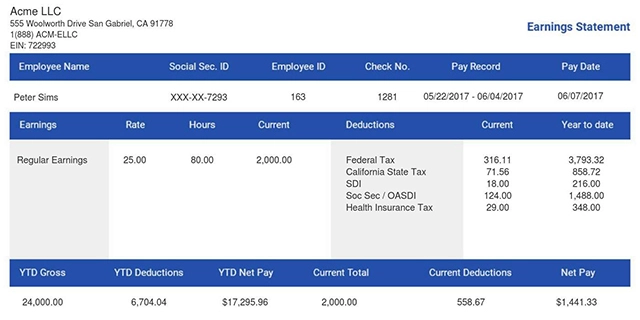
Understanding your W2 is essential for filing your tax return accurately and avoiding costly mistakes. Pay records created with a paystub generator can help you compare your year-to-date earnings to the totals on your W2.
This guide walks you through everything you need to know about the W2 form, including how to read each box, when you'll receive it, and what to do if something doesn't look right.
What Is a W2 Form?
Definition and Purpose
Form W-2, officially titled "Wage and Tax Statement," is an Internal Revenue Service (IRS) tax form that employers use to report wages paid to employees and the taxes withheld from those wages. Every employer engaged in a trade or business must file a W2 for each employee who meets specific criteria.
The W2 serves multiple critical purposes:
-
Reports your annual earnings to you, the IRS, and the Social Security Administration (SSA)
-
Documents tax withholdings for federal, state, and local income taxes
-
Tracks Social Security and Medicare contributions throughout the year
-
Provides proof of income for tax filing, loan applications, and financial aid.
Who Gets a W2 Form?
You'll receive a W2 if you're an employee and meet any of these conditions:
-
You earned $600 or more in wages during the year
-
Your employer withheld any federal income tax, Social Security, or Medicare tax from your pay (regardless of the amount)
-
You worked as a statutory employee (certain types of workers, like full-time life insurance salespeople)
Common scenarios where you'll receive a W2:
-
Full-time employees at any company or organization
-
Part-time workers who earned $600 or more
-
Seasonal employees (summer jobs, holiday retail, tax season workers)
-
Employees who worked only part of the year before quitting or being laid off
-
Workers with multiple jobs (you'll get a separate W2 from each employer)
-
Students with on-campus jobs or work-study positions
-
Tipped employees (restaurant servers, bartenders, valets)
-
Commission-based salespeople classified as employees
-
Remote workers employed by U.S. companies
-
Government employees (federal, state, and local)
Important distinction: Independent contractors and freelancers receive Form 1099-NEC instead of a W2. If you're unsure of your employment status, check whether you fill out a W-4 (employees) or a W-9 (contractors) when starting work.
Read more: What Is A W2 And Why Do I Need One?
Why the W2 Matters
Your W2 is one of the most important documents you'll receive each year:
-
Required for tax filing: You cannot complete your federal or state tax return without the information on your W2.
-
Determines refunds or amounts owed: The taxes withheld (shown on your W2) are subtracted from your total tax liability.
-
Proof of income: Lenders, landlords, and colleges require W2s to verify income for mortgages, rental applications, and financial aid (FAFSA).
-
Social Security benefits: The SSA uses W2 data to calculate your future retirement and disability benefits.
-
IRS matching: The IRS receives a copy of your W2 and will flag discrepancies if your tax return doesn't match.
-
Legal protection: Your W2 serves as official documentation of your employment and earnings.
Read more: Do I Have To File All My W2s? What To Do With Multiple W2s
How to Read Your W2 Form (Box-by-Box Guide)
Your W2 form contains 20 numbered boxes, each reporting different types of wages, taxes, and benefits. Understanding what each box means helps you verify accuracy and complete your tax return correctly.
The six copies of Form W2:
-
Copy A: Employer sends to Social Security Administration
-
Copy B: You attach to your federal tax return
-
Copy C: You keep for your records
-
Copy D: Employer keeps for their records
-
Copy 1: Employer files with state/local tax returns (if applicable)
-
Copy 2: You file with state/local tax returns (if applicable)
Employee Information Section (Top of Form)
Before diving into the boxes, verify this critical information at the top of your W2:
-
Your name: Must match your Social Security card exactly (including middle initial)
-
Your Social Security number: Check every digit carefully
-
Your address: Should reflect where you lived on December 31 of the tax year
-
Employer name and address: Verify this is correct
-
Employer Identification Number (EIN): Your employer's tax ID
Red flag: If your name or SSN is incorrect, request a corrected W2 (Form W-2c) immediately. Mismatches can delay your tax refund or trigger IRS notices.
Boxes 1-6 (Federal Wages and Taxes)
Box 1: Wages, Tips, Other Compensation
This is your taxable income for federal purposes. It includes:
-
Base salary or hourly wages
-
Bonuses and commissions
-
Tips you reported to your employer
-
Taxable fringe benefits (company car personal use, moving expense reimbursements)
-
Taxable awards and prizes
-
Group-term life insurance value over $50,000
-
Educational assistance over $5,250
-
Stock options at exercise
-
Severance pay
-
Back pay awards
What's NOT included (these reduce your Box 1 amount): If you're concerned about what to do if you've lost your W2 form, read our blog for your options.
-
Pre-tax health insurance premiums
-
Pre-tax dental and vision insurance
-
401(k) or 403(b) retirement contributions
-
Flexible Spending Account (FSA) contributions for healthcare or dependent care
-
Health Savings Account (HSA) contributions (employee portion)
-
Transportation/parking benefits (up to IRS limits)
Why Box 1 is lower than your gross pay: If you contribute to a 401(k) or pay health insurance premiums pre-tax, Box 1 will show less than your total earnings because those deductions reduce your taxable income.
Example: You earned $60,000 in salary, but contributed $5,000 to your 401(k) and paid $3,000 in pre-tax health insurance. Box 1 shows $52,000 ($60,000 - $5,000 - $3,000).
Box 2: Federal Income Tax Withheld
This shows the total federal income tax your employer withheld from your paychecks throughout the year based on your W-4 form (Employee's Withholding Certificate).
-
This amount is credited toward your total tax bill when you file your return
-
If Box 2 is higher than what you actually owe, you'll get a refund
-
If Box 2 is lower than what you owe, you'll need to pay the difference
-
If Box 2 shows $0, you likely claimed "Exempt" on your W-4 (no withholding)
Example scenarios:
-
Box 2 shows $8,500 and you owe $7,000 in taxes → $1,500 refund
-
Box 2 shows $8,500 and you owe $10,000 in taxes → You pay $1,500
-
Box 2 shows $0 → You'll likely owe your full tax bill when filing
To ensure your withholdings match your tax liability, learn more about Form W-4 and how to complete it properly.
Box 3: Social Security Wages
This shows wages subject to Social Security tax, up to the annual maximum wage base:
-
2024 wage base: $168,600
-
2025 wage base: $176,100
-
Earnings above these limits are not subject to Social Security tax
What's included:
-
Salary and wages
-
Bonuses and commissions
-
Tips
-
Taxable fringe benefits
What's excluded:
-
Pre-tax health insurance premiums
-
FSA contributions
-
HSA contributions
-
Unlike Box 1, retirement contributions (401k, 403b) do NOT reduce Box 3
For more information about W2 form and understanding how tax responsibilities differ for freelancers, check out this helpful guide.
Exceptions (people who don't pay Social Security tax):
-
Full-time students working for their college/university (enrolled in 6+ credit hours for undergraduates, 3+ for graduates)
-
Employees covered by PERA (Public Employees' Retirement Association) in certain states
-
Nonresident aliens (some exceptions apply)
-
Certain state and local government employees with alternative retirement systems
If you're interested in understanding how your exemptions or status may affect your W-2 wages, you can learn how to calculate them from your pay stub.
Example: You earned $180,000. Box 3 shows $176,100 (the 2025 maximum), even though you earned more.
Box 4: Social Security Tax Withheld
This shows the total Social Security tax withheld from your pay. The rate is 6.2% of your Social Security wages (Box 3), up to the annual wage base.
Calculation: Box 3 × 6.2% = Box 4. For quick and accurate W2 forms, try our W2 Generator.
Examples:
-
Box 3: $50,000 → Box 4: $3,100 (50,000 × 0.062)
-
Box 3: $176,100 (2025 max) → Box 4: $10,918.20 (176,100 × 0.062)
-
Box 3: $200,000 → Box 4: $10,918.20 (only taxed up to $176,100)
Note: If you had multiple jobs and total Social Security wages exceeded the annual limit, you may have overpaid. You can claim the excess as a credit on your tax return.
Box 5: Medicare Wages and Tips
This shows wages subject to Medicare tax. Unlike Social Security, there is no wage limit for Medicare.
What's included is similar to Box 3:
-
All wages, salaries, tips, and bonuses
-
Taxable fringe benefits
Key difference from Box 3: Box 5 has no cap. If you earned $300,000, Box 5 shows $300,000 (while Box 3 maxes out at the Social Security wage base).
Box 6: Medicare Tax Withheld
This shows the total Medicare tax withheld from your pay. The standard rate is 1.45% of all Medicare wages (Box 5).
Additional Medicare Tax: High earners pay an extra 0.9% on wages above:
-
$200,000 for single filers
-
$250,000 for married filing jointly
-
$125,000 for married filing separately
Calculation examples:
-
Box 5: $50,000 → Box 6: $725 (50,000 × 0.0145)
-
Box 5: $220,000 (single filer) → Box 6: $3,370 [(200,000 × 0.0145) + (20,000 × 0.0235)]
-
Box 5: $300,000 (married filing jointly) → Box 6: $4,775 [(250,000 × 0.0145) + (50,000 × 0.0235)]
Boxes 7-11 (Tips and Benefits)
Box 7: Social Security Tips
If you're a tipped employee (server, bartender, valet), this shows tips you reported to your employer that are subject to Social Security tax.
-
Only tips you reported appear here (not cash tips you didn't report)
-
Added to Box 3 to calculate total Social Security wages
Box 8: Allocated Tips
This applies to large food/beverage establishments (10+ employees). If the IRS determines your reported tips were less than your share of 8% of total sales, the difference appears here.
-
This is not included in Box 1, 3, 5, or 7
-
You must include this in your income when filing, even though no tax was withheld
Box 10: Dependent Care Benefits
Shows the total amount your employer paid into your Dependent Care FSA or provided as dependent care assistance.
-
Amounts up to $5,000 ($2,500 if married filing separately) are tax-free
-
Any amount over the limit is included in Box 1 as taxable income
Example: Your employer contributed $6,000 to your dependent care FSA. Box 10 shows $6,000, and $1,000 is added to Box 1 as taxable income.
Box 11: Nonqualified Plans
Shows distributions from a nonqualified deferred compensation plan or nongovernmental Section 457(b) plan.
-
These are retirement/deferred comp plans that don't meet IRS qualified plan rules
-
Most employees will see this box blank
Box 12: Codes (Most Common)
Box 12 uses letter codes to report various types of compensation and benefits. Your W2 can show up to four codes in Box 12. If you have more than four, you'll receive multiple W2 forms.
Most common codes:
For more information on how to mail 1099-NEC forms to the IRS, read this guide.
Code C: Taxable cost of group-term life insurance over $50,000
-
Example: Your employer provides $100,000 in life insurance. The taxable value of $50,000 of coverage appears in Code C and is included in Box 1.
Code D: Elective deferrals to a 401(k) plan
-
Your total contributions to your traditional or Roth 401(k)
-
This confirms how much you saved for retirement
Code DD: Cost of employer-sponsored health coverage
-
Total cost of your health insurance (employer + employee portions)
-
Not taxable (for informational purposes only)
-
Example: Code DD shows $12,000 (employer paid $9,000, you paid $3,000)
Code E: Elective deferrals to a 403(b) plan
-
Contributions to a 403(b) (common for education and nonprofit employees)
Code G: Elective deferrals to a 457(b) plan
-
Contributions to a 457(b) deferred compensation plan (government employees)
Code P: Excludable moving expense reimbursements
-
Non-taxable moving expenses your employer reimbursed (military moves after 2017)
Code W: Employer contributions to your Health Savings Account (HSA)
-
Not taxable, but you must report on Form 8889
Code AA: Designated Roth 401(k) contributions
-
After-tax Roth contributions to your 401(k)
Code BB: Designated Roth contributions under 403(b)
Code FF: Permitted benefits under a qualified small employer health reimbursement arrangement (QSEHRA)
Other codes you might see:
-
Code A: Uncollected Social Security or RRTA tax on tips
-
Code B: Uncollected Medicare tax on tips
-
Code H: Elective deferrals to 501(c)(18)(D) tax-exempt organization plan
-
Code J: Nontaxable sick pay
-
Code K: Excise tax on excess golden parachute payments
-
Code L: Substantiated employee business expense reimbursements
-
Code M: Uncollected Social Security or RRTA tax on taxable group-term life insurance over $50,000
Boxes 13-14 (Checkboxes and Other)
Box 13: Three Checkboxes
Retirement plan: Checked if you were eligible to participate in your employer's retirement plan (401k, 403b, pension) at any point during the year, even if you didn't contribute.
-
Affects how much you can deduct for IRA contributions
-
Important for tax planning
Statutory employee: Checked if you're a specific type of worker (agent-drivers, certain salespeople) who receives a W2 but can deduct business expenses.
Third-party sick pay: Checked if you received sick pay from a third party (like an insurance company) instead of your employer.
Box 14: Other
Employers use this box to report additional information that doesn't fit elsewhere. Common entries:
-
Vehicle: Taxable value of personal use of a company car
-
PreTax: Total pretax cafeteria plan deductions
-
Union dues: Amount of union dues withheld
-
Educational assistance: Employer-provided education benefits
-
State disability insurance: SDI withheld (California, New York, etc.)
-
Moving expenses: Various moving-related codes (14M, 14MT, etc.)
-
Taxable benefits: Gym memberships, transit passes over IRS limits
-
Charitable contributions: Payroll deductions for charity
Note: Box 14 entries are employer-specific and not standardized. Check with your HR department if you don't understand a code.
Boxes 15-20 (State and Local Information)
Box 15: State and Employer's State ID Number
Shows your employer's state tax identification number for the state listed. If you worked in multiple states, you'll receive multiple W2 forms (or a W2 with multiple state sections).
Box 16: State Wages, Tips, etc.
Your state taxable wages. This usually matches Box 1 (federal wages), but some states have different rules:
-
Some states don't tax certain retirement contributions that are federally taxed
-
Some states include benefits that are federally excluded
-
Check your state's specific rules
Box 17: State Income Tax Withheld
Total state income tax your employer withheld for the state shown in Box 15.
-
Use this amount when filing your state tax return
-
If you moved mid-year, you might have two states listed with separate withholding amounts
Box 18: Local Wages, Tips, etc.
Your local taxable wages for cities or counties that impose local income taxes.
Common localities with income tax:
-
New York City
-
Philadelphia, PA
-
Cleveland and Cincinnati, OH
-
Detroit, MI
-
Many counties in Maryland, Indiana, and Ohio
Box 19: Local Income Tax Withheld
Total local income tax withheld for the locality in Box 20.
Box 20: Locality Name
The name of the city or county that imposed the local tax shown in Boxes 18-19.
Example: If you live in Philadelphia, Box 20 shows "PHILADELPHIA," Box 18 shows your local wages, and Box 19 shows approximately 3.79% of those wages (Philadelphia's city wage tax rate).
Multiple localities: If you moved during the year (e.g., from Columbus, OH to Cleveland, OH), you'll see separate entries for each locality.
Read more: What Does a W-2 Income Statement Look Like?
When You'll Receive Your W2
Employer Deadlines
By law, your employer must send your W2 by January 31 of the year following the tax year. For example:
-
For 2024 earnings → W2 must be sent by January 31, 2025
-
For 2025 earnings → W2 must be sent by February 2, 2026 (January 31 falls on a Saturday)
"Sent" means:
-
Paper W2: Postmarked by the deadline (you may receive it a few days later)
-
Electronic W2: Available for download by the deadline (employer must have your consent for electronic delivery)
If you had multiple jobs: You'll receive a separate W2 from each employer. Having 3 jobs in 2024 means receiving 3 different W2 forms.
What to Do If You Don't Receive It by February 15
If February 15 arrives and you still haven't received your W2:
Step 1: Contact your employer immediately
-
Call HR or payroll department
-
Confirm they have your correct mailing address
-
Ask if they offer electronic W2 access
-
Request they mail or email a duplicate
Step 2: Check online portals. If you've realized you didn't file a W-2, learn what happens if you don't file a W-2 and understand the potential consequences.
-
Many employers provide W2s through payroll systems (ADP, Paychex, Workday)
-
Log in to your employee portal and look for tax documents
Step 3: If your employer doesn't respond or refuses to provide a W2 (after February 15), contact the IRS
-
Call the IRS at 800-829-1040
-
Provide: your name, SSN, address, phone, employer name and address, employment dates, and estimate of wages and withholding
-
The IRS will contact your employer
Step 4: File using Form 4852 if necessary
-
If you still don't have your W2 by mid-April, you can file your tax return using Form 4852 (Substitute for Form W-2)
-
Use your final paystub to estimate wages and withholding
-
The IRS will process your return, but may send a notice later if there are discrepancies
Employer penalties: Employers who fail to provide W2s by January 31 face penalties ranging from $60 to $310 per form, depending on how late they file.
What to Do When You Receive Your W2

Step 1: Verify Your Information Immediately
As soon as your W2 arrives, check for errors:
Personal information:
-
Name spelling and middle initial (must match Social Security card)
-
Social Security number (verify all nine digits)
-
Address (should reflect December 31 of tax year)
Employer information:
-
Employer name and EIN are correct
-
The address is accurate
Common errors to spot:
-
SSN transposition (digits reversed)
-
Missing or incorrect middle initial
-
Married name vs. maiden name mismatch
-
Old address if you moved
Why this matters: Name/SSN mismatches can delay tax refunds by months or trigger IRS rejection letters.
Step 2: Compare to Your Records
Pull out your final paystub from December and compare it to your W2. These should match:
What to check:
-
Year-to-date (YTD) gross wages on paystub = Box 1 on W2 (plus pre-tax deductions)
-
YTD federal tax withheld on paystub = Box 2 on W2
-
YTD Social Security tax = Box 4 on W2
-
YTD Medicare tax = Box 6 on W2
-
401(k) contributions = Code D in Box 12
-
Health insurance premiums = reflected in the difference between gross pay and Box 1
Discrepancies to watch for:
-
Missing bonus or commission from late December
-
Incorrect retirement contribution amount
-
Wrong state withholding (if you moved)
-
Missing taxable fringe benefits
If numbers don't match: Contact your employer's payroll department before filing your taxes.
Step 3: Store Safely
Keep your W2 for at least 3 years after filing your tax return (the IRS audit period). Best practices:
Paper copies:
-
Store in a fireproof safe or safety deposit box
-
Keep with other tax documents (receipts, 1099s, etc.)
-
Don't throw away until at least 2028 if filing 2025 taxes
Digital copies:
-
Scan or photograph your W2 and save as a PDF
-
Store in secure cloud storage (Google Drive, Dropbox) with two-factor authentication
-
Encrypt the file if emailing to yourself
-
Back up to an external hard drive
Don't store:
-
In your car
-
In easily accessible drawers (identity theft risk)
-
Only in email (accounts get hacked)
Step 4: Use for Tax Filing
Your W2 provides the data you need to complete your federal and state tax returns:
Federal return (Form 1040):
-
Line 1: Enter Box 1 amount (wages)
-
Schedule 3, Line 11: Additional Medicare tax if applicable
-
Form 8959: If Box 5 exceeds $200,000 ($250,000 married)
Paper filing:
-
Attach Copy B to your Form 1040
-
Attach Copy 2 to your state return
-
Keep Copy C for your records
Electronic filing:
-
Manually enter information from your W2 into tax software
-
Some employers participate in W2 import programs (TurboTax, H&R Block)
-
Do NOT attach the W2 when e-filing (you keep all copies)
Timeline:
-
W2 received by: January 31
-
Tax filing deadline: April 15 (or next business day if it falls on a weekend)
-
Extension deadline (if you file Form 4868): October 15
Pro tip: Don't wait until April to file. File as soon as you have all your W2s and other tax documents (1099s, etc.) to get your refund faster and reduce identity theft risk.
Common W2 Problems and How to Fix Them
W2 Never Arrived
Timeline:
-
Wait until February 15 before taking action (mail delays are common)
-
If still missing, contact your employer
-
If the employer is unresponsive, call the IRS after February 15
Solutions:
1. Check online: Log into your employer's payroll portal (ADP, Paychex, Workday, etc.)
2. Verify address: Confirm the employer has your current address
3. Request a duplicate: Ask your employer to mail or email a copy
4. Contact IRS: Call 800-829-1040 with employer info and wage estimates
5. Use Form 4852: File substitute W2 if you can't get the original by mid-April
What NOT to do:
-
Don't delay filing your tax return indefinitely (file by April 15, even with Form 4852)
-
Don't guess wildly on Form 4852 (use your final paystub for accurate estimates)
-
Don't skip filing entirely (you'll face penalties and miss out on refunds)
W2 Has Incorrect Information
Common errors:
-
Wrong Social Security number
-
Incorrect name or address
-
Inaccurate wage amounts (missing bonus, wrong withholding)
-
Incorrect retirement contributions
-
Wrong state information
How to fix:
1. Contact your employer immediately: Don't wait. Payroll departments get busy in January/February.
2. Request Form W-2c (Corrected Wage and Tax Statement): Your employer must issue a W-2c with the correct information.
3. Timeline:
-
If the error is caught before you file: Wait for W-2c, then file with the correct info
-
If the error is caught after you file: File Form 1040-X (Amended U.S. Individual Income Tax Return)
4. Document everything:
-
Keep both the incorrect original W2 and the corrected W-2c
-
Save email correspondence with your employer
-
Note dates of phone calls and who you spoke with
How long corrections take: Employers typically issue W-2c forms within 30 days, but this varies. If you're close to the April 15 deadline and haven't received your W-2c, file an extension (Form 4868) to give yourself until October 15.
SSN errors are urgent: If your SSN is wrong, the IRS will reject your return or delay your refund. Get this fixed before filing.
W2 Was Lost or Stolen
If your W2 was delivered but you lost it, or you suspect it was stolen:
Immediate steps:
1. Request a duplicate from your employer:
-
Most will provide a copy at no charge
-
Some employers charge a small fee ($5-$10) for additional copies
2. Access online: Check if your employer offers electronic W2 access through their payroll system
3. Identity theft concerns:
-
W2s contain sensitive data (SSN, address, income)
-
If stolen, monitor your credit reports for suspicious activity
-
Consider placing a fraud alert with credit bureaus
-
File IRS Form 14039 (Identity Theft Affidavit) if you suspect someone filed a fraudulent return using your W2
4. Secure your mailbox:
-
Use a locking mailbox
-
Sign up for USPS Informed Delivery to track mail
-
Consider a P.O. box for tax documents
Preventing future theft:
-
Opt for electronic W2 delivery (more secure than physical mail)
-
File your tax return early (before identity thieves can file a fraudulent return)
-
Use the IRS IP PIN program (get a unique PIN for filing)
Multiple W2s from One Employer
You might receive two or more W2 forms from the same employer. This happens when:
Reason 1: Box 12 codes
-
W2 forms only have space for four Box 12 codes
-
If you have five or more reportable items, you'll get multiple W2s
-
The second W2 will show $0 in most boxes, with only Box 12 populated
Reason 2: State changes
-
You moved from one state to another mid-year
-
Each state requires a separate W2 (or separate state sections)
Reason 3: Name changes
-
You got married or divorced and changed your name mid-year
-
Employer may issue separate W2s for each name
How to handle when filing:
-
Add all Box 1 amounts together for total federal wages
-
Add all Box 2 amounts together for total federal withholding
-
Report the combined totals on Form 1040, Line 1
-
Keep all W2 copies with your tax records
-
If e-filing, your tax software will guide you through entering multiple W2s
Example: You have two W2s from Employer ABC:
-
W2 #1: Box 1 = $40,000, Box 2 = $5,000, Box 12 shows codes D, DD, W, AA
-
W2 #2: Box 1 = $0, Box 2 = $0, Box 12 shows code BB
-
Report $40,000 wages and $5,000 withholding on your tax return
W2 Shows Zero Income Tax Withheld
If Box 2 shows $0, it means no federal income tax was withheld from your paychecks. This happens when:
Common reasons:
1. Claimed "Exempt" on Form W-4: You told your employer not to withhold federal taxes
-
Only allowed if you had no tax liability last year and expect none this year
-
Must renew exempt status annually
2. Too many allowances/dependents claimed: Your W-4 had high enough allowances that the calculated withholding was $0
3. Low income: You didn't earn enough for any tax to be withheld based on standard withholding tables
4. Part-year employment: Worked only a few weeks/months and didn't earn enough
What this means for filing:
-
You'll likely owe taxes when you file (unless you qualify for enough credits to offset your liability)
-
No withholding = no refund (refunds only happen when you overpay via withholding)
-
You might owe underpayment penalties if you should have been withholding
Action steps:
1. Calculate your tax liability: Use IRS Form 1040 or tax software to estimate what you owe
2. Update your W-4 for next year:
-
Use the IRS Tax Withholding Estimator
-
Adjust allowances to ensure proper withholding
-
Submit a new W-4 to your employer
3. Set aside money for taxes: If you owe when filing, make sure you have funds available
4. Consider quarterly estimated taxes: If you consistently under-withhold, you may need to pay estimated taxes quarterly to avoid penalties
Bottom line: $0 in Box 2 isn't an error, but it means you need to be prepared to pay when filing.
W2 vs Other Tax Forms: Quick Comparison
Tax season involves multiple forms. Here's how the W2 compares to other common tax documents:
W2 vs. W4
Form W-4 (Employee's Withholding Certificate):
-
Purpose: Tells your employer how much federal tax to withhold from each paycheck
-
When you complete it: When you start a new job or want to adjust withholding
-
Who keeps it: Your employer (you keep a copy for records)
-
Information it contains: Filing status, number of dependents, additional withholding requests
-
Affects: The amount in Box 2 of your W2
Form W-2 (Wage and Tax Statement):
-
Purpose: Reports what you actually earned and what was actually withheld
-
When you receive it: January 31 following the tax year
-
Who gets it: You, the IRS, SSA, and state/local tax agencies
-
Information it contains: Actual wages, actual taxes withheld, benefits received
How they work together: Your W-4 determines withholding → Your employer withholds based on W-4 → Your W2 shows the results → You use W2 to file your tax return
Example: You claimed Single with 0 allowances on your W-4 → Employer withheld $8,500 throughout the year → Your W2 Box 2 shows $8,500 → You report $8,500 as taxes paid on Form 1040.
W2 vs. 1099
The key difference is employment classification:
Form W-2:
-
For: Employees (company controls when, where, and how you work)
-
Taxes: Employer withholds federal, Social Security, and Medicare taxes
-
Employer contributions: Employer pays half of Social Security and Medicare (7.65%)
-
Benefits: Eligible for unemployment, workers' comp, and employer-sponsored health insurance
-
Examples: Full-time staff, part-time hourly workers, salaried employees
Form 1099-NEC (Nonemployee Compensation):
-
For: Independent contractors, freelancers, self-employed individuals
-
Taxes: Nothing withheld (you pay quarterly estimated taxes)
-
Self-employment tax: You pay both halves of Social Security and Medicare (15.3%)
-
Benefits: Not eligible for unemployment or employer benefits
-
Examples: Freelance writers, Uber drivers, consultants, gig workers
Critical difference: W2 workers have taxes paid throughout the year; 1099 workers must pay quarterly estimated taxes and self-employment tax.
Misclassification: Some employers incorrectly classify employees as contractors (1099) to avoid paying payroll taxes and benefits. If you think you should receive a W2 but got a 1099, consult a tax professional or file IRS Form SS-8.
W2 vs. W3
Form W-3 (Transmittal of Wage and Tax Statements):
-
Purpose: Summary form employers send to SSA with all employee W2s
-
Who completes it: Employers only
-
When it's filed: By January 31 (same deadline as W2s)
-
Information it contains: Total wages and taxes for all employees combined
You never receive a W-3. It's an internal form between your employer and the government.
Think of it this way: W2 = your individual report card; W3 = the cover sheet when your employer submits everyone's report cards.
W2 vs. 1040
Form W-2:
-
Type: Information return (reports data)
-
Purpose: Shows the income you earned and the taxes withheld
-
Who creates it: Your employer
-
When you get it: January 31
Form 1040 (U.S. Individual Income Tax Return):
-
Type: Tax return (calculates your tax liability)
-
Purpose: Reports all income, claims deductions/credits, calculates refund or amount owed
-
Who creates it: You (the taxpayer)
-
When you file it: By April 15
How W2 data transfers to Form 1040:
-
W2 Box 1 → Form 1040, Line 1 (wages)
-
W2 Box 2 → Form 1040, Line 25a (federal tax withheld)
-
If filing paper: Attach W2 Copy B to Form 1040
-
If e-filing: Manually enter W2 data into tax software
Example flow: You received $50,000 (W2 Box 1) with $6,000 withheld (W2 Box 2) → Enter $50,000 on 1040 Line 1 and $6,000 on Line 25a → Form 1040 calculates your total tax → If you owe $5,500, you get a $500 refund ($6,000 withheld minus $5,500 owed).
Also Check Out: Get instant 1099 Forms With a Few Steps
Frequently Asked Questions About W2 Forms
Can I file my taxes without a W2?
Technically, yes, but it's not recommended:
-
If you haven't received your W2 by mid-April, you can file using Form 4852 (Substitute for Form W-2)
-
You'll need to estimate your wages and withholding from your final paystub
-
The IRS may delay processing your return or send a notice if the estimates don't match your actual W2.
Better approach: Request a W2 from your employer or file for an extension (Form 4868) to give yourself until October 15 to file.
Do I need my W2 if I'm not filing taxes?
You still need to receive a W2 if you earned $600+ or had taxes withheld, even if you don't plan to file a tax return.
Reasons to keep your W2 even if not filing:
-
Proof of income for loan applications, rental applications, or financial aid
-
Records of Social Security earnings (affects future benefits)
-
You might need to file to get a refund of withheld taxes (many people who don't think they need to file are actually owed refunds)
When you don't need to file:
-
Your income is below the standard deduction ($14,600 for single filers in 2024, $29,200 for married filing jointly)
-
You had no tax withheld (Box 2 = $0) and owe no taxes
-
You don't qualify for refundable credits (Earned Income Credit, Child Tax Credit, etc.)
Still, consider filing anyway if you had federal tax withheld (Box 2), as you'll get that money back as a refund.
How many copies of my W2 do I get?
You receive three copies (B, C, and 2):
-
Copy B: Attach to your federal tax return (if filing by paper)
-
Copy C: Keep for your personal records
-
Copy 2: Attach to your state/local tax return (if filing by paper)
Additional copies:
-
Copy A: Your employer sends directly to SSA (you never see this)
-
Copy D: Your employer keeps for their records
-
Copy 1: Your employer files with state/local tax authorities (if applicable)
If e-filing: You keep all three copies (B, C, and 2) since nothing gets mailed. Enter the information manually into tax software.
Lost your copies?: Request a duplicate from your employer (usually free, sometimes a small fee).
Can my employer email my W2?
Yes, but only with your prior consent:
IRS rules for electronic W2s:
-
You must agree in writing or electronically to receive W2s electronically
-
You can withdraw consent at any time
-
Employer must confirm that you can access the electronic format
-
You must be able to print or permanently save the W2.
Common methods:
-
Employee payroll portals (ADP, Paychex, Workday, etc.)
-
Email as a password-protected PDF attachment
-
Secure document sharing platforms
Benefits of electronic W2s:
-
Faster delivery (no mail delays)
-
Can't be lost or stolen from the mailbox
-
Easy to store and access for years
-
More secure than physical mail
Drawbacks:
-
Requires internet access and the ability to print/save
-
Some people prefer physical copies
-
Must remember login credentials for payroll systems
Your choice: You can always opt for paper W2s even if your employer offers electronic delivery.
What if my employer went out of business?
If your employer closes before issuing your W2:
Steps to take:
1. Try to contact your former employer:
-
Look for forwarding addresses
-
Search for bankruptcy trustee information
-
Contact former HR or payroll staff if you have personal contacts
2. Check for online access:
-
Payroll companies (ADP, Paychex) may still host W2s online even if the company closed
-
Log in to any employee portals you previously used
3. Contact the IRS (after February 15):
-
Call 800-829-1040
-
Provide employer's name, address, and EIN (from old paystubs)
-
Give estimated wages and withholding from your final paystub
-
IRS will attempt to contact the employer or their payroll service
4. Use Form 4852 if necessary:
-
If you can't get a W2 by the filing deadline, file with Form 4852
-
Use your final paystub and year-end records to complete it
-
Include any documents you have (paystubs, employment contract, etc.)
5. Contact the state labor department:
-
If your employer owes you wages or a final paycheck, file a wage claim
-
The state may help locate employer or bankruptcy information
Important: Employer's bankruptcy or closure doesn't relieve their W2 filing obligation. The trustee or successor company must still issue W2s.
Do I need to keep my W2 after filing?
Yes, keep your W2 for at least 3 years after filing your tax return.
IRS audit period: The IRS generally has 3 years to audit your return and request documentation (6 years if they suspect substantial underreporting).
Best practice: Keep W2s for 7 years to be safe:
-
Some states have longer audit periods
-
Mortgage applications may request old W2s
-
Social Security discrepancies can go back decades
-
Identity theft cases may require old records
What to keep:
-
Original W2s (or electronic copies)
-
Related paystubs (especially year-end)
-
Tax returns you filed using those W2s
-
Receipts for deductions claimed
How to store:
-
Scan and save as PDFs
-
Cloud storage with encryption
-
Fireproof safe for paper copies
-
Label by year for easy retrieval
When to destroy: After 7 years, shred paper W2s (don't just throw them away). Delete electronic copies securely.
Can I get my W2 online?
Yes, many employers provide online access:
Common platforms:
-
ADP: Log in at adp.com, click "Pay & Tax," then "Tax Forms."
-
Paychex: Access through the Paychex Flex portal
-
Workday: Available in the "Pay" or "Tax Documents" section
-
Gusto: Found under "Tax Forms" in your employee account
-
UltiPro (UKG): Check "Myself" or "Pay" section
Employer-specific portals:
-
Check your company's HR intranet or employee portal
-
Look for "Tax Forms," "W2," or "Year-End Tax Documents."
Timeline: Online W2s typically available January 31 (same deadline as paper)
First-time access:
-
You may need to register or activate your account
-
Have your employee ID and last paystub handy
-
Create a strong password and enable two-factor authentication
Benefits:
-
Instant access (no waiting for mail)
-
Can download and print multiple copies
-
Access from anywhere
-
Available for past years (most portals keep 3-7 years of records)
If you don't have online access: Ask your HR department how to register, or request they email/mail a copy.
What's the difference between gross pay and Box 1?
Gross pay is your total earnings before ANY deductions:
-
Base salary or hourly wages
-
Overtime pay
-
Bonuses and commissions
-
Tips
-
All taxable and non-taxable compensation
Box 1 (Wages, Tips, Other Compensation) is your federal taxable wages:
-
Gross pay MINUS pre-tax deductions
-
Pre-tax deductions include: 401(k) contributions, health insurance premiums, FSA contributions, HSA contributions (employee portion), and commuter benefits.
Example calculation:
Annual gross pay: $60,000
-
Minus 401(k) contributions: $5,000
-
Minus health insurance (pre-tax): $3,000
-
Minus dental insurance (pre-tax): $500
-
Minus FSA contributions: $1,500
Box 1 amount: $50,000
Why this matters:
-
Box 1 determines your federal taxable income
-
Lower Box 1 = lower tax bill (thanks to pre-tax deductions)
-
Social Security wages (Box 3) may differ from Box 1 because retirement contributions don't reduce Box 3
Common confusion: "I earned $60,000, why does my W2 show $50,000?" Answer: Pre-tax benefits reduced your taxable wages.
Check your final December paystub: Year-to-date gross should match your annual salary; Box 1 on W2 will be lower due to pre-tax deductions.
Key Takeaways
Understanding your W2 form is essential for accurate tax filing and financial planning. Here are the most important points to remember:
1. Verify immediately: As soon as you receive your W2 (by January 31), check all information for accuracy. Compare it to your final paystub and request corrections promptly.
2. Know your boxes: Box 1 (federal wages) determines your tax liability, Box 2 (withholding) determines refunds or amounts owed, and Boxes 3-6 cover Social Security and Medicare. Box 12 codes reveal retirement contributions and benefits.
3. Keep for at least 3 years: Store your W2 safely (paper and digital copies) for the IRS audit period. Consider keeping it for 7 years for extra protection.
4. Act on problems quickly: Missing, incorrect, or stolen W2s require immediate attention. Contact your employer first, then the IRS if necessary. Don't let W2 issues delay your tax filing.
5. Use for tax filing: Your W2 data goes directly onto Form 1040. File as soon as you have all tax documents to get refunds faster and reduce identity theft risk.
Next steps:
-
If you haven't received your W2, contact your employer or check online portals
-
Review this guide's box-by-box section when your W2 arrives
-
Consult a tax professional if you have complex situations (multiple jobs, state moves, large benefits)
-
Use IRS Free File or tax software to complete your return accurately
Additional resources:
-
IRS Form W-2 instructions: IRS.gov/forms-pubs/about-form-w-2
-
Social Security W2 filing info: SSA.gov/employer
-
IRS Tax Withholding Estimator: IRS.gov/individuals/tax-withholding-estimator
This article provides general information about W2 forms for educational purposes. Tax laws change frequently. Consult a qualified tax professional for advice specific to your situation.
Article reviewed by a certified tax professional, December 2025
- 1. Enter Your Information

- 2. Select Your Favorite Theme

- 3. Download Your Stub!


 By
By