

Paycheck Stub Abbreviations: Complete Guide for 2026
 By
By
Understanding paycheck stub abbreviations is the first step to reading your pay stub with confidence. On every paycheck, you will see short codes that stand for income types, taxes, and deductions.
Letters like OASDI, FICA, YTD, and MED are codes set by federal law or your employer's payroll system. These paycheck stub abbreviations tell you exactly where your money goes each pay period.
There are many types of pay stub codes. They help you verify that your wages were calculated correctly. They also give you the details you need to file taxes. Your pay stub is often required when you apply for a home loan or a rental.
Use this page as a quick reference for reading your stubs. Business owners can also use it to see what shows up on an employee's stub. ThePayStubs.com is ready to create new, professional pay stubs with all standard paycheck stub abbreviations.
Key Takeaways
- FICA means Social Security (6.2% OASDI) plus Medicare (1.45% MED). These are required federal payroll deductions on every paycheck.
- YTD (Year-to-Date) shows your total gross earnings and deductions from January 1 through your latest pay date.
- Gross pay is your total pay before deductions. Net pay is your take-home pay after all deductions.
- The Social Security wage base for 2026 is $176,100. Once your earnings hit that cap, the OASDI line stops appearing on your stub.
- MED is the employee Medicare tax (1.45%). ERMED is the employer's matching share. Together they total 2.9% of gross wages.
What Do Paycheck Stub Abbreviations Stand For?
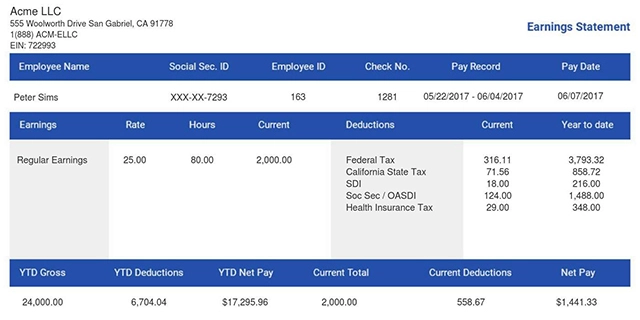
These are the codes for each line of your earnings, taxes, and deductions. Your pay stub is a snapshot of one pay period. The header shows your name, your employer's name, EIN, your masked SSN, the pay date, and the pay period dates. The stub then breaks down into three main sections:
- Earnings (REG, OT, PTO): The dollars paid to you and the reason they were paid. This section lists your regular hours, overtime hours, and any extra pay for holidays.
- Tax and Withholdings (FICA, OASDI, MED, FED): Required deductions set by federal and state law.
- Benefits and Deductions (401k, HSA, FSA, LTD): Optional or employer-sponsored items such as health insurance and retirement contributions.
All codes are set by federal law or your employer's payroll system.
Payroll codes appear on each line. They may look confusing at first, but they are simple to learn. Each line shows the current period amount, the earnings per pay period, and the YTD total. Knowing these paycheck stub abbreviations helps you spot errors fast.
Earnings Paycheck Stub Abbreviations
The earnings section on your pay stub shows how every dollar of your wages was earned. Below are the most common earnings codes and paycheck stub abbreviations.
| Abbreviation | Meaning | Notes |
|---|---|---|
| REG | Regular Pay | Standard hourly or salary earnings |
| OT | Overtime Pay | Hours worked over 40 per week at 1.5x your regular rate |
| PTO | Paid Time Off | Vacation, personal days, or other approved leave at full pay |
| HOL | Holiday Pay | Earnings on designated company holidays |
| SICK / VAC | Sick Leave / Vacation | Some stubs split paid time off into separate lines |
| BONUS / COMM | Bonus / Commission | Supplemental earnings; federal flat rate of 22% applies |
| SHFT | Shift Differential | Premium pay for evenings, nights, or weekends |
| DBL | Double Time | 2x rate; often found in California and union contracts |
REG is your regular earnings. It equals your hourly rate times your hours, or your salary divided by the number of pay periods. OT, or overtime pay, only appears if you work more than 40 hours in a week. The Fair Labor Standards Act (FLSA) sets the minimum OT rate at 1.5 times your regular rate.
ThePayStubs.com makes it easy to keep your workplace running smoothly. When you order pay stubs from ThePayStubs.com, you can modify earnings types and rates for custom stubs. We cover common earnings like regular pay, overtime, bonus, and commission with automatic calculations.
Tax and Withholding Abbreviations on Your Paycheck

Tax lines are legally required deductions. Here is a complete list of tax-related paycheck stub abbreviations:
| Abbreviation | Meaning | Rate |
|---|---|---|
| FICA | Federal Insurance Contributions Act | Social Security + Medicare combined |
| FED / FIT | Federal Income Tax | Based on your Form W-4 choices |
| SS / OASDI | Social Security Tax | 6.2% employee portion |
| MED | Medicare Tax | 1.45% of gross pay |
| ERMED | Employer Medicare Match | Employer's matching 1.45% |
| SIT / ST | State Income Tax | Rate varies by state |
| SDI | State Disability Insurance | Required in CA, NJ, NY, WA, HI |
| SUI / SUTA | State Unemployment Insurance | Paid by the employer; rarely shown on employee stubs |
| FUTA | Federal Unemployment Tax | Employer-paid tax; not withheld from employee wages |
So what does med stand for on pay stub documents? MED is the Medicare tax. It equals 1.45% of your gross pay each period. ERMED is the employer match, which adds another 1.45%. Together, you and your employer pay 2.9% of your wages toward Medicare. If your gross income exceeds $200,000, you also owe an extra 0.9% Medicare surtax, often shown as MEDI on paystub records. You may also see medi on paycheck stub lines for this same surtax.
If you see ermed on paycheck lines, that is your employer's share. It does not reduce your pay. It simply shows the total value of your benefits.
The 9 states with no income tax are AK, FL, NV, NH, SD, TN, TX, WA, and WY. If you live in one of these states, there will be no SIT field on your pay stub.
What Is OASDI on Paystub Records?
OASDI stands for Old-Age, Survivors, and Disability Insurance. It is the full name for Social Security tax. Your employer deducts 6.2% of your gross wages each pay period for this program. The deduction stops once your earnings reach $176,100 for the year. That is why the OASDI line may vanish from your stub mid-year.
If you are asking what is oasdi on my paystub, it is your Social Security contribution. Many people also wonder what does oasdi mean on my paycheck, and the answer is the same. The Social Security Administration runs this program. It pays monthly benefits to workers and their families based on lifetime earnings. The wage base for 2026 is $176,100.
Here is how oasdi on paystub amounts are calculated. If you earn $10,000 per month, you pay $620 per month in OASDI. Your YTD earnings will pass $176,100 around mid-October, at which point OASDI stops until the new year starts on January 1.
Your employer also pays a matching 6.2%. This match is not taken from your wages. It is an added cost your employer covers.
If you are self-employed, you pay both the employee and employer portions. The full self-employment tax rate is 15.3%, which includes both Social Security and Medicare. This amount will appear on your 1099 pay stub.
What Does YTD Mean on a Pay Stub?

YTD shows your year-to-date gross earnings, taxes, and deductions for the calendar year up to your latest pay date. If you earn $3,500 each bi-weekly pay period and have received 12 checks, your YTD gross would be $42,000. Your YTD numbers are used for tax reporting and income verification.
What does ytd stand for on a pay stub? YTD means "year to date." It gives you a running total across all your paychecks for the year. This total changes with each pay period. It shows current amounts for gross earnings, federal tax, Social Security, Medicare, and 401k contributions alongside the running YTD total.
YTD figures serve several key purposes:
- Tax prep: Your December stub YTD numbers should closely match your Form W-2. Use them to double-check your tax return.
- Contribution tracking: The YTD row helps you track your 401k progress toward the $23,500 annual limit for 2026.
- Loan and rental applications: Most lenders and landlords ask for recent pay stubs. Your YTD gross earnings help prove your income. The ytd meaning in paycheck records is the same running total used for these checks.
ThePayStubs.com will calculate and fill in YTD gross earnings for your employee stubs, making lease and loan paperwork simple.
Benefits and Deduction Abbreviations on Your Paycheck
The benefits section shows pre-tax and post-tax deductions for insurance, retirement, and other plans. Pre-tax deductions lower your taxable income before withholding is figured. Post-tax deductions do not.
| Abbreviation | Meaning | Notes |
|---|---|---|
| 401(k) / 403b / 457 | Retirement Plan Contributions | 403b for nonprofits; 457 for government workers |
| HSA | Health Savings Account | Tax-free savings for medical costs; requires a high-deductible plan |
| FSA | Flexible Spending Account | Pre-tax medical spending; use-it-or-lose-it each year |
| INS / MEDINS | Health Insurance Premiums | Employee's share of employer-sponsored coverage |
| DENT | Dental Insurance | Employee dental premium |
| VIS | Vision Insurance | Employee vision premium |
| LIFE | Basic Life Insurance | Employer-provided coverage |
| GTL | Group Term Life | Imputed income is taxable if coverage exceeds $50,000 |
| LTD | Long-Term Disability | Typically replaces 60 to 70% of salary |
| STD | Short-Term Disability | Covers shorter absence periods |
| EAP | Employee Assistance Program | Counseling and mental health support benefit |
ER and EE codes: Some detailed stubs show both an ER (employer) and EE (employee) line for the same benefit. For example, EE 401k = $105 and ER 401k = $105 means your employer matches your contribution dollar for dollar. The ER portion does not reduce your wages. It shows the total value of your pay package.
If you see FSA on your stub, keep in mind that IRS rules require you to spend the balance by December 31 or forfeit it. Check with HR about any grace period or carryover rules your plan allows.
Other Paycheck Stub Abbreviations to Know
Beyond earnings and taxes, some stubs have header codes and lines for other deductions. Here is a quick list of paycheck stub abbreviations you may see less often:
Header codes:
| Abbreviation | Meaning |
|---|---|
| EIN | Employer Identification Number |
| EMP ID | Your employee number |
| SSN | Social Security Number (masked, e.g., XXX-XX-1234) |
| PAY DATE | Date wages are paid |
| PAY PERIOD | Start and end dates of this pay period |
| DEPT / LOC | Department or work location code |
Other payroll deductions:
| Abbreviation | Meaning |
|---|---|
| GARN | Wage garnishment (court-ordered deduction) |
| UNION / UD | Union Dues |
| CHAR / CHARITY | Charitable payroll contribution |
| PARK | Parking or commuter transit benefit |
| LOAN | Employee loan repayment |
If you are unsure what a deduction is for, contact your HR or Payroll team. Employers must give a written explanation for every deduction on your pay stub. A written notice is also required before any wage garnishment (GARN) deduction is taken.
How to Spot Errors in Paycheck Stub Abbreviations
No payroll system is perfect. Here are three common paycheck stub abbreviation errors to watch for:
- OASDI over-deduction: Multiply your gross pay by 6.2% for the period and compare it to the OASDI amount shown. If the deducted amount is higher, flag it with HR.
- MED showing $0: There is no annual wage cap for Medicare. It should appear on every pay stub. A $0 MED line may signal a withholding error.
- GARN without notice: Wage garnishments are court-ordered. You must get written notice from your employer before this deduction starts. An unexplained GARN entry should be verified with HR right away.
If you find an error, ask HR for your last two pay stubs and request a correction for the next pay period. ThePayStubs.com calculates FICA, federal income tax, and OASDI values and auto-checks them against current IRS tables, so rate errors are caught before your stub is generated.
You Might Also Like
- Paycheck Stubs: What They Are and Why You Need Them
- Proof of Income If Paid in Cash
- Self-Employed? Here's How to Show Proof of Income
- What Does a Pay Stub Look Like?
- How to Calculate Your Hourly, Weekly, and Monthly Income
Conclusion
Payroll codes fall into four main groups: Earnings (REG, OT, PTO), Taxes (FICA, OASDI, MED, FED), Benefits and Deductions (401k, HSA, FSA), and Other codes (GARN, EIN, SSN). Once you know the categories, it is simple to learn each code within them.
As an employee, use your YTD gross when applying for loans or apartments. Compare your December stub to your W-2. If the OASDI rate exceeds 6.2% or the MED line is missing, call HR to fix it.
For small business owners, every paycheck stub abbreviation in this guide is filled in automatically when you use our pay stub generator. With our pay stub generator, you can create clean, accurate stubs with all standard paycheck stub abbreviations, earnings, and tax withholdings. Your employees will receive a clear, verifiable pay stub each pay period.
- 1. Enter Your Information

- 2. Select Your Favorite Theme

- 3. Download Your Stub!


 By
By