

What Is a Compensation Package? Your 2026 Guide
 By
By
A new job offer is exciting. But before you sign, do the math. The salary on the offer letter is only part of the story. So what is a compensation package? It's the full value of everything you earn, not just your base pay. A $70,000 salary with weak benefits can be worth less than a $60,000 salary with strong ones. This guide breaks down each part so you can judge any offer with confidence.
Key takeaways
- A compensation package includes your base salary, variable pay, benefits, equity, and perks. It is much more than salary alone.
- Employers paid an average of $7,000 per year toward single health coverage in 2024, per the KFF Employer Health Benefits Survey.
- The 2026 IRS 401(k) employee contribution limit is $23,500. Find out how much your employer matches.
- A $75,000 offer with no benefits can be worth less than a $65,000 offer with full benefits.
- Your first pay stub is the best way to confirm your package is paid correctly.
What Is a Compensation Package?
A compensation package is the full reward an employer gives you for your work. It includes cash pay plus other benefits. Many workers focus only on salary and miss the rest. Yet the extras add up fast. On average, employees receive $10,000 to $15,000 in yearly benefits on top of their cash pay.
Understanding what is a compensation package starts with one habit. Always compare the full offer, not just the paycheck. Two jobs with the same salary can be worth very different amounts. A startup might offer low pay but lots of equity. A large company might offer strong pay but few perks. Knowing what is a compensation package helps job seekers pick the best deal in a busy job market.
What's Included in a Compensation Package?

Your base salary is the starting point. The benefits your employer adds on top build your total reward. So when people ask what is a compensation package, the answer starts with salary and grows from there. A typical package includes several parts. There's your salary and any bonuses. There's health, dental, and vision coverage for you and your family. There's a 401(k) with an employer match. And there's paid time off for vacation, illness, and more.
Some packages go further. They add stock options, a remote work stipend, paid tuition, and other perks. These benefits can add $15,000 or more per year. That turns a $75,000 salary into a package worth over $90,000.
A compensation package breaks down into five key parts.
Base Salary and Variable Pay
Your base salary is your fixed pay. Variable pay is extra money on top. It can be an annual bonus, a signing bonus, or a performance award like stock. For some roles, variable pay matches or beats the base salary.
Here's an example. Say you're in sales and earn 10% commission on closed deals. If you close $200,000 in deals this year, you earn an extra $20,000. On a $60,000 base, your total reaches $80,000.
Benefits: Health, Retirement, and Time Off
Benefits are where the hidden value sits.
Health insurance: Employers paid an average of $7,000 per year for single coverage in 2024, per the KFF Employer Health Benefits Survey. You rarely see this cost. Your paychecks only show your share of the premium. You might pay $450 a month while your employer quietly covers $7,000 a year.
Retirement: Most employers offer a 401(k) or similar plan. The 2026 IRS limit for your own contributions is $23,500. A common employer match is 3% to 5% of your salary. On a $60,000 salary with a 4% match, that's $2,400 in free retirement money each year.
Paid time off: PTO is easy to value. Divide your salary by 260 workdays, then multiply by your PTO days. On a $60,000 salary, each workday is worth about $231. With 15 PTO days, that's about $3,465 a year.
Other benefits save money too. Life insurance, disability insurance, and employee assistance programs all help in hard times. They may be worth less than the big three, but they still matter.
Equity and Perks
Equity ties your reward to the company's growth. Stock options let you buy shares at a set price for a set time. Restricted stock units, or RSUs, are shares that vest over time. Once vested, you own them and can sell them.
Perks vary by company, but a few are common. Flexible work lets you work from home or part time. Professional development covers training and conference budgets. Other perks include a gym membership, unlimited vacation, and even on-site childcare.
Freelancer or self-employed? Learn how to show proof of income in our guide to 1099 pay stubs for independent contractors.
What Makes a Good Compensation Package?
A strong package is competitive and clear. It helps an employer attract top talent in a tight job market. Here's a rough outline of a great offer. The base salary sits near the market midpoint for the role. The employer pays about $7,000 a year toward single health coverage. The 401(k) match is meaningful, say 4% of salary. PTO runs 10 days or more. There's real equity. And remote work is on the table.
This is where what is a compensation package proves its value. A $75,000 salary with no benefits is worth less than $65,000 with full benefits. Add $7,000 in health coverage, $2,600 in 401(k) match, and $3,000 in PTO value. Now the lower offer is worth $77,600 to you. The $65,000 job wins.
Watch for red flags too. Be careful with employers who won't explain your benefits. Be wary if they don't match 401(k) funds, limit PTO rollover, or dodge questions about vesting. Ask for a written summary of benefits before you sign. Read it closely so you understand your full reward and your pre-tax deductions.
What Is a Compensation Package by Company Size?

So what is compensation package design like across different employers? It changes at each stage of a company's life. Base salaries and benefits both shift with company size. A mid-size logistics firm pays very differently than a venture-backed startup.
Small business (10 to 50 employees): Many don't run a formal benefits program. Those that do usually offer base salary plus health insurance, sometimes with dental and vision. PTO is simple, like 10 days that don't carry over. Some match a small amount of 401(k) contributions.
Mid-size company (100 to 1,000 employees): Here the salary comes with health, dental, and vision for your family. You often get life and disability insurance too. The 401(k) match runs around 3% to 4% of salary. Many add a yearly performance bonus.
Large enterprise (1,000+ employees): The biggest firms offer the biggest perks. They cover full family health, a strong 401(k) match, and generous PTO. Extras like on-site childcare are common. At companies like Google, total pay can reach twice the base salary.
Freelancers and self-employed: You fund your own health insurance and retirement. Your income isn't documented for you, which makes proof of income harder for loans or rentals. See our guide on proving income when you're self-employed.
How to Calculate Your Total Compensation Value
Your true pay is your salary plus the value of your benefits. To see it clearly, add up five parts. Those are your salary, your annual bonus, your employer's health contribution, the 401(k) match, and your PTO value. Here's an example using a $60,000 salary with full benefits and 15 PTO days.
| Component | Value |
|---|---|
| Base salary | $60,000 |
| Annual bonus (5%) | $3,000 |
| Employer health contribution | $7,000 |
| 401(k) employer match (4%) | $2,400 |
| PTO value (15 days at $230/day) | $3,450 |
| Total compensation | $75,850 |
So a $60,000 salary really delivers about $75,850 in value. When two jobs differ on pay and benefits, run this math on both. The lower-paying job with strong benefits can come out ahead.
How to Evaluate a Compensation Package Offer
Knowing what is a compensation package is only half the job. You also need to weigh each benefit and the package as a whole. These four steps help.
Know what matters most to you. Everyone values flexibility, health coverage, retirement match, and equity differently. List your priorities first. Then compare each offer against that list.
Get the details, not just the numbers. Companies advertise the highlights. You need the full written summary of benefits. Use it to check the premium split, the 401(k) match formula, the vesting schedule, and the PTO terms.
Check the timeline. Some benefits take months to kick in. A 401(k) match may have a waiting period. If you have needs your salary won't cover right away, raise them during negotiation.
Compare against market rates. Use the Bureau of Labor Statistics at bls.gov or Glassdoor. Find the total pay for your position in your area. Then measure your offer against it.
After your first paycheck, confirm everything was applied. Check that health premiums, the 401(k) match, and any bonus lines are correct. Our guide on how to get a pay stub from direct deposit shows you how.
You Might Also Like
- Payroll Codes: What They Mean on Your Pay Stub
- How to Tell the Difference Between a Real and Fake Pay Stub
- How to Read a W-2 Like a Pro
- Paycheck Stubs: What They Are and How to Get One
- Pay Stubs for Loan Applications: What Lenders Want
Conclusion
Now you know what is a compensation package and why it matters. The real value of any job offer goes far beyond the salary line. Once you understand the difference between salary and total compensation, you can judge any offer with confidence as a candidate.
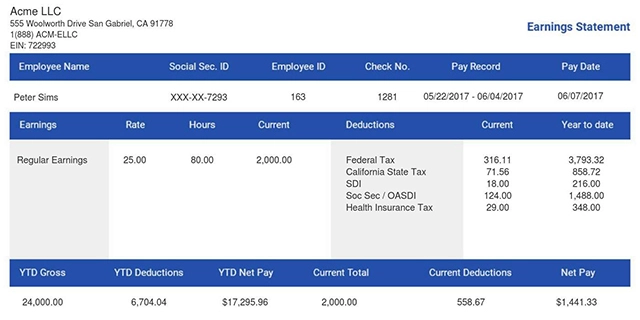
Your pay stub is proof of your package. It shows every deduction and every employer contribution in one place. Review it to confirm you're getting the full reward you agreed to.
A reliable pay stub creator helps you generate accurate pay stubs fast. Employees can check that their benefits are applied correctly. Small business owners can create pay stubs for their workforce and keep payroll organized with ease.
- 1. Enter Your Information

- 2. Select Your Favorite Theme

- 3. Download Your Stub!

 By
By