

What Does a Garnishment Look Like on a Pay Stub? (2026)
 By
By
Checking your pay stub and finding an unexpected deduction labeled "GARN" or "WAGE GARN" can be unsettling. You're not alone. Understanding "What does a garnishment look like on a pay stub?" is the first step to knowing what's happening with your money.
Need a professional pay stub that clearly shows all deductions? ThePayStubs.com makes it easy. Many employees encounter this deduction for the first time without any warning. That labeled line in your pay stub's deductions section, often coded "GARN" or "WAGE GARN," is what garnishment on paystub entries look like in every employer system.
This guide breaks down exactly where garnishments appear on your pay stub. You'll learn what the codes mean, how much can legally be withheld, and what to do if something looks off.
Key Takeaways
-
A garnishment appears in the deductions section of your pay stub, labeled "GARN," "WAGE GARN," or a debt-specific code like "CHLD SUP" or "IRS LEVY."
-
Wage garnishment is a mandatory, court-ordered deduction. It is not voluntary, and your employer cannot ignore it.
-
Federal law (Title III of the CCPA) limits how much can be garnished based on your disposable income.
-
Garnished wages are still fully taxable and appear as gross income on your W-2.
-
Four states prohibit consumer debt garnishment entirely. They include North Carolina, South Carolina, Pennsylvania, and Texas.
- Key Takeaways
- What Is Wage Garnishment?
- What Does a Garnishment Look Like on a Pay Stub?
- Common Garnishment Codes: What Does a Garnishment Look Like on a Pay Stub Label?
- Types of Wage Garnishment
- How Much of Your Wages Can Be Garnished?
- What To Do if You See a Garnishment on Your Pay Stub
- In Conclusion
- You Might Also Like
What Is Wage Garnishment?
Wage garnishment is a legal process. A court or government agency orders your employer to withhold a portion of your paycheck to repay a debt. Private creditors must obtain a court order first, while government agencies like the IRS can act without one. Your employer is legally required to comply immediately upon receiving the order.
When a garnishment order arrives, your employer must start the withholding within 5 to 30 days. They must also notify you in writing that the garnishment has begun. You should receive this notice before or shortly after the deduction first appears on your pay stub.
What Does a Garnishment Look Like on a Pay Stub?

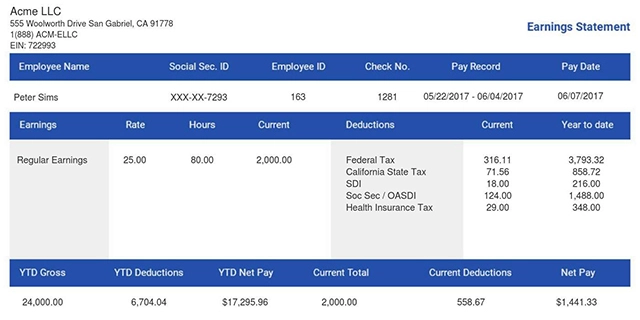
So, what does a garnishment look like on a pay stub, exactly? A garnishment appears in the deductions section of your pay stub, typically below taxes and above net pay. It shows as a coded line item with a dollar amount, such as "GARN $150.00," "WAGE GARN $200.00," or "CHLD SUP $400.00." A year-to-date total also appears, showing the accumulated amount withheld so far.
Here's what you'll typically see in that deductions section:
-
Code: An abbreviation identifying the garnishment type (e.g., GARN, CHLD SUP, IRS LEVY)
-
Current period amount: The dollar amount withheld this pay period
-
YTD (Year-to-Date) total: The running total withheld since the garnishment began
Major payroll platforms all follow the same federal disclosure rules. On ADP Workforce Now, the garnishment appears under "Other Deductions." Workday labels it under "Post-Tax Deductions." Paychex Flex shows it in "Employee Deductions." Labels differ by employer, but the structure is consistent.
Common Garnishment Codes: What Does a Garnishment Look Like on a Pay Stub Label?
If your pay stub shows an abbreviation you don't recognize, it's likely one of these standard codes. Many people search "What is GARN on paystub?" or wonder about "CRED GARN CGPN on paystub." The table below explains both:
| Code | What It Means |
|---|---|
| GARN / WAGE GARN | General wage garnishment (creditor debt) |
| CHLD SUP / CS GARN | Child support garnishment |
| IRS LEVY / FED LEVY | IRS federal tax levy |
| STATE LEVY | State tax levy |
| ED GARN / STUDENT LOAN | Student loan default garnishment |
| CRED GARN / CGPN | Creditor garnishment (private debt) |
| BANKRPT | Bankruptcy-related garnishment |
These codes are part of a broader system of payroll codes on your pay stub that identify every deduction type. If you see "CRED GARN" or "CGPN," it means a private creditor has obtained a court judgment against you. Your employer is withholding wages to satisfy that debt. Contact HR if you're unsure which specific creditor the deduction is tied to.
Types of Wage Garnishment

Garnishments fall into four main categories, each with its own legal limits:
-
Child support and alimony: Up to 50% of disposable income if you support another spouse or child, or 60% if you don't
-
IRS tax levy: No fixed percentage. The IRS calculates the amount based on your standard deductions and the number of dependents. The maximum is generally 50%.
-
Student loan default: Up to 15% of disposable income
-
Consumer or creditor debt: Up to 25% of disposable income
Child support and tax levies take priority over all other garnishments. If you have multiple garnishments, those get paid first.
How Much of Your Wages Can Be Garnished?
Federal law limits most garnishments to the lesser of 25% of your disposable income or the amount exceeding 30 times the federal minimum wage. That threshold is $217.50 per week as of 2026. Child support can reach 50-65% and student loans up to 15%. Four states ban consumer debt garnishment entirely. These states include North Carolina, South Carolina, Pennsylvania, and Texas.
Here's how the calculation works in practice:
-
Start with your gross pay for the period
-
Subtract mandatory deductions, including the federal and state taxes, Social Security, and Medicare
-
The result is your disposable income
-
The maximum garnishment is the lower of 25% of disposable income, OR the excess over $217.50/week
Example: Your gross pay is $1,000. After $200 in taxes, your disposable income is $800.
The maximum garnishment for consumer debt is 25% x $800 = $200. You keep at least $600 as take-home pay.
If you live in a state with a higher minimum wage, your exemption threshold is higher than the federal $217.50 floor. That means less of your paycheck can be garnished. You can check your state's rules by reviewing state pay stub laws for specific protections.
What To Do if You See a Garnishment on Your Pay Stub
Seeing "What does a garnishment look like on a pay stub?' for the first time can be alarming. Start by locating the court order or garnishment notice you should have received. Employers must notify you in writing. Match the garnishment line on your stub to the order details, verifying the creditor name and amount. Contact your HR or payroll department immediately if something doesn't match. You can also dispute or seek a hardship exemption through the court.
Pro tip: Your employer is legally required to provide you with the details of the garnishment order. If you never received written notice and a deduction suddenly appeared, ask HR for a copy of the court order right away.
Here's what you can do depending on the type of debt:
-
Child support: Review the order for the exact amount and support obligation. Contact the court or state child support agency if the amount is incorrect.
-
Tax levy: The IRS will have sent you a notice before the levy began. Call the number on that notice to discuss payment arrangements or hardship relief.
-
Consumer/creditor debt: Request a hardship exemption from the court if the garnishment prevents you from paying basic living expenses like rent and food.
-
Student loans: Contact the Department of Education servicer directly to explore income-driven repayment plans that can reduce or stop garnishment.
In Conclusion
Understanding "What does a garnishment look like on a pay stub?" gives you the tools to verify deductions, decode confusing abbreviations, and know your rights. Garnishments are mandatory, but also transparent. Your pay stub must show you exactly how much is being withheld and why.
Need accurate pay stub documentation that reflects your deductions, including garnishment entries? Use our pay stub creator to generate professional pay stubs in minutes. It shows exactly "What does a garnishment look like on a pay stub?" format that employers and lenders recognize.
You Might Also Like
- 1. Enter Your Information

- 2. Select Your Favorite Theme

- 3. Download Your Stub!

 By
By