

Proof Of Income Documents - 6 Instances You'll Need A Pay Stub
 By
James Wilson
By
James Wilson If you've been asking how many months proof of income for apartment applications landlords require, the short answer is two to three months for most renters. If you need professional pay stubs ready for your application today, you can create a pay stub at ThePayStubs.com in under two minutes.
Below we explain how many pay stubs you need for rental applications, how many months proof of income for apartment approval is typically expected, and the income thresholds landlords use. We'll also cover documentation options for self-employed individuals, new employees, and anyone with variable income.
For a closer look at one document landlords commonly accept, see our employment verification letter guide.
Key Takeaways
- Most landlords require two to three recent pay stubs as proof of income for apartment rental applications.
- Your gross monthly income should be at least three times the monthly rent (the 3x rule).
- Self-employed applicants should prepare two years of tax returns and three to six months of bank statements.
- Bank statements for two to three months can substitute for or supplement pay stubs when needed.
- Federal law does not require employers to issue pay stubs, so having a backup documentation plan matters.
- How Many Months Proof of Income for Apartment Applications Are Required?
- How Many Pay Stubs Do You Need for an Apartment?
- What If You Don't Have 3 Months of Pay Stubs?
- The 3x Rule: How Much Income Do You Actually Need?
- How Many Pay Stubs for Proof of Income?
- What Landlords Look at on Your Pay Stubs
- Income Documentation for Self-Employed Applicants
- Scenario Guide: How Much Proof Is Enough for Each Situation?
- Other Documents That Meet How Many Months Proof of Income for Apartment Requirements
- Tips for Strengthening Your Rental Application
How Many Months Proof of Income for Apartment Applications Are Required?

The standard answer to how many months proof of income for apartment applications landlords require is two to three months. This is true across most of the country, whether you're applying to a mid-size apartment complex or renting from an independent landlord. However, the number can vary based on the market and the type of property you're targeting.
Standard markets: Two to three months of proof of income is the norm. Most landlords want to see your two or three most recent pay stubs to confirm you have a stable paycheck and can afford the rent.
High-cost cities and luxury apartments: In competitive markets like New York, San Francisco, or Los Angeles, or for premium rental units, landlords may require three to six months of income documentation. This often means three months of pay stubs combined with two to three months of bank statements, giving them a fuller picture of your financial stability.
Why landlords want multiple months: A single pay stub is a snapshot, not a pattern. Multiple months of documentation show your income is consistent and reliable, not a one-time bonus or irregular freelance payment. Landlords aren't just verifying that you earned enough money once; they're confirming you earn enough every month.
The 3x rent income rule: Nearly every landlord uses the 3x rule as their income benchmark: your gross monthly income must be at least three times the monthly rent. If a unit rents for $1,800 per month, you need to demonstrate at least $5,400 in gross monthly income.
Multiple months of documentation help landlords apply this rule consistently because they can average out your income rather than relying on a single month that may be unusually high or low.
What "months of proof of income" actually means in practice: Landlords typically accept a combination of documents to cover the required time window. Pay stubs from a traditional employer are the clearest option because they show gross wages and pay dates explicitly. Bank statements work when direct deposits are clearly labeled.
Some landlords accept a mix (for example, two pay stubs plus one month of bank statements) as long as together they cover the required time period and tell a consistent income story.
Here's a quick breakdown by income type:
| Income Type | Typical Requirement |
|---|---|
| Traditional employee (salaried or hourly) | 2-3 most recent pay stubs |
| Hourly with variable hours | 2-3 months of pay stubs or bank statements |
| New hire with no pay stubs yet | Signed offer letter on company letterhead |
| Self-employed or freelance | 2 years tax returns + 3-6 months bank statements |
| Retired or pension income | Pension distribution statement |
| Government benefits (SSI, disability) | Official benefits award letter |
Our guide on pay stubs for rental applications walks through requirements from both the renter's and landlord's perspective if you want a deeper dive into what each document type covers.
When it comes to consistent income, there are many types of employment, and various ways to receive a paycheck. Our employment verification and proof of income documents guide can help to give you a better idea of which of your employment-related documents qualify as proof of income and how they can be used.
How Many Pay Stubs Do You Need for an Apartment?
The most common requirement is two to three of your most recent pay stubs. When renters ask how many months proof of income for apartment applications require, this is usually the pay stub count landlords have in mind. This is the range most property managers and independent landlords use regardless of location.
Two pay stubs confirms you're currently employed and earning consistently; three pay stubs gives a broader view of income stability.
Pay frequency math: how many stubs equal "three months"?
This is where applicants get confused, and it's important to understand. The number of pay stubs you need depends entirely on how often you're paid:
- Weekly pay: You receive roughly 4 stubs per month, so 3 months = 12 pay stubs
- Bi-weekly pay (every two weeks): You receive roughly 2 stubs per month, so 3 months = 6 pay stubs
- Semi-monthly pay (twice a month, e.g., 1st and 15th): You receive 2 stubs per month, so 3 months = 6 pay stubs
- Monthly pay: You receive 1 stub per month, so 3 months = 3 pay stubs
Most landlords who say "two to three pay stubs" are thinking in terms of bi-weekly pay cycles, which is the most common pay schedule in the US. If you're paid weekly, bring more stubs than you think you need. Four to six is a reasonable range to cover the same income window.
What if you just started a new job less than two months ago? If you don't yet have two to three pay stubs because you're newly employed, most landlords will accept a combination of documents: your signed employment offer letter on company letterhead (showing your salary and start date) plus your bank statements showing the most recent deposits.
Some landlords will also accept a verification letter from your HR department. The key is to show that you have a confirmed income source, even if the paper trail is short.
How to organize and present pay stubs professionally: Gather your pay stubs in reverse chronological order (most recent first). Make sure each stub is legible. If you have digital stubs from an employer portal, print clean copies. If any information is missing or hard to read, note it in a cover letter. A tidy, organized package signals to landlords that you're a serious, prepared applicant.
What If You Don't Have 3 Months of Pay Stubs?
If you can't meet the standard how many months proof of income for apartment applications usually call for, don't panic. Falling short on pay stubs doesn't automatically disqualify you from renting. Landlords deal with this situation regularly, and most accept alternatives. Here are the most practical options:
Employment offer letter plus contract: If you're starting a new job, ask your employer for a signed offer letter on company letterhead. It should include your name, job title, salary or hourly rate, and start date. Pair this with your most recent bank statements to show existing financial stability.
Bank statements showing consistent direct deposits: Two to three months of bank statements that clearly show regular income deposits can substitute for pay stubs. Landlords look for a consistent pattern, meaning the same type of deposit arriving on a predictable schedule. Highlight the relevant transactions to make the landlord's review easier.
Prior year tax return (Form 1040): A recent federal tax return shows your verified annual income and is widely accepted as proof of income. It doesn't show current income the way a pay stub does, so pair it with at least one current pay stub or bank statement if possible.
Co-signer option: A co-signer with strong, verifiable income can bridge the gap when your own documentation falls short. The co-signer agrees to be responsible for the rent if you can't pay, which removes the landlord's risk. This is especially common for new graduates, recent job changers, or people rebuilding after a financial setback.
Larger security deposit negotiation: Some landlords will accept an offer to pay an additional month of security deposit in exchange for accepting thinner documentation. This is not universally available, but it's worth asking, since it's a low-risk arrangement for the landlord and gets you approved.
Self-generated pay stubs as supplemental documentation: If you're self-employed or your employer doesn't issue formal pay stubs, you can generate professional, accurate ones yourself through ThePayStubs.com. This kind of documentation can supplement your other materials and make your application package more complete.
Use this alongside bank statements or tax returns, not as a standalone replacement for employer-issued documents.
The 3x Rule: How Much Income Do You Actually Need?
Beyond knowing how many months proof of income for apartment applications to prepare, you also need to confirm your income is high enough to qualify. The most widely used benchmark is the 3x rule: your gross monthly income must be at least three times the monthly rent. For example:
Practical examples:
- Rent of $1,200 per month requires at least $3,600 monthly gross income ($43,200 annually)
- Rent of $1,800 per month requires at least $5,400 monthly gross income ($64,800 annually)
- Rent of $2,500 per month requires at least $7,500 monthly gross income ($90,000 annually)
This ties directly to the 30% guideline: no more than 30% of your gross monthly income should go toward housing. Pay stubs are preferred by landlords because they show gross wages before taxes, while bank statements only show net deposits after deductions.
How Many Pay Stubs for Proof of Income?
When you're figuring out how many months proof of income for apartment applications your situation calls for, start with your pay frequency. A typical salaried or hourly employee provides 2-3 most recent pay stubs. An hourly employee with variable hours provides 2-3 months of pay stubs or 3-6 months of bank statements.
A new hire who has just started work and has no pay stubs yet would typically need a signed offer letter on company letterhead.
A few things decide how many pay stubs a renter needs to hand over, and the biggest one is how often you get paid. Someone paid weekly usually needs 4-6 stubs to cover the same income window as someone paid bi-weekly (2-3 stubs a month), while a monthly-paid employee may only need 1-2 stubs for that same stretch.
As a rule of thumb, aim to show at least four to six weeks of verified income so a landlord can clearly see you can cover the rent.
What Landlords Look at on Your Pay Stubs
Once you know how many months proof of income for apartment approval typically requires, the next step is understanding which details get the most attention. A handful of specifics carry the most weight on each stub:
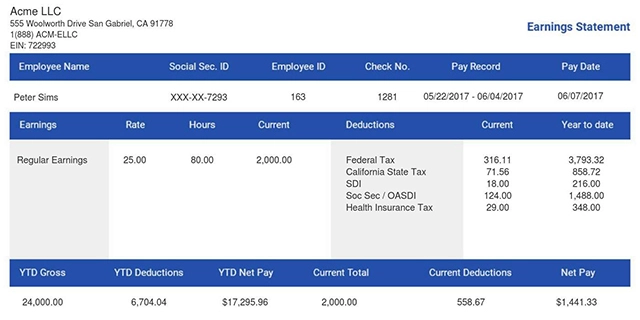
- Employer name and address: The landlord wants to verify that the employer listed on your documents is legitimate and that you are employed at the address listed on your rental application
- Your name matching your rental application exactly
- Gross wages: This will help you determine if you meet the income requirements for housing in relation to your rent.
- Pay period dates: Verify that the documents were produced recently.
- Year-to-date (YTD) earnings: If the landlord reviews several pay stubs, they will be able to evaluate your annual income.
- Consistency: Landlords will typically review multiple pay stubs to ensure that your income is consistent from one pay period to another. If one pay stub appears to be an outlier and therefore suspicious, it may result in your rental application being denied.
One pay stub is not enough proof of income on its own. When landlords decide how many months proof of income for apartment applications they want, they ask for 2-3 pay stubs so they can confirm your income is steady over time, not just a single strong week. Consistent stubs reassure them that you can pay the rent every month.
Income Documentation for Self-Employed Applicants

Self-employed renters face different requirements when it comes to how many months proof of income for apartment applications they need to submit. Because self-employment income can vary month to month, landlords ask for broader documentation over a longer time window.
Standard requirements for self-employed applicants include:
- 2 years of federal tax returns (IRS Form 1040 with Schedule C for sole proprietors)
- Three to six months of bank statements from all of a self-employed applicant's accounts. Landlords reviewing bank statements from a self-employed applicant will be looking for consistencies of money deposited into an account on a regular basis. If money is earned from another entity, it can be transferred into the account(s) of a self-employed individual from another account(s).
- 1099 forms from clients or from your gig platform (if you're an independent contractor).
- Profit and loss statement: Similar to a YTD earnings statement, a current year profit and loss statement can be very relevant because it shows the growth in your earnings over the past year. For example, if you submit your application in the middle of the year and your earnings have increased substantially from the prior year, then the profit and loss statement for the current year will be very relevant.
If you are a W-2 employee with some part time earnings and you also freelance, the landlord will probably count both of your types of income for the 3x rental application income calculation.
The landlord will probably want to see separate documentation for each type of income that you have, and you will want to make sure that you have that documentation all organized to be able to show the landlord your income. See how to show proof of income when self-employed for a complete guide to how self-employed individuals can prove their income for rental applications.
Scenario Guide: How Much Proof Is Enough for Each Situation?
Here's a practical breakdown of how many months proof of income for apartment applications you'll need in common rental scenarios:
| Situation | Documentation to Submit |
|---|---|
| Stable salaried job, paid bi-weekly | 2-3 most recent pay stubs |
| Hourly job with variable hours | 2-3 pay stubs plus bank statements |
| New job, no pay stubs yet | Offer letter on company letterhead |
| Changed jobs in the past 30 days | Last stub from old job + offer letter from new job |
| Self-employed, consistent income | 2 years tax returns + 3-6 months bank statements |
| Gig worker (rideshare, delivery, freelance) | 1099s + 3-6 months bank statements + earnings summaries |
| Recently changed income (divorce, layoff) | Most recent tax return + current pay stubs |
| Retired on pension | Pension distribution statement |
| Social Security or disability recipient | SSA award letter |
The income of a small business owner is typically the income of that business but in addition the owner reports a salary on his or her tax return. Therefore the documents that a small business owner can use to prove their personal income such as tax returns, Schedule C's (showing the net profit of the business), and even the owner's personal salary are generally acceptable to landlords.
Other Documents That Meet How Many Months Proof of Income for Apartment Requirements
These documents can be used singularly or in combination to confirm and support an applicant's income. For example, two years of tax returns along with three to six months of bank statements could be used to verify the income of a self-employed applicant.
Bank Statements
Landlords usually ask for two to three months of statements so they can watch for a steady stream of deposits hitting your account. This confirms that there are regular incoming deposits of income into the account(s) of the applicant(s).
This will typically be used in conjunction with the pay stubs of the applicant(s) as pay stubs list the applicant's gross wage(s), and bank statements list the net deposits of income into the account(s) of the applicant(s). Gig workers who are paid in cash will be happy to read our article on proof of income if paid in cash for information regarding how to prove cash income.
Tax Returns
For self-employed renters, landlords often want one to two years of filed returns (such as Form 1040) to confirm a longer track record of income. In addition, current pay stubs can serve as a reference point to verify whether current pay stubs appear to be unusually high or low (e.g. due to excessive overtime at work or reduced hours at work).
Employment Verification Letter
This document is a common stand-in for renters who recently started a new job and haven't collected enough pay stubs yet. Written by your employer, it should include your name, job title, salary (gross or net), and the date the letter was written.
The landlord may accept employment verification letters for a period of 30 to 60 days or until the employee has acquired enough pay stubs to confirm their income. In the meantime, the employee should include pay stubs from previous employment in order to confirm their past income as well as their current income from their new job.
Offer Letter
A signed offer letter is the document a new employer gives you before your first paycheck arrives. Printed on company letterhead, it should list your name, job title, start date, and your salary or hourly rate. Landlords frequently accept an offer letter as temporary proof of income until you've built up a few pay stubs, usually covering your first 30 to 60 days on the job.
Tips for Strengthening Your Rental Application
Once you know how many months proof of income for apartment applications your target property requires, you can strengthen your file even if your income is borderline or your documentation is limited. There are several practical steps that increase your approval odds.
- Submit more months than required. If the landlord asks for two pay stubs, submit three. More documentation builds confidence.
- Pair bank statements with pay stubs. Bank statements confirm that your income deposits match the pay stubs you're showing.
- Get a co-signer. If you have a co-signer with strong income it could help cover your lack of income to meet the 3x threshold.
- Pay 2-3 months rent upfront. Paying 2-3 months rent upfront can get you approved by a landlord if you don't meet the income minimum.
- Include a cover letter if needed. If you have an unusual income situation such as a new job, recently changed jobs, or if you are self-employed, a cover letter will help explain your situation to a landlord.
- Fix documentation gaps before applying. Even if you've been paid informally or off the books, ThePayStubs.com can provide you with professional-looking and completely accurate documentation of your income that can be used to show potential landlords in rental applications.
Conclusion
For most renters, the answer to how many months proof of income for apartment applications is straightforward: two to three months, typically in the form of your most recent pay stubs. High-cost cities and luxury apartments may require three to six months.
Self-employed applicants, gig workers, and those with variable income need more, usually two years of tax returns plus several months of bank statements. Prepare more documentation than you think you'll need, confirm your income meets the 3x monthly rent threshold, and use a mix of document types if one alone isn't enough.
Need professional pay stubs for your rental application? Create a pay stub at ThePayStubs.com and get accurate, downloadable documents in under two minutes. Your application deserves professional documentation.
You Might Also Like
- 1. Enter Your Information

- 2. Select Your Favorite Theme

- 3. Download Your Stub!

 By
By