

How Do Banks Verify Income For An Auto Loan?
 By
By
If you're buying a car with financing, one of the first questions a lender will ask is: can you afford it? To answer that, they need proof of income for a car loan from you before they approve anything. Whether you're a salaried employee, a 1099 contractor, or self-employed, what you hand over directly affects your rate, your approval odds, and how fast the process moves.
Get a clean, verifiable pay stub in minutes at ThePayStubs.com/create-stub so you walk into the dealership ready to go.
This guide covers exactly what documents banks accept, how lenders verify income by employment type, what your debt-to-income ratio means, and how to strengthen your application when your income situation is less than straightforward.
- Why Banks Require Income Verification for Auto Loans
- What Documents Count as Proof of Income for a Car Loan
- How the Income Verification Process Actually Works
- Key Factors That Affect Your Loan Approval Beyond Income
- Options When You Cannot Provide Traditional Proof of Income
- How to Prepare Strong Income Documentation
- Proof of Income for Self-Employed Car Buyers: A Closer Look
- Related Resources
Why Banks Require Income Verification for Auto Loans
Lenders require income verification because they need confidence you can make monthly payments without defaulting. It is also a federal regulatory requirement under the Truth in Lending Act and Fair Credit Reporting Act frameworks that lenders assess repayment ability before extending credit.
Income is not the only factor, but it is central. A lender weighs it alongside your credit score, existing debts, and the loan amount to set approval and rate. Higher verifiable income, paired with strong credit, typically results in lower rates and more flexible terms. For the wider context on what counts as income across every loan type, see our complete proof of income guide.
According to Experian, the average monthly car payment on a new vehicle hit $738 in early 2025. Lenders want to confirm your take-home can absorb that cost without pushing your debt-to-income ratio into risky territory.
What Documents Count as Proof of Income for a Car Loan
Most lenders accept several document types. What you need to bring depends on how you earn your money. For a broader rundown of the records that satisfy lenders, landlords, and agencies, see our guide to proof of income documents and when you will need a pay stub.
For Full-Time Employees (W-2)
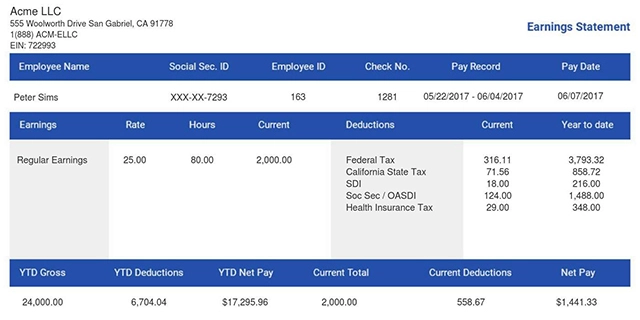
If you receive a regular paycheck, your most recent pay stub is the go-to document. Some lenders accept a single stub; others want the last 30 to 60 days. The stub should show your year-to-date earnings and your employer's contact details.
Additional documents they may request:
- W-2 forms from the past one to two years
- Bank statements confirming direct deposit deposits
- Employer contact information for phone verification
Tip for business owners: If you pay your employees and need clean, compliant pay records that hold up to a lender's scrutiny, ThePayStubs.com makes it fast to generate professional stubs for your team.
For Self-Employed Individuals and 1099 Contractors
This is where income verification for car loans gets more involved. Because self-employed income can fluctuate month to month, lenders want a longer view of your earnings. Expect to provide:
- The two most recent years of federal tax returns (Schedule C or Schedule SE)
- 1099 forms from clients or platforms
- Three to six months of personal and business bank statements
- A profit and loss statement for the current year
- Business license or proof of active business insurance
A self-employed car loan approval often comes down to your average net income after deductions. If your tax returns show heavy write-offs, your qualifying income may be lower than your gross revenue suggests. One workaround is bank statements showing consistent deposits even when taxable income looks lean. Our guide on how to show proof of income when self-employed covers each document in detail.
For freelancers and gig workers who need a pay stub document that reflects actual earnings, ThePayStubs.com/create-stub lets you generate an accurate income summary in under two minutes. If you drive or shop on a delivery app, our guide to Instacart pay stubs shows how gig workers turn platform earnings into lender-ready records.
For Part-Time and Temporary Workers
Lenders will want to see:
- Recent pay stubs covering at least three months
- Bank statements showing consistent deposits
- Tax returns if applicable
Stability matters here. Most lenders prefer to see that you have been at the same job or in the same industry for at least three to six months before applying.
For Fixed-Income Recipients (Social Security, Disability, Pension)
Banks do accept alternative income sources. If your income comes from:
- Social Security or SSDI benefits
- Pension or retirement distributions
- Alimony or child support (you are not required to disclose these, but may choose to)
- Investment income or dividends
You will need to provide an award letter, 1099-R, or official statement showing the regular payment amount. Banks cannot garnish these income types if you default, which can make them view these applications more cautiously.
How the Income Verification Process Actually Works

Once you submit your application and documents, lenders verify your income using one or more of the following methods:
1. Document review: A loan officer reviews your pay stubs, tax returns, or bank statements for consistency. They check that your employer name, dates, income figures, and year-to-date totals add up logically.
2. Employer phone verification: Some lenders call your employer to confirm you are still employed and your salary matches what you reported. If your lender does this, let your HR department or manager know in advance so they are prepared to respond.
3. Digital income verification platforms: Many larger lenders and banks now use services like Equifax Workforce Solutions (The Work Number) or Plaid to pull employment and income data directly from employer payroll systems. This is fast, reduces paperwork, and is increasingly common.
4. Third-party credit bureau data: Your lender may pull employment data from Experian, Equifax, or TransUnion, which aggregate employment history from public and lender-reported data.
The entire income verification process typically takes a few hours to two business days, depending on the lender and how clean your documentation is.
Key Factors That Affect Your Loan Approval Beyond Income
Credit Score
Your credit score is the most influential single factor. A score above 670 typically qualifies you for competitive rates across most lenders. Scores above 740 unlock the best offers. With poor credit (below 580), lenders will scrutinize your income much more closely and may require a minimum monthly income of $1,500 to $2,000 before taxes as a baseline for approval.
For context, as of 2026, the average auto loan interest rate ranges from roughly 6% for excellent credit borrowers to over 20% for deep subprime applicants. Your income helps, but credit score drives the rate.
Debt-to-Income Ratio (DTI)
Your debt-to-income ratio measures how much of your gross monthly income goes toward existing debt payments. Lenders calculate it by dividing total monthly debt obligations (credit cards, student loans, rent, existing car payments) by your gross monthly income, then multiplying by 100.
Example: If you earn $5,000 a month before taxes and your total monthly debt payments are $1,800, your DTI is 36%.
Most auto lenders prefer a DTI below 50%. Some set a stricter threshold of 36%. A DTI above 50% signals to lenders that you are already stretched thin, and adding a car payment creates meaningful default risk.
Down Payment
Making a larger down payment reduces the loan amount, lowers your monthly payment, and signals financial stability to the lender. If your income or credit is borderline, offering 10% to 20% down can shift an approval from uncertain to confirmed. Some lenders may even waive strict income verification requirements for borrowers who put significant money down.
Car Price
The more expensive the vehicle, the more a lender will scrutinize your income. Luxury vehicles priced above $50,000 almost always require full income verification regardless of your credit score. Cheaper vehicles or used cars have more flexible approval standards.
Options When You Cannot Provide Traditional Proof of Income

Use a Cosigner
A cosigner with strong income and good credit essentially lends their financial credibility to your application. The cosigner is equally responsible for the loan if you default, so this is a significant ask. It works best when the primary borrower has limited credit history or irregular income.
Apply Through a Credit Union
Credit unions are member-owned, nonprofit institutions that tend to offer more flexible underwriting than traditional banks. They may accept alternative income documentation, offer lower rates, and give more weight to your overall financial picture rather than checking rigid income boxes.
No Income Verification Car Loans
Some lenders offer a car loan without pay stubs or tax returns, relying instead on credit score, existing bank relationships, and stated income. These no income verification car loans often come with higher interest rates and stricter repayment terms to compensate for the added risk. They may also require a larger down payment.
If you bank with an institution where you have held an account in good standing for years, ask directly about relationship-based lending. Established customers occasionally qualify without the full documentation stack.
Provide Bank Statements Instead
If your tax returns understate your actual income because of legitimate business deductions, bank statements can paint a more accurate picture. Twelve months of consistent deposit history sometimes satisfies lenders even when W-2s or tax returns are not available. If most of your earnings arrive as cash, our guide to proof of income when you are paid in cash covers how to document it credibly.
How to Prepare Strong Income Documentation
Start collecting documents early. Most lenders want records that are no more than 30 to 60 days old. If you are planning to buy in the next few months, save your most recent pay stubs as they arrive.
Make sure your pay stub is accurate and professional. Lenders cross-check your stub against employment records and tax documents. Discrepancies, formatting issues, or missing data points (like an employer EIN or year-to-date totals) can derail an approval. For employees with manual checks or contractors documenting income cleanly, ThePayStubs.com/create-stub generates professional stubs with all required fields fast.
Know your DTI before you apply. Add up your monthly debt payments, divide by your gross monthly income, and calculate your ratio. If it is above 45%, consider paying down a credit card or delaying the purchase until your ratio improves.
Get pre-approved before you shop. Pre-approval gives you a firm loan offer before you step onto a lot. It tells you exactly how much you qualify for and at what rate, which removes a significant source of dealership pressure. Most lenders offer pre-approval with a soft credit check that does not affect your score.
Proof of Income for Self-Employed Car Buyers: A Closer Look
Self-employed borrowers face the most documentation hurdles. Here is a practical checklist:
- Two years of filed federal tax returns (1040 with all schedules)
- Current year profit and loss statement (can be self-prepared but should be accurate)
- Three to six months of business bank statements
- Three to six months of personal bank statements
- Any 1099 forms received in the past two years
- Business license or fictitious business name registration
The most common mistake self-employed buyers make is applying immediately after a year where they maximized deductions. A year showing $30,000 in net income on paper but $80,000 in actual bank deposits makes it harder to qualify. If you have this situation, bank-statement lending is your best route.
For the self-employed who need a pay stub document for car loan purposes, you can create a self-employed pay stub at ThePayStubs.com that reflects your actual income accurately. The same documentation discipline applies when you apply for a home loan, so it is worth reading our guide on proof of income for a mortgage before your next big purchase.
Related Resources
Understanding proof of income goes beyond just car loans. Here are pages that connect directly to your situation:
- What qualifies as proof of income overall: See the full breakdown at our pillar guide What Qualifies as Proof of Income? The Ultimate Guide
- Self-employed income proof: Freelancers and contractors should read Self-Employed? Here Is How to Show Proof of Income
- Mortgage income requirements: If your next big purchase is a home, start planning with Proof of Income for a Mortgage
- Proof of income when paid in cash: Learn how to document cash earnings at Proof of Income If You Are Paid in Cash
- Proof of income for renters: Putting a packet together for a landlord? See How to Write a Proof of Income Letter for Apartments
- Pay stubs as proof: Understand the documents and moments you will need one at Proof of Income Documents: 6 Instances You Will Need a Pay Stub
Conclusion
Proof of income for a car loan is not a single document but a package that varies by how you earn. Salaried employees typically need one to two recent pay stubs and possibly W-2s. Self-employed buyers need two years of tax returns, bank statements, and a profit and loss statement. Borrowers with non-traditional income can lean on bank statements, award letters, or a cosigner to fill the gap.
The most important thing you can do before you apply is to get your documentation in order before you walk through any dealership door. Pre-approval, a healthy DTI, and clean income records put you in a strong negotiating position and often unlock meaningfully better interest rates.
Ready to get your income documentation sorted? Create a professional, lender-ready pay stub in under two minutes at ThePayStubs.com/create-stub.
- 1. Enter Your Information

- 2. Select Your Favorite Theme

- 3. Download Your Stub!

 By
By