

What Is Non Employee Compensation? A 2026 Guide
 By
You finished a big freelance job, got paid in full, and then a tax form showed up in January with no taxes taken out. So, what is non employee compensation, and why does it matter? It's the IRS term for pay that goes to people who aren't on a company's payroll, so it never shows up on regular pay stubs.
This guide is for both sides of the deal. Freelancers will learn how the money is taxed. Small business owners will learn when to send a 1099-NEC and how to avoid fines. We'll also cover the big change for 2026 that most guides still miss.
Key Takeaways
- Nonemployee compensation is pay for services from a business to someone who is not its employee.
- Businesses report it on Form 1099-NEC by January 31.
- The reporting threshold is $600 for 2025 payments and $2,000 for payments made in 2026.
- Contractors pay 15.3% self-employment tax plus income tax, usually in quarterly payments.
What Is Non Employee Compensation?
Nonemployee compensation is money a business pays someone who is not its employee for work done for the business. Think freelancers, independent contractors, and gig workers. No taxes are taken out of these payments. The business reports the total on Form 1099-NEC, and the worker pays their own income tax and self-employment tax.
So what does nonemployee compensation mean in everyday terms? It's any payment for a service where you're the boss of how the work gets done. The IRS spells it as one word, "nonemployee," but you'll see "non-employee" on many sites. Both mean the same thing.
Here's what usually counts:
- Fees paid to freelancers, consultants, and contractors
- Commissions paid to people who aren't employees
- Prizes or awards given for services
- Legal fees paid to an attorney for services
Here's what doesn't count:
- Wages paid to employees, which go on a Form W-2
- Payments to most corporations
- Payments by credit card or apps like PayPal, which are reported on Form 1099-K
- Rent and royalties, which go on Form 1099-MISC
Who Receives Non-Employee Compensation?

Freelancers, independent contractors, consultants, and sole proprietors receive non-employee compensation. So do single-member LLCs and partnerships. A business must send a 1099-NEC once it pays one worker $600 or more in 2025. For payments made in 2026, that threshold jumps to $2,000. Most payments to corporations are exempt.
The new $2,000 rule comes from the One Big Beautiful Bill Act, and it's now in the IRS instructions for Form 1099-NEC. It applies to payments made after December 31, 2025. Starting in 2027, the amount will rise with inflation. One thing stays the same: you still owe tax on every dollar you earn, even if a client never sends you a form.
Let's look at an example. A freelance graphic designer builds a new website for a dental office and gets paid $3,500 in 2026. That's over $2,000, so the office sends her a 1099-NEC. If the job had paid $1,500, she'd get no form. She'd still report the full $1,500 on her tax return.
Employee vs. Independent Contractor
You can't decide whether a payment is non-employee compensation until you know the worker status. Worker classification is about control, not job title, and it's the same question behind 1099 vs. W-2 freelance work. The IRS looks at three areas: who controls the work, who controls the money, and how the two sides relate.
| Factor | Employee | Independent contractor |
|---|---|---|
| Control | Company sets hours and methods | Worker decides how and when |
| Tools | Company supplies them | Worker buys their own |
| Benefits | Often gets health or retirement plans | Usually no benefits |
| Taxes | Employer withholds income tax and FICA | Worker pays all taxes |
| Year-end form | Form W-2 | Form 1099-NEC |
Picture a delivery driver. If the company sets the route and the schedule and hands over a van, that driver looks like an employee. If the driver picks their own jobs and uses their own car for several apps, they look like a contractor.
Still not sure? Either side can file Form SS-8, and the IRS will decide the worker's status.
Is Nonemployee Compensation Taxable?

Yes. Nonemployee compensation is taxable income, even if no 1099-NEC arrives. Because no one withholds tax from it, you pay two taxes yourself. Federal income tax is based on your bracket. Self-employment tax is 15.3% of 92.35% of your net profit. Most workers pay both through quarterly estimated payments.
Nonemployee Compensation Tax Rate
The self-employment tax rate is 15.3%. It has two parts:
- 12.4% for Social Security, on earnings up to $184,500 in 2026
- 2.9% for Medicare, with no cap
You pay that rate on 92.35% of your net profit, which is your income minus business costs. Here's how the math works for a contractor with $40,000 in net profit:
- $40,000 x 92.35% = $36,940
- $36,940 x 15.3% = about $5,652 in self-employment tax
You can deduct half of that tax, about $2,826, when you figure your income tax. Business costs help too, and there are more ways to reduce taxes on 1099 income. Your income tax is then added on top, based on your bracket. So your total nonemployee compensation tax rate is your income tax bracket plus about 14.1% of profit.
Since nobody holds back tax for you, the IRS expects payments during the year. A 1099 tax calculator can help you estimate the amount. Use Form 1040-ES and pay by April 15, June 15, September 15, and January 15. A good habit is to set aside 25% to 30% of each payment in a separate savings account.
How to Report 1099 Non Employee Compensation
If you run a business, reporting this pay takes a few clear steps. Start before the first payment, not in January.
- Confirm the worker is a contractor. Use the control factors above.
- Collect a Form W-9. This gives you their legal name, address, and taxpayer identification number. If they won't give you a valid number, you may need to apply backup withholding at 24%.
- Track payments made all year. Note the date, amount, and method. Payments by check, cash, or direct deposit count. Card and app payments don't.
- Fill out the form. Form 1099-NEC nonemployee compensation goes in box 1a, and any federal tax you withheld goes in box 4.
- File by January 31. Send Copy B to the worker and file Copy A with the IRS. You can file on paper or online, but if you have 10 or more information returns in total, the IRS says you have to e-file.
- Check your state. Many states want their own copy, too.
Here's a real-world case. A small landscaping company pays a tree-trimming crew $6,000 over the summer. The owner collected a W-9 in May, so the 1099-NEC takes five minutes in January. You can create a 1099-NEC form online when it's time to send it.
1099-NEC vs. 1099-MISC vs. 1099-K
These three forms often get mixed up. Each one covers a different kind of payment.
| Form | What it reports | 2026 threshold |
|---|---|---|
| 1099-NEC | Pay for services by non-employees | $2,000 |
| 1099-MISC | Rent, royalties, prizes not tied to services | $2,000 (royalties $10) |
| 1099-K | Card and payment app transactions | Over $20,000 and 200 transactions |
The NEC form came back in 2020. Before that, this pay went in box 7 of Form 1099-MISC. For a closer look, see how 1099-MISC and 1099-NEC differ.
Penalties and Misclassification Risks
Late or wrong forms that report non-employee compensation cost money. For returns due in 2026, the IRS charges $60 per form if you're up to 30 days late. That rises to $130 if you file by August 1, and $340 after that. If you ignore the rules on purpose, it's $680 per form with no cap. These fines apply per form, so they add up fast.
Misclassifying an employee as a contractor is worse. You could owe back payroll taxes and penalties. If that happens, the IRS Voluntary Classification Settlement Program, filed on Form 8952, can lower what you owe.
You Might Also Like
- Should Independent Contractors Receive a 1099 Pay Stub?
- Self-Employed? Here's How to Show Proof of Income
- How to Create a Self-Employed Pay Stub
- W-2 vs. 1099: How to File Taxes When You Have Both
- Schedule C on a 1099-NEC
Conclusion
So, what is non employee compensation in one line? It's pay for services from a business to someone who isn't its employee. It's taxable income, it carries a 15.3% self-employment tax, and it's reported on Form 1099-NEC once a client pays you $2,000 or more in 2026.
Business owners should collect W-9s early and file by January 31. Contractors should set aside money for quarterly taxes and keep clean records. Need simple income records for a rental or loan application? Use our paystub generator to create professional pay stubs in minutes.
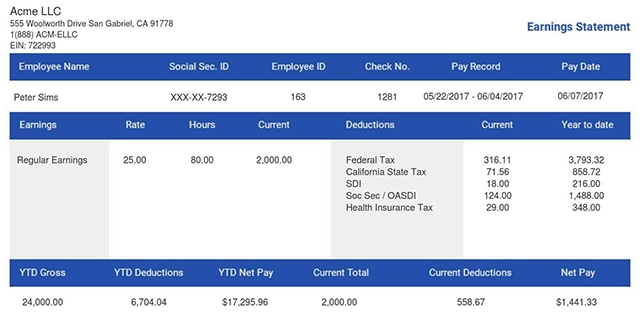
- 1. Enter Your Information

- 2. Select Your Favorite Theme

- 3. Download Your Stub!


 By