940 Tax Form Explained: FUTA Rules, Deadlines and Filing Steps for 2026
 By
The 940 tax form is the one federal payroll return most small employers file just once a year. It reports federal unemployment tax, a cost you pay on your own, never out of your workers' checks. For most businesses the bill is small, often $42 or less per person. Yet a missed form 940 can still bring penalties and interest, so accurate pay stubs and payroll records matter.
This guide covers who has to file, the dates for 2025 and 2026, how to fill out each part, and where to mail your return. If the 940 form is on your payroll checklist this winter, you'll know exactly what each line asks for by the end.
Key Takeaways
- Form 940 reports FUTA tax: 6.0% of the first $7,000 paid to each employee, usually cut to 0.6% by a state credit.
- File it if you paid $1,500 in wages in any quarter or had a worker in 20 or more weeks.
- The 2025 return was due February 2, 2026; the 2026 return is due February 1, 2027.
- Deposit FUTA tax through EFTPS any quarter your unpaid balance tops $500.
- What Is a 940 Tax Form?
- How FUTA Tax Works on Form 940
- Who Needs to File the 940 Tax Form?
- When Is Form 940 Due?
- How to Fill Out the 940 Tax Form
- Form 940 Schedule A and Credit Reduction States
- How to File Form 940 and Where to Mail It
- Form 940 and 941 vs 944: What's the Difference?
- How Pay Stub Records Support Your 940 Tax Form
- How to Amend a 940 Tax Form and Avoid Late Penalties
What Is a 940 Tax Form?
A 940 tax form is the IRS return employers file once a year to report federal unemployment (FUTA) tax. The tax is 6.0% of the first $7,000 you pay each employee, and most employers get a 5.4% credit for state unemployment tax, which leaves an effective rate of 0.6%, or $42 per worker.
Its full name is the Employer's Annual Federal Unemployment (FUTA) Tax Return. You'll also see it called federal form 940. IRS letters tend to say IRS form 940. Some payroll tools label it the FUTA form 940. They're all the same two-page return.
FUTA money pays for the federal side of unemployment benefits. Our guide to what FUTA tax is goes deeper on the tax itself. Your state runs its own program, funded by a separate state unemployment tax. So in plain terms, what is a form 940? It's your yearly report of how much of that federal tax you owed, what you already paid, and what's left to send.
Only the employer pays FUTA. That's the big difference between tax form 940 and returns that cover withheld income tax.
How FUTA Tax Works on Form 940

The math behind Form 940 is simple once you see the pieces.
- The wage base: FUTA applies only to the first $7,000 paid each employee in a calendar year. Pay above that isn't taxed.
- The tax rate: The gross rate is 6.0%.
- The SUTA tax credit: Pay your state unemployment tax in full and on time, and you can take a credit of up to 5.4%.
- The net rate: 6.0% minus 5.4% leaves 0.6%, so the most you'll usually owe is $42 per worker.
Here's a quick example. A café pays three employees $30,000 each this year. Only $7,000 per person counts, so FUTA wages are $21,000. At 0.6%, the total FUTA bill is $126.
Some payments don't count toward FUTA wages at all. The IRS lists section 125 cafeteria plan benefits, group-term life insurance, and employer contributions to qualified retirement plans as exempt. You subtract these on the payroll tax form 940 before you figure the tax.
Who Needs to File the 940 Tax Form?
You must file Form 940 if you paid $1,500 or more in wages in any calendar quarter, or had at least one employee for some part of a day in 20 or more different weeks, in the current or prior year. Household and farm employers follow separate thresholds.
Count every worker on payroll: full time, part time, and temporary. The 20 weeks don't need to be in a row. Picture a café that hires two summer servers. Once its payroll crosses $1,500 in one quarter, it has to file the 940 tax form for the full year.
A few groups follow other rules:
- Household employers: FUTA applies if you paid $1,000 or more in cash wages in any quarter. Most report it on Schedule H with their personal return instead.
- Farm employers: The test is $20,000 in cash wages in a quarter, or 10 or more farmworkers in 20 different weeks.
- Exempt employers: 501(c)(3) nonprofits and state or local government employers don't pay FUTA.
A sole proprietor with no employees doesn't file. Pay to independent contractors also doesn't count, since they aren't employees. Curious how their records differ? See whether contractors should get a pay stub.
When Is Form 940 Due?

Form 940 for 2025 was due February 2, 2026, or February 10, 2026 if you deposited all FUTA tax on time. The 2026 return is due February 1, 2027, because January 31 falls on a Sunday. FUTA deposits are due quarterly whenever your undeposited tax exceeds $500.
So when is form 940 due in a normal year? January 31 for the prior tax year, moved to the next business day on weekends and holidays.
People often search for a form 940 quarterly filing. There isn't one. You file the return once a year, but you may need to deposit the tax each quarter. Track your tax liability like this:
| If your unpaid FUTA tax is more than $500 on | Deposit it by |
|---|---|
| March 31 | April 30 |
| June 30 | July 31 |
| September 30 | October 31 |
| December 31 | January 31 |
If your balance is $500 or less, carry it into the next quarter. Make every deposit through EFTPS, the IRS's free electronic payment system. See how to pay the IRS with EFTPS step by step.
How to Fill Out the 940 Tax Form
The IRS posts a fillable form 940 PDF each year. You can type into it, print it, and sign. Keep the official form 940 instructions open as you go. Here's how to fill out form 940, one part at a time.
- Header: Enter your EIN (find your EIN if it isn't handy), legal name, trade name, and address. Check a box if this is an amended, successor, or final return.
- Part 1: Enter your state code if you paid unemployment tax in one state. Check the box for multiple states or a credit reduction state.
- Part 2: Report total payments to employees, subtract exempt pay and wages over $7,000, then multiply FUTA wages by 0.006.
- Part 3: Add adjustments, such as unpaid state tax or a credit reduction amount from Schedule A.
- Part 4: Compare total FUTA tax with deposits. Show a balance due or an overpayment.
- Part 5: If your yearly FUTA tax is over $500, list it by quarter.
- Parts 6 and 7: Name a third-party designee if you want one, then sign and date.
For a form 940 example, use the café above: $90,000 in Part 2 payments, $69,000 over the wage base, $21,000 in FUTA wages, and $126 in tax.
Common Mistakes to Avoid
- Counting contractor pay as wages.
- Skipping Schedule A when you paid wages in a second state.
- Mailing Form 940-V when you already paid through EFTPS.
Form 940 Schedule A and Credit Reduction States
Some states borrow federal money to pay unemployment claims. If a state doesn't repay on time, the U.S. Department of Labor names it a credit reduction state. Employers there get a smaller FUTA credit and owe more.
For 2025, the credit reduction states were California at 1.2% and the U.S. Virgin Islands at 4.5%. You'll report those wages on form 940 schedule a, which also covers employers who paid unemployment tax in more than one state.
Back to the café. If it's in California, it owes an extra $252 ($21,000 x 1.2%), for $378 in total. The 2026 list comes out after the November 10 repayment deadline.
How to File Form 940 and Where to Mail It
You have two ways to file. You can e-file through an IRS-approved provider or your payroll software, or you can mail a paper return.
Where to mail form 940 depends on your state and on whether a check is enclosed. The IRS lists every address on its where to file page for Form 940.
| Your situation | Mail to |
|---|---|
| No payment, eastern states (for example NY, NJ, PA, GA, IL, OH) | Department of the Treasury, Internal Revenue Service, Kansas City, MO 64999-0046 |
| No payment, western states (for example CA, TX, FL, AZ, WA) | Department of the Treasury, Internal Revenue Service, Ogden, UT 84201-0046 |
| Payment enclosed, any state | Internal Revenue Service, P.O. Box 932000, Louisville, KY 40293-2000 |
If you're wondering where to mail form 940 without payment because you paid online, use the Kansas City or Ogden address. Paid through EFTPS or by card? That counts as no payment enclosed. Only use the address for where to mail form 940 with payment if a check and Form 940-V are inside the envelope.
Form 940 and 941 vs 944: What's the Difference?
People mix up form 940 and 941 all the time. Here's how they compare with Form 944.
| Form | How often | What it covers | Who pays |
|---|---|---|---|
| 940 | Once a year | FUTA tax | Employer only |
| 941 | Every quarter | Withheld income tax, Social Security, and Medicare | Employer and employee |
| 944 | Once a year | Same taxes as 941 | Employer and employee |
Form 944 is only for very small employers the IRS has told to use it. If you file Form 940 and 944, that's just two federal payroll returns a year. Most businesses file the 940 together with four 941s. For the bigger picture, compare payroll tax vs income tax.
How Pay Stub Records Support Your 940 Tax Form
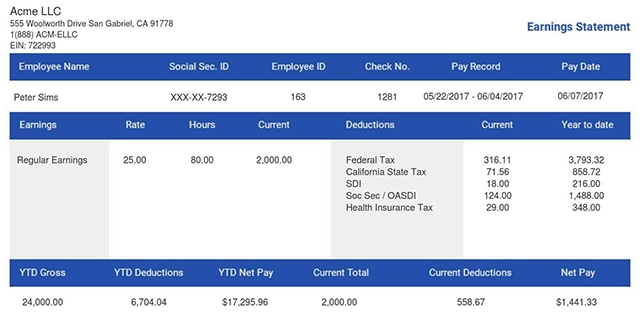
Every number on your 940 tax form starts with payroll records. The year-to-date gross on each pay stub shows when a worker crosses the $7,000 cap. Your total wages paid for the year feed Part 2.
Employees can learn something here too. FUTA never appears as a deduction on your pay stub, because your employer pays it alone. If a landlord or lender reviews your stubs, they'll see federal income tax, Social Security, and Medicare, but no FUTA line.
Small employers can prepare the return with our Form 940 generator once payroll totals are ready.
How to Amend a 940 Tax Form and Avoid Late Penalties
Found a mistake after filing? Use the form for that same year, check the "Amended" box, and attach a short explanation. Mail it to the no-payment address, even if you include a payment.
Late returns and late deposits carry separate penalties, plus interest. If you can't pay in full, the IRS offers an online installment plan when you owe $25,000 or less and can pay within 24 months.
You Might Also Like
- How to Calculate W-2 Wages From a Pay Stub
- Tax Withholding Explained
- Form 941-X: How to Correct a Quarterly Return
- Unemployment Taxes and the Small Business Owner
- W-2 Form Deadline
Conclusion
The 940 tax form is short once you know the pieces: a $7,000 wage base, a 0.6% net rate for most employers, quarterly deposits over $500, and one return each winter. Keep clean payroll records all year, and filing takes minutes.
Need accurate pay records for your team or proof of income for yourself? Use our paystub generator to create professional pay stubs with built-in tax calculations.
- 1. Enter Your Information

- 2. Select Your Favorite Theme

- 3. Download Your Stub!

 By