


Multi Member LLC: Taxes, Setup, and How Members Get Paid in 2026
 By
By
You and a business partner shook hands, filed some paperwork, and now you own a company together. That structure has a name. It's a multi member LLC, and the moment a second owner joined, your taxes and your paperwork both changed. One thing that never arrives is a paycheck. Many owners turn to a pay stub generator to document what they earn.
Most guides stop at the definition. This one keeps going. Here's what's covered: how the business is taxed and which forms you'll file. Then the three separate ways members actually get paid, and how to prove your income when no paycheck exists. Finally, what changes the first time you hire someone, plus the steps to set the whole thing up.
Key Takeaways
- A multi member LLC is any limited liability company with two or more owners, and the IRS taxes it as a partnership by default.
- The LLC files Form 1065 and issues a Schedule K-1 to every member, but the LLC itself pays no federal income tax.
- Members are not employees, so they receive guaranteed payments and distributions instead of a W-2 salary.
- Your share of profit is taxable even in a year when the business distributes no cash to you.
- What Is a Multi Member LLC?
- Multi Member LLC vs Other Business Structures
- How Multi Member LLC Taxes Work
- How Members Actually Get Paid
- How to Prove Your Income as a Member
- When Your Multi Member LLC Hires Employees
- How to Set Up an LLC With Multiple Owners
- Benefits and Drawbacks of a Multi Member LLC
What Is a Multi Member LLC?
A multi member LLC is a limited liability company with two or more owners, called members. The IRS treats it as a partnership by default, so the LLC files Form 1065 and issues each member a Schedule K-1. Members report their share of profit on their personal returns.
There's no ceiling on membership. Members can be individuals, corporations, other LLCs, or foreign investors. Can an LLC have two owners? Yes, and a 2 member LLC is by far the most common version of this. A 2 person LLC between two friends works the same way as one with fifteen members.
You'll see this structure written a dozen ways. A multi-member LLC, a multimember LLC, a multi owner LLC, a multiple member LLC, and a multi person LLC all describe the same business entity. Accountants often shorten it to MMLLC. None of these labels change your legal standing.
The limited liability part carries the most weight. Your personal assets sit behind a wall that business creditors generally can't reach. That protection holds as long as you keep business and personal finances genuinely separate.
Member-Managed vs Manager-Managed
You pick one of two governance models when you form the LLC, and the choice decides who can legally bind the business. In a member-managed LLC, every owner can act for the business and sign contracts. In a manager-managed LLC, the members appoint someone to run daily operations, and that manager can be an outside hire. Most small businesses pick member-managed because it needs no extra structure.
Multi Member LLC vs Other Business Structures

Picking a business structure comes down to five questions. This table answers them side by side.
| Feature | Multi Member LLC | Single Member LLC | General Partnership | LLC With S Corp Election |
|---|---|---|---|---|
| Number of owners | 2 or more | Exactly 1 | 2 or more | 1 or more |
| Default IRS form | Form 1065 | Schedule C | Form 1065 | Form 1120-S |
| Personal liability | Protected | Protected | Not protected | Protected |
| Self-employment tax | On your full share | On full profit | On full share | On salary only |
| How owners get paid | Guaranteed payments and distributions | Owner draws | Owner draws | W-2 salary plus distributions |
Liability is the gap that matters most. An LLC with 2 owners shields personal assets from business creditors. A general partnership doesn't, and that single difference is why almost nobody forms one deliberately anymore.
The S corporation column describes an election, not a separate kind of company. Your LLC keeps its legal form and only changes how the IRS taxes it. A limited liability partnership is a different entity again, and it's mostly limited to licensed professions like law and accounting.
Married couples get one special rule. Nine states use community property rules. There, spouses who jointly own an LLC may treat it as a single member LLC instead of a partnership. Everywhere else, a married couple counts as two members and files as a partnership.
How Multi Member LLC Taxes Work
The LLC itself pays no federal income tax. Profit passes through to the members, who report it on their personal returns. That's all pass-through taxation means. Pass-through owners may also qualify for the qualified business income deduction. It can cut up to 20% off taxable business income.
Multi member LLC tax filing runs on two documents. The LLC files Form 1065, the partnership return, which reports total income and expenses. It then issues each member a Schedule K-1 showing that member's share of profit, losses, and credits.
For the 2025 tax year, Form 1065 is due March 16, 2026. The usual March 15 date lands on a Sunday, so it rolls forward. Missing it gets expensive fast, because the penalty accrues per member, per month, for up to twelve months. A four member LLC that files three months late is penalized four times over for each of those months.
Knowing how to file a multi member LLC return matters even in a losing year. The return is required whether or not the business made money.
Self-Employment Tax
Your share of profit counts as self-employment income, so self-employment tax applies. The rate is 15.3%, which splits into 12.4% for Social Security and 2.9% for Medicare. The Social Security portion covers 2026 earnings up to $184,500, up from $176,100 in 2025. Medicare has no ceiling.
Changing Your Tax Classification
You aren't locked into partnership treatment. File Form 8832 to be taxed as a C corporation, or Form 2553 to elect S corporation status. The IRS publishes the full entity classification rules for LLCs. Most owners stay with the default until profit grows enough that payroll tax savings outweigh the added complexity.
How Members Actually Get Paid

Here's where most guides go quiet. "Profits pass through to the members" describes a tax result, not a payment method. Money actually leaves the business three different ways, and each one is treated differently.
Guaranteed Payments
A guaranteed payment is compensation for work, paid whether or not the LLC turns a profit. It's the closest thing to a salary a member can receive. The operating agreement sets the amount. The LLC deducts it as a business expense, and the member reports it as ordinary income subject to self-employment tax.
Distributions
A distribution is a share of profit paid out in cash. Nothing gets withheld, because the tax was already assessed on your allocated share. Distributions usually follow ownership percentage, though the operating agreement can split them another way.
Your Distributive Share
This is the one that catches people. Your distributive share is the slice of the LLC's profit assigned to you on your K-1. You owe tax on it whether or not that money ever reached your bank account.
Say your LLC earns $200,000 and you own half. You're taxed on $100,000. If the business reinvested every dollar into equipment, you still owe that tax out of pocket.
The fix is a tax distribution clause in your operating agreement. It forces the LLC to distribute enough cash each year to cover members' tax bills. Write it in on day one. Renegotiating later, when one member wants to reinvest and another needs cash, turns into a fight.
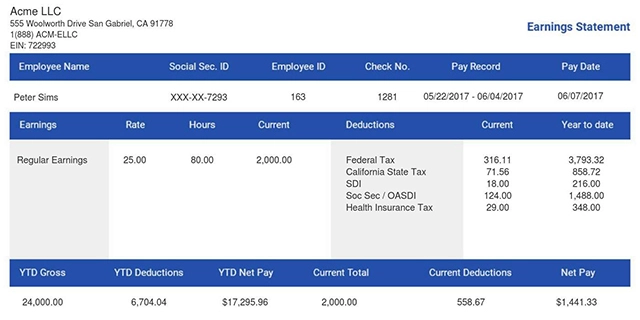
Notice what none of these produce: a pay stub. Members aren't employees, so there's no withholding and no W-2 at year end. The gap mirrors what 1099 contractors run into with pay stubs, even though the tax forms differ.
How to Prove Your Income as a Member
This catches new owners off guard. A landlord asks for recent pay stubs. A mortgage underwriter wants a W-2. The problem is the same one self-employed workers face when showing proof of income. You have neither, because you don't work for your own LLC in the employment sense.
Here's what works instead:
- Schedule K-1 reports your allocated share of profit for the tax year
- Form 1065 backs up that K-1 with the LLC's complete financial picture
- Bank statements document distributions that actually landed in your account
- A CPA letter confirms your ownership stake and typical monthly income
- Personal tax returns, usually the last two years, are what most lenders ask for first
The K-1 carries a timing problem. It arrives only after the LLC files, so last year's K-1 may not exist until March. Apply for an apartment in July and your newest K-1 is already stale by more than a year.
Two things change that picture. Some members take regular guaranteed payments on a fixed schedule, which creates a consistent monthly figure they can document. Others elect S corporation status, put themselves on payroll, and start receiving genuine pay stubs and a W-2 like any employee.
Running payroll for members or staff and need clean records? Our pay stub templates produce properly formatted stubs in minutes.
When Your Multi Member LLC Hires Employees
Hiring your first employee splits the business into two payment systems running side by side.
Members keep taking guaranteed payments and distributions with nothing withheld. Employees are handled completely differently. Classifying each worker correctly comes first, and the line between 1099 and W-2 workers decides everything downstream. For employees you withhold federal income tax, Social Security, and Medicare from every paycheck. You also pay the employer share of those payroll taxes. Each employee receives a pay stub every pay period and a W-2 in January. It helps to know how to read a W-2 properly before you start issuing them.
An EIN comes first. Most already hold one, since the IRS requires an employer identification number for any LLC taxed as a partnership. If yours doesn't have one yet, apply free through the IRS EIN application.
Register for state withholding and unemployment insurance too. Those sit separately from your federal registration and the rules vary by state.
One trap worth flagging: a member generally can't be a W-2 employee of the same LLC under default partnership treatment. Paying a member through payroll anyway creates a mess at filing time.
How to Set Up an LLC With Multiple Owners
The filing process barely differs from a single owner LLC. One step carries far more weight.
- Pick a business name. It has to be distinct in your state and carry an LLC designator. Check your Secretary of State's database before you commit.
- Appoint a registered agent. This is the person or service that accepts legal mail for you. They need a physical street address in the state.
- File articles of organization. This document legally creates the LLC. State filing fees commonly land between $50 and $500.
- Write an operating agreement. Most states don't require one, but skipping it leaves your state's default rules to settle anything you never wrote down.
- Get an EIN. It's free from the IRS and required once you have two or more owners. If you think the business already has one, here's how to find your EIN number.
- Handle ongoing compliance. Most states expect an annual report and a recurring fee.
The 50/50 Problem
A 50/50 split between two founders is both the most common setup and the most common failure. With no tiebreaker written down, one disagreement can freeze the company. Neither member can outvote the other.
Your operating agreement needs to answer specific questions. Who breaks a tie? What happens when a member wants out? How is the business valued if someone sells their stake? Can a member sell to an outsider without approval? Anyone working out how to start an LLC with two owners should settle all of this before the first dollar arrives.
Do You Still Need to File a BOI Report?
Probably not. FinCEN's interim final rule of March 21, 2025 removed beneficial ownership information reporting for companies formed in the United States. As of 2026, a domestic LLC and its members carry no BOI filing obligation. Foreign companies registered to do business here still report.
Benefits and Drawbacks of a Multi Member LLC
The upside:
- Liability protection keeps personal assets separate from business debts
- Profit splits don't have to match ownership percentages if your operating agreement says so
- Pass-through taxation avoids the double taxation a C corporation faces
- Adding members is simpler than issuing corporate stock
- Banks and clients take a registered business entity more seriously than a handshake
The downside:
- Self-employment tax applies to your entire share of profit
- Form 1065 is mandatory every year, even with zero income
- Shared control means major decisions need agreement
- One member's actions can legally bind the whole business
- Some states charge franchise taxes or annual fees that scale with revenue
You Might Also Like
- How to Create a Self-Employed Pay Stub
- Proof of Income Documents: 6 Times You'll Need a Pay Stub
- W-2 vs 1099: Filing Taxes When You Have Both
- Should Independent Contractors Receive a 1099 Pay Stub?
- EIN Lookup: How to Track Down a Business EIN
Conclusion
A multi member LLC gives two or more owners real liability protection without corporate formality. The tradeoffs are a partnership return every year, self-employment tax on your full share, and decisions that need agreement. Get the operating agreement right, especially the tax distribution clause and the tiebreaker, and most of these problems never surface.
The part nobody warns you about is documentation. Members don't receive pay stubs, which makes proving income harder than it should be. If you're running payroll for employees, or you elected S corp status and put members on the books, a reliable paystub generator creates professional pay stubs in minutes.
- 1. Enter Your Information

- 2. Select Your Favorite Theme

- 3. Download Your Stub!


 By
By