

The 8 Best Payroll Software Programs of 2026: Price, Tax Forms and Pay Stubs Compared
 By
James Wilson
By
James Wilson Choosing the best payroll software used to mean picking whichever brand your accountant already knew. In 2026 the choice is harder and the stakes are higher. Prices have crept up. Several big providers have stopped posting rates at all. And the IRS now makes most employers e-file their tax forms once they hit ten of them. If you landed here needing a single pay stub rather than a payroll platform, ThePayStubs solves that directly, and we come back to it at the end.
We rebuilt this guide from scratch for small business buyers. Every price below was read off the vendor's own pricing page in August 2026. None of it was copied from another review site. Where a firm will not publish a number, we say so instead of making one up. You will get a side by side table, the four types of payroll software, and a plain walk through of a real payroll run. You also get one thing almost no other list covers. That is how each tool gets a pay stub to the person who earned it.
Key Takeaways
- Published 2026 base prices for the best payroll software range from $17 a month (Patriot Basic) to $180 a month (Gusto Premium), plus a per-employee fee of $4 to $22.
- ADP, Paychex and Rippling publish no pricing at all in 2026. Any article quoting a specific ADP or Paychex rate is repeating a stale third-party number.
- The most expensive mistake is buying a plan that does not file your taxes. Patriot Basic Payroll at $17 a month is DIY, while Full Service at $37 a month actually files.
- QuickBooks retired the Payroll Core, Premium and Elite names. The 2026 tiers are Workforce Payroll, Workforce Premium and Workforce Elite.
- If you only need a pay stub and do not run a payroll, a payroll subscription is the wrong purchase.
- The 8 Best Payroll Software Programs of 2026 at a Glance
- What Is Payroll Software and How Does It Work?
- The 4 Types of Payroll Software
- How We Picked the Best Payroll Software
- The 8 Best Payroll Software Programs of 2026
- Best Payroll Software for Pay Stubs and Employee Self-Service
- Which Payroll Software Files W-2, 1099 and 941 Forms?
- What Payroll Software Actually Costs in 2026
- Payroll Software for the Self-Employed and Contractors
- How to Choose the Best Payroll Software for Your Business
- How to Set Up and Run Payroll Software Step by Step
- What to Do When You Need a Pay Stub Right Now
- Conclusion: Choosing the Best Payroll Software in 2026
The 8 Best Payroll Software Programs of 2026 at a Glance
Here is the shortlist for 2026. "Quote only" means the firm does not publish a price. That is worth knowing when you plan a budget.
| Payroll software | Best for | 2026 base price | Per employee | Employee pay stub access |
|---|---|---|---|---|
| Gusto | Best overall for small business | $49/mo (Simple) | $6/mo | Employee app, no stub claim published |
| OnPay | Flat, transparent pricing | $49/mo | $6/mo | Pay stubs in the app |
| QuickBooks Payroll | QuickBooks accounting users | $50/mo (Workforce Payroll) | $7/mo | Portal with pay stubs and W-2s |
| Patriot Software | Budget and DIY payroll | $17/mo (Basic), $37/mo (Full Service) | $4 to $5/mo | Free employee portal |
| ADP RUN | Scaling and compliance depth | Quote only | Quote only | Employee Access, 3 years of forms |
| Paychex Flex | Bundled HR and payroll | Quote only | Quote only | Mobile self-service |
| Square Payroll | Retail and restaurants | $35/mo | $6/mo | Digital pay stubs, Team App |
| Wave Payroll | Very small teams | $40/mo | $6/mo | Portal with pay stubs and W-2s |
All figures verified against each vendor's official pricing page on August 25, 2026. Promotional discounts are excluded because they expire. Below we break down what each of the best payroll software options actually does for the money.
What Is Payroll Software and How Does It Work?

Payroll software calculates employee pay, withholds federal, state and local taxes, pays workers by direct deposit and files payroll tax forms. You enter hours or salary, the system applies current tax rates such as 6.2% Social Security and 1.45% Medicare, then issues pay stubs and remits withholdings to the IRS.
That short answer hides a lot of moving parts. A payroll system has to know when to stop taking out Social Security. That happens once a worker passes the yearly wage base, which is $184,500 for 2026. Medicare has no cap at all, so it applies to every dollar. It also has to add the extra 0.9% Medicare tax once a worker passes $200,000 in wages for the year. Filing status does not change that. And it must keep taking it out for the rest of the year.
Now add state rules, local rules, wage garnishments, benefit deductions and retirement plans. It is easy to see why a spreadsheet goes wrong. The abbreviations that end up on the finished stub are their own small language, which we break down in our guide to payroll codes. In fiscal year 2024 the IRS charged about 4.4 million civil penalties on employment taxes, worth roughly $26.8 billion. Most were not fraud. They were late deposits and filing slips. That is the exact kind of mistake automated payroll software is built to stop.
The 4 Types of Payroll Software
Before you compare brands it helps to know which category you are shopping in. Buyers often waste time weighing the best payroll software against tools that are not really competitors, so start with the type.
1. Full-service cloud payroll. This is cloud payroll software that works out pay, then files and deposits your payroll taxes. It also takes on the risk if a filing is wrong. Gusto, OnPay, Square and Patriot Full Service sit here. Tax tables update on their own, so this is also what people mean by payroll automation software. It is what most small firms should buy.
2. DIY or self-service payroll. This is often searched as do it yourself payroll software. These payroll programs do the math and move the money. You still file your own federal and state returns. Patriot Basic Payroll is the clearest example. It is genuinely cheaper, and genuinely riskier if you are not already comfortable with Form 941.
3. Payroll bundled into a bigger HR or accounting platform. Here payroll is one module beside benefits, onboarding, time tracking and devices. ADP, Paychex, Rippling and QuickBooks all sell this way. Most accounting and payroll software sits in this group. So does enterprise payroll software built for large staff counts. It also covers payroll software for accountants who keep books for many client firms. You buy the platform and payroll comes with it. That is why several of them quote in private rather than list a price.
4. Desktop and on-premise payroll. Software you install and run on your own machine. It still exists, and people still search for computer software payroll and desktop payroll software. But the group is shrinking. Tax tables change often, and cloud tools update themselves. If you want simple payroll software that stays current on its own, stay in the cloud.
There is a fifth thing people often mean by payroll tools. It is not payroll software at all. It is a pay stub generator, which makes one document without running a payroll. We cover when that is the right choice further down.
How We Picked the Best Payroll Software

Three rules shaped this list.
First, pricing came from the source. Every dollar figure came off the vendor's own pricing page in August 2026. None came from pooled payroll software reviews. This matters more than it sounds. While writing this guide we found one tool listed at two different base prices by two published comparisons. They were quoting different plans without saying so. Where a payroll software company posts nothing, we report quote only.
Second, tax filing was treated as a feature, not an assumption. Several tools that look cheap are cheap precisely because they do not file anything.
Third, we scored pay stub delivery. Nearly every other ranking of top payroll software leaves this out. Payroll really ends when the worker can see what they were paid and prove it to a landlord or lender. That is the part ThePayStubs deals with every day. It is also the part most comparison articles skip.
The 8 Best Payroll Software Programs of 2026
Each review below states only what the vendor itself publishes. That way you can see where the best payroll software picks differ on price, filing and stub access.
1. Gusto: Best Overall Payroll Software for Small Business
Of every tool here, Gusto payroll software turns up on almost every shortlist. For once that is deserved. It covers the whole job for a small employer: pay runs, direct deposit, benefits, onboarding and year-end forms.
On filing, Gusto is clear. It files federal, state and local payroll tax forms for you. It names Form W-2, Form 1099, Form 940, Form 941 and Form 8974 among them. You can e-file, e-sign and store those forms from your account.
2026 pricing is public and tiered. Simple is $49 a month plus $6 per person. Plus is $80 a month plus $12 per person. Premium is $180 a month plus $22 per person. There is also a Contractor Only plan at $35 a month plus $6 per contractor. That is a useful middle step for a startup with no W-2 hires yet.
One honest catch. Gusto's pricing page sells an employee app. But it never says staff can view pay stubs there, so we will not claim it does. If stub access is your deciding point, the tools below are clearer.
Best for: small businesses that want one system for payroll, benefits and HR.
2. OnPay: Best Flat Pricing in Payroll Software
OnPay does something rare among payroll software companies. It charges one price for everything. That is $49 a month plus $6 per worker, with no tiers to climb. A five-person business pays $79 a month. One employee costs $55.
What sits inside that one price is the good part. W-2s, 1099s and year-end filings are included. So are federal, state and local tax filings. You can pay workers in as many states as you need. Pay runs and schedules are unlimited. OnPay charges no setup or hook-up fees, and setup and data moves are free. New customers get one month free.
On pay stubs, OnPay is direct. Staff get pay stubs right in the app. They can also download W-2s and 1099s from the same place.
Best for: businesses that want predictable payroll software costs with no upgrade path and no surprise fees.
3. QuickBooks Payroll: Best Payroll Software for QuickBooks Users
Do your books already live in QuickBooks? Then this is the easy path. It also answers a very common question: can you just use QuickBooks for payroll? You can, and you can buy it on its own.
Watch out for a 2026 name change that trips up older articles. The Payroll Core, Payroll Premium and Payroll Elite names are gone. Today the tiers are Workforce Payroll at $50 a month plus $7 per employee. Then Workforce Premium at $88 a month plus $13 per employee. And Workforce Elite at $134 a month plus $17 per employee.
There is a second trap, and it catches plenty of best payroll software shoppers. Intuit's main pricing page now shows payroll and accounting bundles. Those start higher because they include QuickBooks Online. Bundle prices are not payroll prices. If you only want payroll, look for the stand-alone option.
On staff access, QuickBooks is one of the clearest here. Your team can open their pay stubs and W-2s. They can also enter personal, direct deposit and tax details online or in the app. Tax penalty cover, which pays back IRS penalties up to a set yearly cap, is Elite tier only.
Best for: current QuickBooks accounting users. It also suits anyone who wants accounting apps with payroll features behind one login.
4. Patriot Software: Best Budget and DIY Payroll Software
Patriot is the cheapest credible option here, and also the one where you most need to read carefully, because the two plans do fundamentally different jobs. No other entry among the best payroll software we compared has such a wide gap between its cheap tier and its useful one.
Basic Payroll is $17 a month plus $4 per worker paid. It runs payroll, handles direct deposit and gives staff a portal. But it does not file or deposit your payroll taxes. You do that yourself.
Full Service Payroll is $37 a month plus $5 per worker paid. It adds federal, state and local tax filings and deposits. It also sends your 940, 941, W-2 and W-3 data to the right agencies at no extra fee.
That $20 a month gap is the line between software that helps you and software that answers for you. For most owners, Full Service is the right buy.
Two details to budget for. Full Service charges $12 for each extra state it files in, so do the math if you cross state lines. And 1099 e-filing costs a small fee on Basic Payroll. On the plus side, you are billed after the fact. In months with no payroll, you pay only the base price.
Patriot's staff portal is free on both plans. Workers get safe access to pay stubs, pay history, time off balances and electronic W-2s.
Best for: small employers watching every dollar. It is also the pick for confident filers who want cheap payroll software and do not mind the paperwork.
5. ADP RUN: Best Payroll Software for Scaling and Compliance
ADP is the old guard of enterprise payroll software, and RUN is its small business product. The depth is real. It works out taxes, files them, deposits them and squares the books. ADP also covers fines that come from its own filing errors.
The RUN lineup today is Essential Payroll, Enhanced Payroll, Complete Payroll and HR Plus, plus HR Pro Payroll and HR. Here is the part most comparisons leave out. ADP publishes no prices. Every price slot on its packages page is a "Get pricing" button. It opens a form that asks how many staff you have. ADP does explain the logic. Price depends on how often you run payroll, how many people you pay, and how often you add or drop them. Add-on services change the total too.
So if you see a firm ADP monthly rate quoted somewhere, treat it as an outside guess. It is not a published price. No honest best payroll software comparison should present it as one.
Two more points. ADP makes, sends and e-files your W-2 and 1099 forms, but it notes this carries an extra fee. And ADP Employee Access lets staff view pay history plus up to three years of W-2s and 1099s. They can also switch to paperless pay statements. That is one of the deepest self-service records here.
Best for: firms that expect to grow past the small business tier, or that need heavy duty compliance help.
6. Paychex Flex: Best for Bundled HR and Payroll Software
Paychex goes head to head with ADP and follows the same sales pattern. Its payroll lineup is Paychex Flex Select, Paychex Flex Pro and Paychex Flex Enterprise. Above those sit HR Pro and HR PEO. Those suit firms that want HR advice, benefits, compliance and risk cover in one contract.
Like ADP, Paychex publishes no pricing. Every plan card carries a "Request Pricing" button. Let us be blunt here. A widely shared figure of about $39 a month plus $5 per employee for a "Paychex Flex Essentials" tier is not on the current page. Essentials is not even a current tier. We will not print a number Paychex does not stand behind.
On the product, taxes run through Taxpay. That service works out, pays and files payroll taxes with the right agencies. Staff sign up for a Paychex Flex account. From there they can view pay and tax details on mobile.
Best for: firms that want payroll, HR advice and benefits from one known provider, and do not mind a sales call.
7. Square Payroll: Best Payroll Software for Retail and Restaurants
Do you already take payments on Square? Then payroll programs that share the same system save real time. That is most true for tipped and hourly staff, whose hours flow in from the register.
Pricing is public and simple. Full-service payroll is $35 a month plus $6 per person paid. Contractor-only payroll drops the base fee to zero and costs $6 per person paid per month. That makes Square one of the cheapest honest ways to pay a few 1099 contractors.
Square is clear about stubs. Digital pay stubs are included, and so is the Square Team App. Both plans send W-2s and 1099s online. A $3 per person yearly fee applies only if you choose mailed paper copies.
Best for: retail, restaurants, and any business already running Square POS.
8. Wave Payroll: Best Payroll Software for Very Small Teams
Wave is built around solo operators and very small businesses, and its pricing reflects that: $40 a month base, plus $6 per active employee and $6 per independent contractor paid. For a one or two person operation it is among the better value best payroll software options on this list.
One key 2026 update. Wave used to charge different rates based on whether your state was a tax-service state or a self-service state. Many older articles still repeat that split. It is gone. Wave now runs its tax service in all 50 states, so pricing is the same everywhere. There is a 30-day free trial.
Wave gives staff a built-in portal. They can log in safely to open pay stubs and W-2s, and update their contact and bank details.
Best for: solo owners and very small teams who want simple payroll software next to free accounting.
Best Payroll Software for Pay Stubs and Employee Self-Service
Almost every comparison of the best payroll software ranks tools on price, tax filing and add-ons, then stops. But that skips the moment payroll matters most to the person being paid. That is opening an app to see where the money went. Or needing a stub fast because a landlord asked for one. If what you want is the best software for paystubs, the ranking changes.
It pays to be exact about what each vendor promises, because the gaps are real:
| Payroll software | What the vendor states about employee stub access |
|---|---|
| Patriot Software | Free employee portal with pay stubs, pay history, time off balances and electronic W-2s, on both plans |
| Square Payroll | Digital pay stubs included, plus the Square Team App |
| Wave Payroll | Portal to access pay stubs and W-2s and manage contact and banking details |
| OnPay | Pay stubs in the app, with W-2 and 1099 downloads |
| QuickBooks Payroll | Portal for pay stubs and W-2s, online or in app |
| ADP RUN | Pay history plus up to three years of W-2s and 1099s, with paperless pay statements |
| Paychex Flex | Mobile account to view pay and tax information |
| Gusto | Employee app included, but no pay stub statement published |
Two practical points follow from this table.
For employers: self-service is not a soft perk. It is a support cost. Every ask for a replacement stub or a new W-2 is a job somebody does by hand. Tools with a real portal remove that work. They also cover you when a past employee needs papers months after leaving. ADP's three-year window is the strongest promise here.
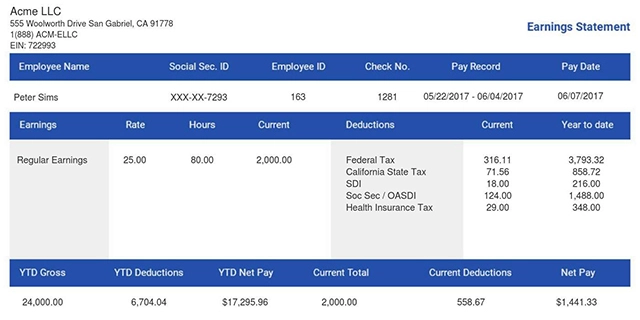
For workers: a pay stub is proof of income. You use it for flat rentals, mortgage and car loan approvals, and benefit claims. A stub that gets accepted has to show more than a net figure. It should name the employer and the worker. It should give the pay period and pay date. It should split out gross pay, list each deduction, and show year to date totals. That last one is where thin stubs fail. A lender wants the YTD column to prove the income is steady, not one good week.
If your employer's payroll system has a portal, start there. Paid by direct deposit? There are several ways to get a pay stub from direct deposit. If there is no portal at all, you still need a document with the same details. It helps to know what a pay stub looks like before you make one.
Which Payroll Software Files W-2, 1099 and 941 Forms?
Gusto, OnPay, Patriot Full Service, Square and Wave all file year-end forms. OnPay includes W-2s and 1099s at no extra cost, Patriot Full Service submits 940, 941, W-2 and W-3 free, and ADP charges an additional fee for W-2 and 1099 forms. Patriot Basic does not file taxes at all.
"Does it handle taxes" is the vaguest question in payroll software shopping. Here is what to check before you pick the best payroll software for your filing needs.
Ask which forms are included. Form 941 is your quarterly federal return. Form 940 is yearly federal unemployment. W-2 and W-3 are the year-end staff filings. Form 1099-NEC covers contractors. Want to know what staff will see on the form? Our guide on how to read a W-2 goes box by box. We also have a guide to filling out a 1099-MISC. A tool can fairly say it "handles payroll taxes" and still charge extra for year-end forms.
Ask if filing is included or billed on its own. ADP says plainly that it makes, sends and e-files W-2 and 1099 forms for an extra fee. Patriot gives year-end filings free on Full Service, but charges a small 1099 e-file fee on Basic. OnPay throws them in.
Check the deadlines you are buying cover against. For the 2026 tax year, you must give W-2 copies to staff and file Copy A with the Social Security Administration by February 1, 2027. That date is the same on paper or online. If a worker asks for a copy of their W-2, you have 30 days from the request or 30 days from the final wage payment, whichever is later.
Check whether you must e-file. Filing 10 or more information returns? Then you must file online unless the IRS grants a waiver. The count adds up across form types, W-2s included. That limit catches far more small firms than the old 250-form rule. It is a good reason to let payroll software send them rather than mail paper.
What Payroll Software Actually Costs in 2026
The headline "starts at" number means little. Nearly all payroll software charges a monthly base fee plus a per-employee fee. Your real payroll software cost comes down to headcount.
Using published 2026 rates, here is the real monthly cost at two common team sizes:
| Payroll software | 1 employee | 5 employees | 15 employees |
|---|---|---|---|
| Patriot Basic | $21 | $37 | $77 |
| Patriot Full Service | $42 | $62 | $112 |
| Square Payroll | $41 | $65 | $125 |
| Wave Payroll | $46 | $70 | $130 |
| Gusto Simple | $55 | $79 | $139 |
| OnPay | $55 | $79 | $139 |
| QuickBooks Workforce Payroll | $57 | $85 | $155 |
ADP, Paychex and Rippling are missing from this table for one reason. They do not publish rates. Any figure we put in those rows would be a guess.
Three cost traps to watch. Add-ons stack fast. Time and attendance, HR support and faster pay runs are usually priced on their own. Multi-state filing can carry its own fee, as with Patriot's $12 per extra state. And promo pricing runs out. The discount that made a tool look cheap in month one is not what you pay in month seven. Where vendors ran promos during our research, we used list price above. The best payroll software for your budget is the one that stays cheap after the intro deal ends.
Payroll Software for the Self-Employed and Contractors
Every list of the best payroll software quietly assumes you have staff. Plenty of people who search for payroll software do not. The honest answer for them is different.
If you are a sole proprietor or a single-member LLC, you are usually not on payroll at all. You take owner draws, not a paycheck. There is no withholding to work out. Buying payroll software here solves a problem you do not have. What you need is a way to show income to the IRS, lenders or landlords.
If you run an S corporation, the picture flips. The IRS expects fair pay to owner-employees as W-2 wages. That means real withholding, real quarterly filings and real W-2s. This is where a one-employee payroll plan earns its keep. The one-employee costs in the table above are the numbers to compare.
If you pay contractors rather than staff, you do not need full payroll. You need payroll software for contractors. Square's contractor-only payroll has no base fee and costs $6 per person paid per month. Gusto's Contractor Only plan is $35 a month plus $6 per contractor. Both file 1099s. That beats a full payroll plan you would only half use. It is also the usual start point for payroll software for startups that lean on freelancers before the first W-2 hire.
If you are the contractor, nobody makes your pay papers for you. That becomes your problem the moment someone asks you to prove income. It is worth knowing whether independent contractors should receive a pay stub at all. Freelancers get asked for proof of income all the time. Bank statements alone often get turned down, because they show deposits without showing what the deposits were for.
How to Choose the Best Payroll Software for Your Business
No single best software for payroll fits every business. Work through these in order. The order matters, because getting question one wrong makes the rest moot.
1. Do you need filing, or just the math? This fork decides everything else. Full-service payroll files and deposits your taxes. It also answers for getting it right. DIY payroll hands you the numbers and leaves filing to you. If nobody at your firm is at ease with Form 941 deadlines, do not buy a DIY plan to save $20 a month.
2. Count your real headcount, contractors included. Per-employee fees mean a 15-person team can pay triple what a 5-person team pays on the same plan. Run the math at your true size, not at the ad price.
3. Count your states. Multi-state payroll is where cheap plans get costly. Check if your provider charges per extra state. Ask whether it signs you up in new states or leaves that to you.
4. Decide how staff get paid and get their stubs. Direct deposit timing varies by provider. Faster funding is often a paid add-on. Check what the staff portal includes. Ask whether past staff keep access to old W-2s.
5. Check the tools you already depend on. If you keep books in one accounting system, payroll that writes to it saves real time at month end. That is the strongest case for QuickBooks payroll software in an Intuit shop. It is also why accounting apps with payroll features appeal to owners who keep their own books. Combined accounting and payroll software sells on the same promise.
6. Ask about hidden and year-end fees. Year-end form fees, extra state fees, paper copy fees and off-cycle pay run fees are all common. They rarely show up in the headline price.
7. Pressure test support. Payroll problems are urgent by nature, because people must be paid on a set day. Find out if support is chat only. Ask if phone help costs extra. Check the hours against your payday. Answer those seven and the best payroll software for your business usually picks itself.
How to Set Up and Run Payroll Software Step by Step
Even the best payroll software needs setup before the first run. That first run is the hard one. After that it is mostly review and approve.
Step 1: Sign up and gather your ID numbers. You need your federal Employer Identification Number. You also need your state withholding and jobless-tax account numbers. No state accounts yet? Get them first, because filing setup depends on them.
Step 2: Add your company and pay schedule. Pick weekly, every two weeks, twice a month or monthly. How often you pay drives your deposit dates. It is hard to change later, so choose with care.
Step 3: Add staff and collect their forms. Each worker needs a filled-in Form W-4 for federal withholding, plus any state version. They also need an I-9 to prove they can work. Contractors need a W-9 instead. Most payroll software sends these out to be signed online.
Step 4: Enter pay and deductions. Add the salary or hourly rate. Add benefit deductions, retirement plans and any wage garnishments. Care pays off here. A slip repeats every pay period until someone spots it.
Step 5: Link and confirm your bank account. Checks usually take a couple of work days. Do not leave this to the day before payday.
Step 6: Run a preview and read it. Every good payroll system shows gross pay, each tax, each deduction and net pay before you commit. Check that Social Security has stopped for anyone above the wage base. Check that new hires have the right withholding.
Step 7: Approve, then check the filings. Approving the run sends the direct deposits. On a full-service plan it also queues the tax deposits and filings. After your first quarter, log in and confirm the 941 was filed. Trust the system, but check it once.
What to Do When You Need a Pay Stub Right Now
Sometimes the problem is not picking payroll software. It is that a leasing office wants two recent pay stubs by Friday and you have none.
That happens more than you would think. You might be self-employed with no payroll system at all. You might have just changed jobs and be stuck between two employers. You might be a small employer still setting up a payroll platform, with someone to pay this week. In each case, buying and setting up a full payroll plan will not meet a Friday deadline.
For those cases, ThePayStubs makes a clean, correctly laid out pay stub in minutes. You enter the employer and worker details, the pay period, the earnings and the deductions. The calculator does the math. It returns a document with gross pay, listed deductions, net pay and year to date totals. Those are the fields lenders and landlords look for. You can create a pay stub and download it at once. That matters most when the document goes straight into an application, as our guide to pay stubs for loan applications explains.
Let us be clear about what this is and is not. A stub generator records pay. It does not run payroll. It does not withhold or send taxes to the IRS. It does not file your 941 or your W-2s. If you have staff on an ongoing basis, you need one of the payroll platforms above. But for a one-off document, a gap between systems, or a self-employed worker who needs proof of income, it solves the real problem with no monthly plan.
Conclusion: Choosing the Best Payroll Software in 2026
For most small firms in 2026, the best payroll software for small business use is Gusto. That is the pick if you want depth across payroll, benefits and HR. Prefer one flat, steady price with year-end filings included? Choose OnPay. Patriot Full Service is the value pick at $37 a month plus $5 per worker. Patriot Basic is right only if you truly plan to file your own returns. Square fits if you are already on Square. Wave suits the smallest teams. QuickBooks is the clear choice if your books already live there. ADP and Paychex stay strong for firms that expect to grow, as long as you accept that you must ask for a quote.
Whichever best payroll software you pick, remember what payroll is for. Tax filing keeps you on the right side of the IRS. But the pay stub is what your staff use to rent a flat, finance a car or prove income. Need one of those today? You can build one from a ThePayStubs pay stub template in minutes, with no payroll plan needed.
You Might Also Like
- 1. Enter Your Information

- 2. Select Your Favorite Theme

- 3. Download Your Stub!

 By
By