

Negative PTO Balance Explained: Laws, Risks & Policies (2026)
 By
By
Every HR manager and small business owner can face a difficult situation when an employee needs a week or some time off but has not yet earned enough PTO to take it. Time off can be advanced to PTO-earning employees, and this is known as a negative PTO balance or PTO advance.
It’s a common practice and one that employees greatly appreciate. However, there are many legal issues associated with negative PTO balances, and using a paystub generator to track both the time advanced to employees and the time repaid is strongly advised in order to protect both the employer and the employees.
In this article, we’re going to explain the negative PTO balance, what it is, and how you can apply it. We’ll cover the circumstances under which you would allow your employee to take an unearned negative PTO balance, as well as ways the employee can repay the hours.
We will discuss the details of the written employee consent policy. You'll learn what to do when an employee leaves work with hours of unearned paid leave outstanding.
Key Takeaways
- A negative PTO balance is a paid time off or salary advance of unearned PTO that an employee takes before they have earned those hours.
- No federal law requires you to allow it. It’s a voluntary policy decision.
- Always obtain written approval from the employee before allowing them to take an unearned negative PTO balance.
- Recovering unearned PTO from an employee’s pay or final paycheck can get complicated and is subject to federal and state wage laws.
- California and several other states restrict the repayment of unearned PTO through wage deductions.
- Key Takeaways
- What Is Negative PTO?
- How Is the PTO Balance Calculated?
- Do Employers Have To Allow Negative PTO?
- How To Write a Negative PTO Policy
- How Can Employees Repay the PTO Balance?
- Repaying the Advance: Withholding From Future Accruals of PTO
- How To Handle PTO Deductions for Exempt and Non-Exempt Employees
- State Laws That Restrict PTO Balance Deductions
- Tips To Avoid PTO Balance Issues
- You Might Also Like
- Conclusion
What Is Negative PTO?
Negative PTO is a term used when an employee takes paid time off (PTO) prior to earning it. Payment of unearned PTO is essentially a loan from the employer to the employee that must be repaid, either by taking PTO from subsequent accruals or by cash repayment by the employee. Federal law does not require or prohibit an employer from allowing employees to take unearned PTO. It is a matter of employer policy.
Allowing employees to take unearned PTO is another way employers can extend a short-term salary loan. Such advances are particularly helpful for employees who have a family member become ill, or who fall ill themselves, at a time when they don’t have sufficient PTO hours available. The loan would be repaid by deducting hours from the employee’s future accrued PTO.
As mentioned above, no federal law requires an employer to provide PTO to employees. However, once an employer offers PTO, the employee can use it as they wish, unless the PTO policy restricts that use in some way. Employees on an accrual model of PTO (as opposed to a front-loaded model) do not have PTO hours available to take until they have accrued them.
Similar issues can exist for employers who grant front-loaded PTO. For example, an employee may be granted their entire annual PTO bank on January 1, use it all in the first month, and then quit the following month.
The problem faced by the employer in this scenario is the attempt to recoup PTO that the employee was not entitled to. However, the rules and methods to recover PTO in these instances are different from those for an employee with a negative PTO balance as described above.
The hours of paid time off an employee takes before earning them are essentially a small, interest-free loan. If the employee were to leave the company while still holding unearned PTO hours, the employer would generally be able to recoup the unearned hours that had been advanced.
How Is the PTO Balance Calculated?

A negative PTO balance is computed by taking the number of PTO hours an employee uses for time off and subtracting the hours the employee had accrued prior to taking the time off. For example, if an employee had 6 hours of PTO accrued and then took a 16-hour vacation, the employee would have a negative 10 hours of PTO. At an hourly rate of $25, that means the employee effectively owes $250 in unearned PTO. The 10-hour deficit would then need to be repaid through future PTO accruals.
The dollar amount of unearned PTO is simply the number of unearned PTO hours multiplied by the employee’s hourly wage. For example, an employee who earns $22 per hour and has 8 hours of unearned PTO would have $176 of unearned paid leave.
PTO accruals are based on hours worked. Typically, an employee earns 1 hour of PTO for every 20 hours worked. In the example above, if the employee worked 240 hours over 6 weeks at that accrual rate, they would have accrued 12 hours of PTO. So, if they had taken 20 hours of PTO for a vacation, they would end up with a negative 8 hours in their PTO bank.
This would leave the employee with roughly $176 worth of unearned PTO. For more on calculating wages, see our article on how to calculate your hourly, weekly, and monthly income.
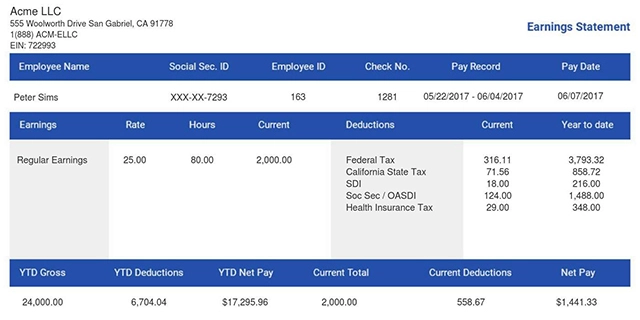
Advances of unused PTO hours are treated by the employer as a loan, which the employee repays by giving up subsequent PTO accruals or by having the unearned PTO deducted from their PTO bank. The balance of unearned hours is then shown on the employee’s pay stubs as a negative number in the PTO Accruals column.
In short, advanced PTO is different from front-loading PTO. Front-loading means granting an employee a full year of PTO at the beginning of the year. If that employee uses all of their PTO in the first month and then quits the following month, the employer is left trying to recover unearned PTO. However, that scenario is a separate issue from how a negative PTO balance arises.
Do Employers Have To Allow Negative PTO?
No. Allowing a negative accrual balance is entirely optional. Most employers do offer PTO as part of an employee benefit package, that is, paid leave that employees can use for rest and recreation. To offer PTO at all, you’ll first need a written PTO policy that clearly defines accrual terms. Each employee should receive a copy of the policy in writing and acknowledge it by signing and dating a receipt indicating they’ve read and agree to the terms.
Two things need to be considered when deciding whether to allow a negative balance.
- The goodwill it can build with employees: Most employees feel positively about being allowed to take time off before they’ve earned it. It shows trust, and they’ll appreciate the option.
- The business risk: If the employee leaves the company before working off the hours owed, recovery can be difficult.
Offering paid time off in advance of accrual is generally seen as a very positive employee benefit and can give prospective employees a favorable impression of the company.
On the downside, unpaid PTO advances can create problems for employers. For example, when an employee quits, it can be difficult to recover PTO that wasn’t earned. In many states, unused or unearned PTO can be deducted from an employee’s final paycheck, provided that the employee was given written notice prior to the deduction stating;
- The amount to be deducted
- The reason for the deduction
A Note for Small Business Owners
While informal PTO “borrowing” is common in many small businesses, allowing it without documentation can lead to legal issues. For example, trying to recover unearned paid leave from an employee’s final paycheck at termination could be unlawful in your state.
Many states allow unearned paid leave to be deducted from a final check, provided the employee was given prior written notice of the amount to be deducted. Without a written policy in place, there’s no basis for the deduction, and it could result in fines from your state labor board or wage claims in court.
If you’ve advanced time off to an employee and you expect repayment but never had the employee sign a written PTO policy, you may not have a basis to collect any unrepaid leave from that employee’s final wages. This is true even in states that generally allow such deductions.
Prior written notice of an employer’s intention to make such a deduction is essentially required across the board. Distributing your PTO policy before any advance of leave is made satisfies that prior-notice requirement, as long as the advance is then made in accordance with the terms of that policy.
For very small businesses where a formal PTO accrual policy is too cumbersome to administer, a simple paid-holiday model (a fixed number of paid days per year, with no carryover or advances) may be the better fit.
How To Write a Negative PTO Policy

The key to avoiding disputes and potential claims is a well-documented PTO policy. The following are the basic components to include in a PTO policy that allows employees to repay negative balances:
- Cap the maximum negative balance allowed per employee: A negative balance can be capped, for example, at 40 hours or 5 days of PTO.
- Repayment of the negative balance: Decide whether the negative balance should automatically start to accrue back once it reaches zero. You can also decide whether it should be repaid through a deduction from the employee’s paycheck each pay period. Define the repayment rate per pay period (e.g., 1 hour per pay period).
- Written employee acknowledgment: A written acknowledgment that advances of PTO are permitted and that any negative balance will be repaid according to the policy. The employee must sign and date the acknowledgment form prior to any advance of PTO.
- What happens at the end of employment: Will any outstanding negative PTO balance be deducted from the employee’s final paycheck, and under what conditions?
- State-specific language: If you have employees working in multiple states, you may need different wording in your PTO policy to comply with different state laws. For example, some states prohibit so-called “Blanket PTO policies” that require a fixed minimum advance notice before taking time off. Other states have specific rules about how PTO must be reflected on employee pay stubs.
- Rules for exempt vs. non-exempt employees: There are different rules for recovering PTO from salaried, exempt employees compared with hourly, non-exempt employees.
An employee handbook is where you store your written policies and procedures, including the time-off policy. When creating a new policy to offer advanced unearned PTO, have employees acknowledge their agreement to the repayment terms by signing a consent form. This should be included either in a new hire’s offer letter or as an addendum to an existing employee’s employment contract.
Discrimination in time-off policies could give rise to claims against the employer for:
- Failure to honor promises of PTO
- Unlawful discrimination on the basis of race, religion, sex, or other protected characteristics. This is because allowing some, but not all, similarly situated employees to receive advanced unearned PTO can appear to be a decision based on a protected characteristic.
How Can Employees Repay the PTO Balance?
An employee’s outstanding negative PTO balance can be repaid in a few ways. These include:
1. Accrue It Back
The employee’s negative balance will be gradually repaid at their normal PTO accrual rate (i.e., the same way they would normally earn PTO). For example, an employee who typically earns 10 hours of PTO per month may take 2–3 months to rebuild a deficit of -10 hours of PTO.
2. Repayment Through Payroll Deductions
The PTO deficit can also be repaid as a reduction in pay each pay period. This amount could be fixed (e.g., $200 per pay period) and based on the amount of PTO advanced and the employee’s current rate of pay.
The only limitation is that the repayment cannot reduce the employee’s hourly rate below the minimum wage for their category of employee for that pay period. A non-exempt employee, for example, cannot have their hourly rate reduced below the applicable minimum wage. For salaried, exempt employees, deductions cannot reduce their pay below the salary level for which they were hired.
Determine prior to paying the advance whether it will be repaid through continued PTO accruals until the balance returns to a positive number, or through paycheck deductions until the full amount is recovered. Include the repayment terms in the employee’s written acknowledgment. Include the amount to be deducted and the frequency of deductions. Make sure the terms are clear so both the employer and employee know exactly how the balance will be settled.
If you’d like the negative hours and repayment schedule reflected on your employees’ pay period breakdowns, you can use a paystub generator to display accrual and deduction details clearly on every stub.
Repaying the Advance: Withholding From Future Accruals of PTO
Under federal law, deductions for unearned PTO may be taken from an employee’s gross wages to repay an advance. The employee must be informed of the deduction prior to taking the advance, and the deducted amount must reflect the same rate of pay the employee received when they took the time off. Several states, however, including California and Massachusetts, restrict or prohibit such repayments from being taken from an employee’s wages.
Here’s where employers commonly go wrong when recovering unearned PTO through payroll. Under federal rules, repayment can be taken from the employee’s pay as long as the following conditions are met:
- The employee was informed of the employer’s intention to deduct unearned PTO from their pay prior to taking the advance.
- The deduction is calculated at the same rate of pay the employee received when the time off was taken.
- The deductions continue across subsequent pay periods until the balance reaches zero, with the employer ensuring the employee’s wages for any workweek are not reduced below the federal minimum wage for the hours worked in that week (see 29 U.S.C. § 206).
Federal regulations governing repayment of PTO advances through wage deductions allow employers to recover unearned PTO from an employee’s pay even when wage deductions would otherwise be limited. However, this is true only when the deduction is properly authorized. If the employee did not sign a Repay PTO in Advance form (or similar written consent), and the company’s employee handbook does not address recovering unearned PTO, then those deductions can be challenged as unauthorized.
For employees wondering about their rights to have PTO taken back from their paycheck:
If your employer is deducting from your pay for unearned PTO, review your signed consent agreement to confirm that it explicitly authorizes such a deduction. If you did not sign an agreement and your employer is recovering unearned PTO from your wages, contact your state’s labor agency. You should do this especially if your state has worker-friendly wage laws. You can also review our guide on how to get pay stubs from a previous employer if you need to verify previous income after your employment has ended.
The best practice for an employer is to clearly spell out the PTO recovery rules in advance, both in the employee’s written agreement for advances against accrued PTO and in the employee handbook. It’s also a good idea to have every employee acknowledge in writing that they’ve read the relevant section of the handbook.
This kind of documentation was a key factor in the employer’s defense in the Massachusetts case of O’Donnell v. Robert Half Int’l, Inc., where the employee had signed two conflicting documents regarding his absence policy. One that allowed his manager to grant him PTO while on medical leave, and another that did not.
How To Handle PTO Deductions for Exempt and Non-Exempt Employees
When recovering unearned PTO from an employee’s wages, the rules differ depending on whether the employee is exempt (salaried, and meeting the FLSA salary basis test) or non-exempt (hourly, and entitled to overtime pay for hours worked beyond 40 in a workweek). The recovery rules can be especially tricky when the employee is also on a leave of absence, such as FMLA leave.
Recovering Unearned PTO Advances from Hourly (Non-Exempt) Employees
For non-exempt employees, an employer may deduct unearned PTO from wages as long as the deduction does not reduce the employee’s effective hourly wage below the federal or state minimum wage, and the employee has provided written authorization prior to the advance.
Recovering Unearned PTO Advances from Exempt Employees (Salaried Employees Meeting the FLSA Salary Basis Test)
Under federal law, an exempt employee must receive a fixed salary for a fixed period each week (for example, $800 per week for 40 hours), regardless of the amount of actual work performed. This predetermined salary generally cannot be reduced because of variations in the quality or quantity of the employee’s work.
As a result, employers must exercise extreme caution before making PTO advances that they expect to recover from an exempt employee’s wages. Any deductions to recover advances of unearned PTO could risk the loss of the employee’s exempt status, which, in turn, could expose the employer to liability for overtime on all prior work the employee performed. An employer would be well advised to consult with an employment attorney before making any such deductions from an exempt employee’s wages for unearned PTO.
Another high-risk practice for exempt employees is reducing their salary in the final week of employment on a proportional basis for unearned PTO that has not been worked back. This is another area of significant uncertainty and is best avoided. The safer path is to write your own policy and have an employment attorney review it. You can also have an attorney draft the policy outright before implementing it.
Note that the policy language for exempt employees should be different from the policy language for non-exempt employees when it comes to recovering unearned PTO.
State Laws That Restrict PTO Balance Deductions
While federal wage deduction rules set a minimum floor, many states impose stricter rules of their own, including specific provisions about recovering unearned PTO. The chart below summarizes some key state rules for 2026.
| State | Key Rule |
|---|---|
| California | Earned vacation is treated as vested wages. Recovery of unearned PTO advances through paycheck deductions is generally not allowed because the advances are treated as having vested during the time they were outstanding. |
| Illinois | Written authorization is required prior to any deduction from an employee’s wages. |
| New York | Allows unearned PTO advances but requires prior written authorization. Employers must also comply with strict rules regarding the payment of accrued vacation. |
| Massachusetts | A complex area of wage and hour law, with multiple cases where employers have had to justify deductions in court. Final-paycheck deductions for unearned PTO are tightly limited. |
| Washington | Requires written authorization for all wage deductions. |
| Connecticut | Requires prior written notice for accruals and has special provisions governing wage deductions. |
For multistate employers, a single nationwide policy isn’t realistic. However, adding state-specific addenda for the most restrictive states can avoid most compliance problems.
Employers and HR administrators should review their wage policies annually to ensure compliance with both federal and state requirements. State wage deduction rules can change with little notice. The U.S. Department of Labor maintains links to each state’s labor agency, which is the most reliable source for current state-specific requirements.
Tips To Avoid PTO Balance Issues
A few simple practices will save you a lot of headaches both in preventing PTO overdraft situations and in handling them when they occur.
For Employers
- Limit the number of PTO hours an employee can accrue or take. For example, many companies cap accrued PTO at 40 hours (or 5 days), and additional PTO can’t be earned until some of the previously accrued PTO is used.
- Require manager approval for PTO advances. Such requests should not be automatically approved.
- Configure payroll software to flag a negative PTO balance at the time pay is calculated.
- Review your PTO and wage deduction policies annually to ensure compliance with current state laws. These rules can change throughout the year, and what was compliant in January may no longer be compliant by December.
- Keep a signed consent form on file for every employee who has been overdrawn at any time in the past.
For Employees
- Know how many hours of PTO you earn per year. Tracking that gives you a better sense of when you can and can’t afford to borrow PTO from your employer.
- Keep a small buffer (8–16 hours) for emergencies to avoid having to take advances.
- Before you resign, check your outstanding PTO deficit. You may owe money when you leave your job, and knowing this ahead of time will help you plan your departure.
- If your employer has deducted unearned PTO from your pay and you did not sign an authorization beforehand, contact your state’s labor board.
When you pay employees by direct deposit and use payroll software to calculate PTO, make sure to reconcile the PTO records against actual pay stubs each pay period. Reviewing pay stubs throughout the year is the easiest way to catch and correct PTO-tracking discrepancies.
You Might Also Like
- Can I Be Fired for Being Sick Too Much?
- Can My Employer Change My Schedule Last Minute?
- How Many Hours Is Part Time?
- Proof of Income If Paid in Cash
- Payroll Codes: A Complete Guide
Conclusion
At its core, a negative PTO balance is a simple concept. The employer allows an employee to use PTO before they’ve earned it, and then recovers the advance over time. This is done either through future PTO accruals or through authorized payroll deductions. The risk lies in the details. These include how the policy is documented, whether the employee has authorized any deductions in writing, and how state law treats the recovery.
Proper documentation is essential for both the employer and the employee when it comes to PTO and its impact on pay. To keep accurate records, use a reliable paystub generator that reflects PTO accruals, balances, and deductions on every pay stub.
- 1. Enter Your Information

- 2. Select Your Favorite Theme

- 3. Download Your Stub!

 By
By