

Unpaid PTO: What It Is, How It Works & Your Rights
 By
James Wilson
By
James Wilson Unpaid PTO, also known as unpaid time off (UTO), is used by millions of workers to care for family and personal needs. The impact shows up directly on your pay stubs, reducing gross earnings for every unpaid day.
When an employee takes unpaid time off, their gross pay drops for the days of UTO they take. A worker with young children may use it to care for a sick family member or to handle a personal crisis.
For small business owners, UTO is a useful tool for offering employees flexibility beyond their accrued leave. However, it can also hit your bottom line if it isn't managed well. That's why establishing clear guidelines for when you grant unpaid time off matters.
Unpaid PTO can have very different effects on your company and your employees. While it can be useful to offer as a benefit, set up a policy that is fair to your organization and the people who work for you. When should you say no to a request, and why?
In addition to explaining what UTO is and when it is applied to workers’ paychecks, this guide provides information on workers’ rights and how to establish UTO fairly for employees at your small business. We will also explain what your employees’ checks will look like after you have taken UTO.
Key Takeaways
- Unpaid PTO (UTO) is time off from work for which an employee receives no wages, separate from paid leave, such as vacation or sick time.
- Under Federal law (Family and Medical Leave Act-FMLA), employees are entitled to up to 12 weeks of unpaid leave per year for qualifying reasons (see job-protected leave).
- Businesses can refuse to give employees unpaid PTO for personal reasons. However, they must allow employees to take time off for certain reasons (e.g., a family emergency) as required by federal or state law.
- Unpaid days (Unpaid Time Off) reduce your gross earnings, while most benefit-related deductions will remain the same.
- Always request unpaid time off in writing to ensure proper tracking and documentation of your absence in your employee file.
- Key Takeaways
- What Is Unpaid PTO?
- When Does Unpaid PTO Apply?
- Unpaid PTO vs. Paid Time Off: Key Differences
- Unpaid PTO Laws: FMLA, ADA, and State Rules
- How To Create an Unpaid PTO Policy
- How To Calculate Unpaid PTO Deductions
- What Unpaid PTO Looks Like on Your Pay Stub
- Can an Employer Deny Unpaid PTO?
- You Might Also Like
- Conclusion
What Is Unpaid PTO?
Unpaid PTO is another term for time off without pay. It's sometimes called unpaid time off or UTO. The key difference between UTO and paid PTO (Paid Time Off) is simple. With PTO, your employer pays you for the time you take off. With UTO, your gross pay drops for every hour or day you don't work.
If an employee normally earns $800 per week and takes 2 full weeks (10 working days) of UTO, their gross pay for those two weeks drops to $0. They receive no wages for the time spent on unpaid leave.
For partial weeks, gross pay is reduced by the hours spent on unpaid time off. For example, a full-time employee who earns $800 per week ($20/hour for 40 hours) and takes 2 hours of UTO per day for 5 days works 30 hours that week, earning $600. In this case, the employee's benefit deductions (health, dental, disability, etc.) typically remain unchanged.
UTO can be a powerful tool for employers to offer their employees additional time off when their paid leave has been exhausted. It can also be used by employees whose leave of absence has been denied for business reasons but who still need to take time off for family or medical reasons.
When Does Unpaid PTO Apply?

Unpaid time off comes into play in several common scenarios:
- Exhausted paid leave: An employee has used all 80 hours of PTO but needs an extra week for a family matter.
- FMLA-ineligible situations: A server who’s worked for six months needs time to care for a sick parent, but doesn’t meet the 12-month FMLA requirement.
- Personal or voluntary time: An employee wants a month of travel or to help a family member move across the country. No protected leave applies, but they’re willing to go without pay.
- No PTO policy: If you are a small business just starting out, then you might not have a PTO policy in place for your employees. In this case, all of their absences would be unpaid by default.
Partial Unpaid PTO
Additionally, there are circumstances in which employees choose to work fewer than a full schedule of hours. This would result in the employee receiving pay for the hours worked while, at the same time, requiring the employee to be on unpaid UTO for the remaining hours off.
- Reduced schedule: Work three days per week instead of five, unpaid for the two days off.
- Intermittent unpaid days: Take every Friday off for a month, unpaid.
- Combination leave: An employee with a family member who needs care would take 2 weeks of Paid Family and Medical Leave as specified in accrued PTO, and then take 4 weeks of additional unpaid time.
For example, a salon stylist could take 2 weeks of paid family and medical leave and then 4 weeks of unpaid PTO as needed. This way, the stylist gets paid coverage when she needs it most, then takes additional unpaid time on top of that.
Unpaid PTO vs. Paid Time Off: Key Differences
While both PTO and UTO are time taken off from work, there are important financial and legal distinctions for both employees and employers.
| Paid PTO | Unpaid PTO (UTO) | |
|---|---|---|
| Pay during leave | Yes, regular wages continue | No, the paycheck reflects hours worked only |
| Accrual (Annual Leave) | Accrues over time with service | Does not accrue during UTO |
| Legal protection | Employer discretion | Some UTO is federally mandated (FMLA, ADA) |
| Benefit continuation | Typically unaffected | May be affected after 30 days |
| Paycheck impact | Gross pay unchanged, all required deductions made | Reduced to reflect only hours worked, same required deductions as regular pay |
Once employees have used up all their paid time off, any further time away from work becomes unpaid. For business owners, classifying time off as unpaid rather than paid can lower payroll costs. However, employers need a written policy for UTO to avoid claims of unfair treatment.
Unpaid PTO Laws: FMLA, ADA, and State Rules

Most leave decisions are at the employer's discretion, but three federal laws require employers to grant time off for specific circumstances.
Family and Medical Leave Act (FMLA)
The Family and Medical Leave Act (FMLA) is the most significant federal law relating to employee leave. It requires covered employers to provide up to 12 weeks of unpaid, job-protected leave per year to eligible employees. To qualify, an employee must meet all three conditions:
- Have worked for the employer for at least 12 months.
- Have worked at least 1,250 hours in the last 12 months.
- Work at a location where the employer has 50 or more employees within a 75-mile radius.
FMLA covers leave for the birth or adoption of a child, the placement of a foster child, the serious health condition of a spouse, child, or parent, or the employee's own serious health condition. The law applies equally to all eligible employees regardless of gender.
Americans With Disabilities Act (ADA)
The Americans with Disabilities Act employment laws provide rules for people with disabilities, mandating that employers make reasonable accommodations to enable them to perform the functions of their jobs. In such circumstances, employers are required to provide appropriate leave as an accommodation to enable disabled employees to recover from illnesses or to have surgery.
The decision to grant leave for such purposes is made on an individual basis and cannot be denied on the grounds that it would be an “inconvenience” for the company.
Uniformed Services Employment and Reemployment Rights Act (USERRA)
USERRA protects employees who take unpaid leave for military service. They must be reinstated to the same position they held before leaving, or to a substantially equivalent role in terms of pay and benefits.
State Laws That Go Further
Many states provide unpaid leave protections that go beyond federal requirements. Examples include leave for a child's school activities, bone marrow or organ donation, and emergency response duties for volunteer firefighters or ambulance crews.
- California: The California Family Rights Act (CFRA) provides up to 12 weeks of unpaid, job-protected leave per year for serious health conditions and family caregiving. This applies to employers with 5 or more employees.
- Minnesota: Employees may take up to 16 hours of unpaid leave per year for school activities, such as parent-teacher conferences.
- Hawaii: After 1 year of service, employees are entitled to leave for bone marrow donation and organ donation, with the duration set by employer policy and state guidelines.
- New York: Volunteer firefighters and ambulance service members are entitled to leave to respond to emergencies declared by local authorities.
- Connecticut and Washington: State family leave laws cover employers with fewer than 50 employees, extending family leave protections to workers at smaller companies.
Furloughs
A furlough is when an employee's hours are temporarily reduced, often with reduced pay or no pay at all, for a set period ranging from weeks to months. In most furloughs, employees keep their benefits but receive no wages for the time they are not working.
As the employer, you should maintain accurate employment verification and proof-of-income documents for any employee placed on furlough, as they may need those records for future job applications.
How To Create an Unpaid PTO Policy
Building a fair unpaid PTO policy matters for both your employees and your business. In most small businesses, HR is handled by one person, so clear written guidelines save time and prevent disputes. Here are the key elements to include:
1. Eligibility
Decide whether the company will grant UTO to part-time, temporary, or contract employees. If so, set a minimum length of service that workers must complete first (for example, 90 days).
2. Approved Reasons
List the reasons you'll consider approving. Common examples include medical treatment and recovery, caring for a sick or injured family member, bereavement after a death in the immediate family, recovery from domestic violence, personal reasons, and educational purposes. Also, list situations that will be reviewed case by case and require discussion and approval before the employee takes leave.
3. Request Process
Require employees to submit a written request for leave, whether or not it's an emergency. For non-emergency leave, require at least 30 days of advance written notice. Identify which manager reviews leave requests in your employment contract, and define a process for employees to appeal if a request is denied.
4. Duration Limits
Set a maximum amount of time that can be taken for an approved UTO. A common limit is 4 weeks per year per employee. Then establish the process for holding an employee's position open for extended periods, if needed.
5. Benefits During Unpaid Leave
While a worker is on an approved UTO, they typically continue to receive employment benefits (such as group health insurance with the worker paying their share of premiums) for up to 30 days. Employees do not accrue paid time off during UTO, and they receive no pay for holidays that occur during their unpaid leave.
6. Job Protection
Employees on discretionary UTO are not covered by FMLA-protected leave. Be clear in your policy about what protection (if any) the leave provides for their position, so there are no surprises when they return.
7. Non-Retaliation Clause
Document that approved unpaid leave will not result in disciplinary action, a negative performance review, or termination. Note that, since discretionary unpaid leave is granted at the company's discretion, employees are not guaranteed to retain their positions for an extended period.
Know the FMLA Trigger Rule
Even if neither you nor the employee mentions FMLA by name, you may still be required to provide FMLA paperwork. The reasons an employee can qualify for FMLA-protected leave are broad enough that if a worker tells you they need time off for a reason that might qualify (such as a serious health condition), the responsibility shifts to you to notify them of their FMLA rights.
Failing to do so can expose your business to retaliation claims. Many small business owners aren't aware of this obligation, which is why a clear written process for handling leave requests matters.
2026 FLSA Threshold for Exempt Employees
Under the Fair Labor Standards Act, the salary threshold for an exempt (overtime-ineligible) employee in 2026 is $684 per week ($35,568 per year). If a salaried employee meets that threshold, they must receive their full salary for any week in which they perform any work. In other words, if an exempt employee is out for part of a week, you generally can't deduct pay for the days they didn't work.
The Department of Labor's recommended practice is to require exempt employees to use all of their accrued PTO first, then take full-day deductions from salary for days off after PTO is exhausted.
For employees: Even in casual workplaces, put your UTO request in writing. That gives you evidence of what you asked for, when you asked, and how long the leave was approved for, which helps if a payroll error later shows the wrong dates on your check.
How To Calculate Unpaid PTO Deductions
When an employee takes unpaid leave, their pay drops by the number of hours or days they don't work. The calculation differs slightly for salaried vs. hourly workers.
1. Salaried Employees
Divide an employee's yearly salary by 260 (the typical number of working days per year) to find their daily rate. Then multiply that daily rate by the number of unpaid days taken to get the deduction from their paycheck.
Example: $65,000 per year ÷ 260 working days = $250 per day.
3 days of unpaid PTO = $750 deducted from that pay period.
2. Hourly Employees
For hourly workers, there's no formula needed. They simply don't get paid for the hours they didn't work. To illustrate, an employee who normally works 40 hours per week at $20 per hour has gross weekly earnings of $800.
If she took 16 hours of unpaid leave in a week, she would work 24 hours that week and earn $20 × 24 = $480. See How to Calculate Your Hourly, Weekly, and Monthly Income for more on this calculation.
Benefit contributions, such as life insurance, disability income insurance, and 401(k) plans, usually remain the same regardless of unpaid time off. That means during a week with unpaid hours, these deductions take a larger percentage of your reduced gross monthly income than they would on a full paycheck.
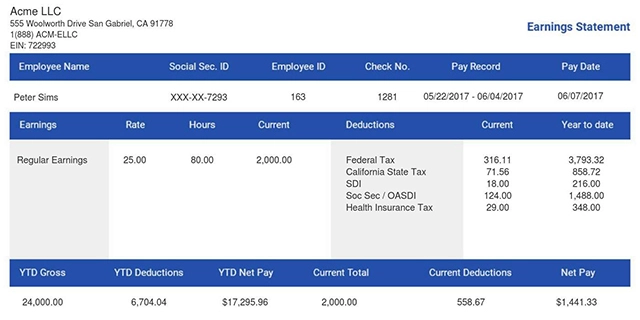
What Unpaid PTO Looks Like on Your Pay Stub
Most HR guides cover the laws and policies behind unpaid leave, but the paycheck is where it gets real. Here's what to expect on your pay stub during and after taking unpaid PTO:
Reduced Gross Earnings
The pay stub for a period with unpaid leave will show gross pay only for the hours you actually worked. Using the example above, an hourly employee who worked 24 hours during a week with 16 hours of unpaid leave would see $480 in gross earnings for that week, not the usual $800.
Unchanged Deductions
Health insurance, dental, and vision premiums typically remain the same. The fixed contributions for 401(k) or similar plans also remain unchanged unless you elect otherwise.
Lower Tax Withholding
Your federal and state income tax withholding decreases because gross pay for the period is lower. Withholding is calculated as a percentage of gross pay, so when your gross drops, withholding drops automatically with it.
What To Check After Returning
Go through your pay stub to confirm:
1. The hours or days listed match what you actually worked.
2. Deductions were calculated correctly.
3. Your gross for the period matches your daily or hourly rate multiplied by the days or hours worked.
Payroll errors in relation to unpaid leave are common because manual payroll processing can cause problems, especially in companies with multiple locations. When returning from unpaid leave, review your pay stub deduction codes for errors, and familiarize yourself with the payroll codes found on the pay stub.
Can an Employer Deny Unpaid PTO?
Yes, an employer can deny an employee's request for unpaid leave in most cases. Reasons can include business needs, staffing shortages, or poor timing. However, employees are legally entitled to leave in specific circumstances:
- Leave protected by the Family and Medical Leave Act (FMLA) or similar state family and medical leave laws.
- Leave related to a work-related injury covered by workers' compensation benefits.
- Leave for military service under USERRA.
- Other leave types granted under state or local law.
Employees are not entitled to unpaid leave for reasons like vacation, voluntary travel, or other personal matters, though they can still request it, and the employer can choose to grant or deny it.
Legitimate reasons to deny a request include:
- Peak-season staffing needs.
- Lack of coverage from other employees.
- Insufficient advance notice from the employee.
- The employee does not meet your eligibility requirements (such as minimum service length).
However, an employer cannot deny leave based on race, religion, disability, serious health condition, pregnancy, or any other protected characteristic. Doing so would be discriminatory and could expose your business to legal liability.
You Might Also Like
- How to Get a Pay Stub From Direct Deposit
- How to Calculate W-2 Wages From a Pay Stub
- Proof of Income Documents: 6 Instances You'll Need a Pay Stub
- FIT Taxable Wages: What They Are and How They're Calculated
- Proof of Income If Paid in Cash
Conclusion
Unpaid PTO is a practical reality for employees who've exhausted their paid leave and for employers who want to offer flexibility without an unlimited payroll commitment. Understanding the rules on both sides (what the law protects, what your policy should say, and what your pay stub should show after those unpaid days) is what separates a smooth experience from a payroll headache.
Need to verify how unpaid days affect your paycheck? Our paystub generator makes it simple to build professional pay stubs that reflect real hours worked, including weeks with unpaid time off.
- 1. Enter Your Information

- 2. Select Your Favorite Theme

- 3. Download Your Stub!

 By
By