

What Is Off-Cycle Payroll? A Complete 2026 Guide
 By
By
Off-cycle payroll is any pay run done outside your regular payroll schedule. Companies use it for bonuses, fixes to a payroll error, final paychecks, and other one-off payments.
This guide explains how off-cycle payroll works in 2026. You will learn the tax rules, state payroll laws, and how to make a stub with a paystub generator when you need one.
Key Takeaways
- Off-cycle payroll covers any wages paid outside the normal pay period. This includes bonuses, fixes, and final pay.
- A bonus payment paid off-cycle is taxed at a flat 22%. The IRS calls this supplemental income tax.
- Some states, such as California, require final pay within 1 to 3 days of termination.
- Direct deposit usually takes 1 to 3 business days. A paper check can be issued the same day.
- An off-cycle paystub shows only one payment. It does not show full year-to-date totals.
- Key Takeaways
- What Is Off-Cycle Payroll?
- Common Reasons To Run Off-Cycle Payroll
- How Does Off-Cycle Payroll Affect Taxes?
- State Law Compliance for Off-Cycle Payroll
- How Long Does Off-Cycle Payroll Take?
- Best Practices for Managing Off-Cycle Payroll
- How To Read Your Off-Cycle Pay Stub
- You Might Also Like
- Conclusion
What Is Off-Cycle Payroll?
Off-cycle payroll is a payroll run done outside the regular payroll schedule. It is also called unscheduled payroll, manual payroll, or on-demand pay. Some payroll software tools list it as an off-cycle payroll run.
Most companies pay staff on a fixed pay period. The most common pay periods are weekly, biweekly payroll, semi-monthly, and monthly. Off-cycle payroll happens between these dates. The HR department or payroll team uses it to correct a missed payment or to send a bonus payment quickly.
The setup is the same as regular payroll. Tax withholding and employee benefits deductions still apply. The only difference is the timing.
Common Reasons To Run Off-Cycle Payroll

Off-cycle payroll falls into two groups. The first group fixes mistakes. The second group covers planned one-off payments. Both help boost employee morale when handled fast.
Unplanned Runs
These runs fix a payroll error from a recent pay period.
- Missed hours or a timesheet error: A manager missed the payroll cutoff and did not approve hours in time.
- Wrong pay rates: Overtime, holiday pay, or a wage rate was off.
- Expense reimbursement: A worker paid for fuel, travel, or supplies and needs the money back.
- Payroll advance: A staff member needs an advance before the next pay date for a hardship.
For example, a restaurant owner finds that a server's tips were left out of last week's payroll. A quick fix can be done that day. The corrected record can act as proof of payment for compliance audits.
Planned Runs
These runs are scheduled but fall outside the normal payroll processing calendar.
- Bonus payment and sales commissions: Many firms pay these on a separate cycle to make tracking easier.
- Severance pay and final paycheck: Final pay for a worker who was let go or quit.
- Holiday pay or wage advances: Some firms pay early before a long weekend.
How Does Off-Cycle Payroll Affect Taxes?
A bonus payment paid off-cycle is taxed at a flat rate of 22%. This is the IRS supplemental income tax rate. If a worker earns more than $1 million in supplemental wages in a year, the rate goes up to 37%. Some firms use the aggregate method instead. With this method, the bonus is added to the worker's normal pay and taxed at the worker's normal withholding rate.
All other payroll taxes still apply. FICA, Medicare, and state income tax must be deducted from every off-cycle check. Wage garnishments, such as child support, cannot be skipped.
Tax withholding rules also differ for W-2 staff and 1099 contractors. For more, see how to file taxes when you have W-2 and 1099 income.
State Law Compliance for Off-Cycle Payroll

Termination pay rules vary by state. State payroll laws set strict deadlines for the final paycheck. Below is a quick view of five states:
| State | Final Paycheck Deadline |
|---|---|
| California | At the time of termination |
| Arizona | Within 7 working days or by the next regular payday, whichever comes first |
| Texas | Within 6 calendar days |
| New York | Next regular payday |
| Florida | Next regular payday |
California has the strictest rule. The worker must get the final paycheck on the day of termination. The check can be a paper check or a direct deposit, based on the worker's choice. Always check the state payroll laws where your staff works, as they change frequently.
Wage garnishments need extra care. A garnishment order must be honored on every payroll, even off-cycle ones. Stop a garnishment only when you get formal proof from the agency that issued it.
How Long Does Off-Cycle Payroll Take?
The time depends on the payment method. Most direct deposit off-cycle payroll runs take 1 to 3 business days. Some payroll providers offer 2-day or even same-day options for a small fee. A paper check can be printed and handed out the same day.
Need to pay a worker fast? Print the paper check yourself or ask your payroll provider for a same-day option. Many big payroll providers, such as ADP, offer rush service. They can also push the payment through with full payroll automation.
Best Practices for Managing Off-Cycle Payroll
A few simple steps can prevent most off-cycle payroll issues. They also help with payroll compliance and clean payroll recordkeeping.
- Set a clear policy. Write down who can approve a run. List the reasons that are valid. Set a deadline to request a run.
- Keep good records. Save the worker's name, the amount, the tax withholding, and the date for each payment. Federal law (FLSA) requires you to keep payroll records for at least three years.
- Act fast. Fix errors the same day you find them. Tell the worker the amount and the new pay date.
- Watch for repeats. If the same payroll error keeps coming up, look upstream. The cause may be poor timesheet approvals, a payroll cutoff issue, or a payroll software bug.
- Sync to your books. Post each off-cycle payment to your general ledger. Many payroll providers and HRIS tools do this for you.
Not getting a paycheck as a self-employed worker or small business owner? See our guide on proof of income documentation for tips.
How To Read Your Off-Cycle Pay Stub
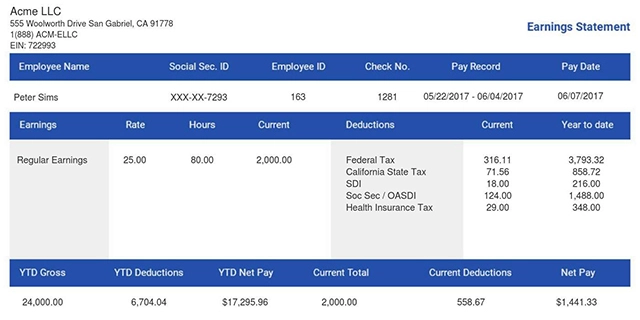
An off-cycle pay stub looks a bit different from a regular one. Here is what to check:
- Gross pay: This is the total of just this one payment. It is not the year-to-date total.
- Withholding rate: A bonus may be taxed at the flat 22% rate. Your normal pay is calculated using your true tax rate.
- Deductions: Your normal employee benefits deductions, such as health insurance and 401(k), may not be on this stub. They often come out only on the regular payroll.
- Net pay: This is the take-home for this single payment.
An off-cycle pay stub can serve as proof of income for a loan or rental check. If your job does not give you one, you can make one at ThePayStubs.com. We have more tips on this in our guide on Pay Stubs for Loan Applications.
You Might Also Like
- DoorDash Pay Stubs: What Dashers Need to Know
- Proof of Income If Paid in Cash
- Pay Stubs for Loan Applications
- Proof of Income for a Mortgage: What Lenders Need
- How Do Banks Verify Income for an Auto Loan?
Conclusion
Off-cycle payroll lets you fix errors and send bonuses outside the normal pay cycle. Run each off-cycle payroll on time, apply the correct taxes, and record the date and amount in your payroll records. Follow your state payroll laws to stay in line.
Need a stub for an off-cycle payment? Use a paystub generator like ThePayStubs.com to make accurate pay records in minutes.
- 1. Enter Your Information

- 2. Select Your Favorite Theme

- 3. Download Your Stub!

 By
By