

What Is Straight Time Pay? Definition and How To Calculate It
 By
James Wilson
By
James Wilson Straight time pay is what an employee earns for normal hours at the regular hourly rate. It does not include overtime, bonuses, or paid time off.
In 2026, knowing this rule is still the easiest way to spot mistakes on your pay stubs.
This guide covers the straight time pay definition, the formula, and how it differs from overtime under the FLSA.
Key Takeaways
-
Straight time pay is wages for regular hours up to 40 hours per week.
-
The formula is simple: hourly wage × regular hours worked.
-
Under the FLSA, nonexempt employees earn time-and-a-half for hours worked beyond 40.
-
Paying nonexempt staff at straight time for overtime hours breaks federal labor laws.
-
The "Regular Earnings" line on a pay stub shows your straight time pay.
-
Good time tracking and the right employee classification keep your payroll taxes correct.
What Is Straight Time Pay?
Straight time pay covers wages for all regular hours worked at the standard hourly rate. It applies to hours up to 40 in a standard workweek. It does not cover overtime, bonuses, paid time off, or holiday pay.
Under the Fair Labor Standards Act (FLSA), this is the straight time pay definition used . It is also called base pay, regular pay, or straight pay. Some employers list it as straight time overtime on a pay stub. The rate does not include any premium pay.
How To Calculate Straight Time Pay

To calculate straight-time pay, you only need two numbers. Take the hourly wage. Then multiply by the regular hours worked.
The formula is: Straight-time pay = hourly wage × regular hours worked.
For example, suppose an employee earns $18 per hour. They work 40 hours a week.
The math is simple: $18 × 40 = $720.
For salaried employees, the steps are a bit different. Take the annual salary. Then divide by the number of biweekly pay periods or other pay periods in the year. Most payroll software does this for you. For more help, learn how to calculate your hourly and monthly income.
1. Hourly Employees
For hourly workers, the math stays simple. Suppose a server earns $15 per hour. For 37 hours of straight-time work, gross pay is $555. This must be at least the federal, state, or local minimum wage.
If the worker has multiple pay rates, use a weighted average for overtime. The weighted average gives a fair, regular rate of pay. It also helps avoid employee misclassification issues.
2. Salaried Employees
The annual salary is split across each pay period. Biweekly pay periods give 26 paychecks per year. Semi-monthly gives 24. So a $52,000 annual salary works out to $2,000 per pay period before payroll taxes and other paycheck deductions.
Straight Time Pay vs. Overtime Pay
The straight time vs overtime rule under FLSA is easy to remember. The first 40 hours in a workweek are straight time. Hours past 40 are overtime. Overtime pays at 1.5 times the regular rate.
Paying nonexempt employees their regular rate for overtime hours is a violation of federal labor law. The Department of Labor enforces this rule. Note that some sources call it straight time overtime when the company simply pays the regular rate for extra hours, but this is not allowed for nonexempt staff.
For example, a warehouse worker earns $20 per hour. In one week, they work 45 hours.
Straight time pay is $20 × 40 = $800
Overtime is 5 × $30 = $150
Total gross pay is $950. We explain more common errors on paycheck stubs.
| Pay Type | Rate | Notes |
|---|---|---|
| Straight time pay | 1× regular rate | Hours up to 40 per workweek |
| Overtime pay | 1.5× regular rate | Hours past 40 for nonexempt staff |
| Straight time overtime | 1× regular rate | Common error; not allowed for nonexempt staff |
Who Does Straight Time Pay Apply To?

Straight time pay applies to nearly all workers. The rules differ by employee classification.
Nonexempt employees get straight time for the first 40 hours each week. After that, they earn overtime at time and a half. Exempt employees who earn $35,568 or more per year (about $684 per week) can be paid at straight time for all hours.
Independent contractors are not covered by the FLSA straight time rule. They should still keep records of income for their own taxes. State labor laws can be stricter. In California, daily overtime kicks in after 8 hours in a workday. So, check your state rules along with the federal FLSA.
Straight Time Pay on Your Pay Stub
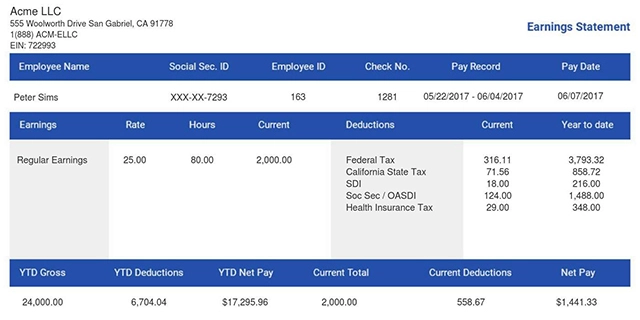
On your pay stub, straight time pay shows up as "Regular Earnings." This number is your hourly wage multiplied by your regular hours worked during the pay period. For more on the other items on a pay stub, see what a pay stub looks like.
Your pay stub should list straight time hours and overtime hours in separate lines. If something looks wrong, talk to HR. Employers should also use payroll software with robust time-tracking capabilities. Good time tracking helps catch errors before they hit the pay stub.
You Might Also Like
-
Payroll Codes Explained: What the Abbreviations on Your Stub Mean
-
How to Tell the Difference Between a Real and a Fake Pay Stub
Conclusion
Straight time pay is the answer to most paycheck questions. The formula is short. It is the hourly wage multiplied by the regular hours worked. Knowing this helps workers spot mistakes on their paycheck stubs. It also helps employers stay in line with FLSA rules in 2026.
For free online paycheck stubs that calculate straight time and overtime correctly, use our paystub generator.
- 1. Enter Your Information

- 2. Select Your Favorite Theme

- 3. Download Your Stub!

 By
By