

What Is Piece Work? Pay Rules and Examples (2026)
 By
By
Piece work pays people for what they finish, not for how long they stand at the bench. A sewing operator earns per shirt. An orchard crew earns per bin. A repair tech earns per job. It sounds simpler than an hourly wage, but the payroll math underneath is where employers get into trouble. This guide covers the definition, how to calculate piece work pay, and what it should look like on a pay stub, plus what a pay rate means, how it compares to hourly wages, which jobs use it, and the minimum wage and overtime rules that still apply in 2026.
Key Takeaways
- Piece work pays a fixed piece rate per unit produced instead of an hourly wage.
- Employees paid this way are still owed at least minimum wage and overtime.
- Overtime uses the FLSA regular rate: total weekly pay divided by total hours worked.
- Employers must track hours worked even when pay isn't based on hours.
- California bans piece rate pay in garment manufacturing, with a narrow union-contract exception.
What Is Piece Work?
Piece work is compensation for the number of units an employee produces rather than the hours they spend working. The employer sets a fixed piece rate per unit, and gross pay equals units produced times that rate. Whatever the units add up to, federal law still guarantees minimum wage and overtime on top.
So what is piecework? Same arrangement, one word, and the older phrase piece meal work means it too. You'll also see it called output work in legal writing. The piece work definition hasn't shifted much since early factory floors: count what's finished, multiply by the rate, pay that amount.
What is a piece rate, then? It's the dollar figure attached to one completed unit, like $0.40 per garment or $12 per cleaned room. The piece rate definition stops at that number, which is exactly where employers get caught: the rate says nothing about what happens when a slow week drags earnings under the wage floor. Ask what is piece rate pay and you're really asking two things at once: what's the rate, and what catches the worker underneath it?
The piece work meaning that matters on payroll day comes down to risk. Under an hourly compensation structure the employer absorbs a slow day; under this compensation system the employee does.
What Does Pay Rate Mean?

A pay rate is the agreed amount an employee earns per unit of measurement. That unit can be time, output, or revenue. An hourly rate pays per hour, a salary pays per year, commission pay is a share of sales, and a piece rate pays per unit produced.
Pay rate meaning trips people up because the phrase stretches across all of those arrangements. So what is a pay rate when the unit isn't time at all? It's still just a rate; the thing being counted changes:
- Hourly rate: dollars per hour on the clock
- Salary: dollars per year, regardless of hours
- Piece rate: dollars per unit produced
- Commission: a percentage of what you sell
How to Calculate Piece Work Pay
The Basic Formula
Multiply output by the rate per unit:
Units produced x rate per unit = gross pay
Say a packer completes 500 units in a week at a flat rate of $1.20 each. That's $600 for the week. If someone's paid per piece across two tasks, run the math separately and add the totals.
Checking Against Minimum Wage
Gross pay has to clear the minimum wage for the hours actually worked, and you check it every single workweek.
Two packers, both on the same $1.20 flat rate, both working 40 hours in a state with a $12 minimum wage:
| Units | Piece work pay | Minimum owed | Make-up pay | |
|---|---|---|---|---|
| Packer A | 500 | $600 | $480 | $0 |
| Packer B | 350 | $420 | $480 | $60 |
Packer A cleared the floor. Packer B came up $60 short, and that $60 is owed as make-up pay on this week's check. You can't average it against a stronger week later in the pay period.
Need to document pay like this for your team? See what a compliant pay stub looks like before you run payroll.
Piece Work Pay vs Hourly Pay

The real difference is who carries the cost risk. Paying by output fixes your labor cost per unit no matter how fast anyone moves. Under hourly wages it swings with productivity.
| Piece work | Hourly | |
|---|---|---|
| Cost per unit | Fixed and predictable | Varies with output |
| Payroll admin | Heavier, needs unit tracking | Lighter |
| Worker earnings | Rise with speed | Steady |
| Quality risk | Higher | Lower |
A related model is pay per head, used in livestock and agricultural work. How does pay per head work? Same principle, except the unit counted is an animal handled rather than a product made.
Advantages and Disadvantages of Paying by the Piece
Advantages
- Faster workers earn more, which rewards skill directly
- Labor cost per unit becomes predictable for budgeting
- Management spends less time policing pace
- Output often rises without adding headcount
- Some employees gain real flexibility over their hours
Disadvantages
- Quality can slide when speed is the only thing being paid for
- Slower employees may take home less than they did hourly, which drives turnover
- The serious drawback is pressure on sick or injured workers to keep going, since stopping means earning nothing
- Tracking units accurately takes systems most small employers don't have
- Compliance overhead is heavier than a simple hourly compensation system
Which Jobs and Industries Use Piece Rate Pay
It shows up wherever output is countable and individual. Common examples in 2026:
- Agricultural harvest crews paid per bin, bushel, or row
- Garment and textile assembly paid per finished piece
- Flat rate auto repair technicians paid per job, not per hour on the lift
- Call center and data entry roles paid per call or per record
- Carpet cleaning and housekeeping paid per room or per property
- Independent contractors such as freelance writers and photographers, billing per project
Is Piece Work Legal? Minimum Wage and Overtime Rules
Yes, piece work is legal across the United States. The Fair Labor Standards Act still requires piece rate pay to meet the highest applicable federal, state, or local minimum wage, currently $7.25 an hour federally, plus overtime past 40 hours per week. California bans piece rate in garment manufacturing.
Minimum Wage and Overtime
Nothing about paying by output exempts you from the FLSA. Your floor is whichever minimum wage is highest where you operate: federal, state, or local. The federal figure has sat at $7.25 since July 24, 2009.
Calculating overtime pay works through what the Department of Labor calls the regular rate. Divide total weekly earnings by total hours worked to get a base rate, then pay an extra half of that base rate for every hour past 40. The DOL explains it in its fact sheet on the regular rate of pay.
One tip that saves audits: run the minimum wage check per workweek, not per pay period. A biweekly run can hide a shortfall in week one behind a strong week two.
State Rules That Go Further
California's paystub requirements are the outlier worth knowing. Under AB 1513, employers owe piece rate employees paid rest and recovery time, at least ten minutes for every four hours worked, plus separate pay for other non-productive time.
The state went further in garment manufacturing. The Garment Worker Protection Act took effect January 1, 2022 and bans paying garment workers by the piece, with a $200 penalty per employee per pay period and a narrow exception for workplaces under a collective bargaining agreement. California's garment worker guidance covers the details.
How Piece Rate Pay Shows Up on a Pay Stub
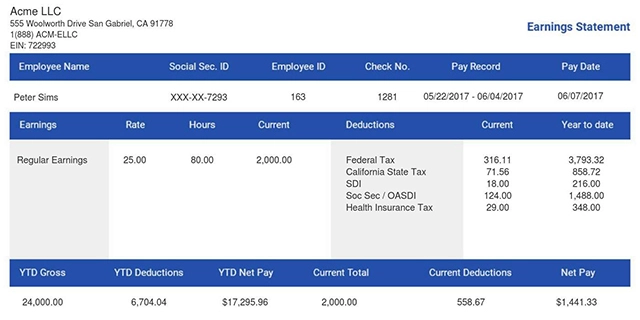
A compliant stub carries more lines than an hourly one, and state pay stub laws can add more. At minimum:
- Units completed during the period
- The rate per unit applied
- Gross piece rate pay
- Minimum wage make-up pay, listed separately when owed
- Overtime premium, calculated from the regular rate
- Total hours worked
That last line is the one employers drop, and it's the expensive mistake. When pay isn't based on hours, tracking them feels pointless. It isn't. Hours worked proves you met the wage floor, and it sits alongside the other pay stub deduction codes you already report. Without it, the employer carries the burden of proof in a wage claim.
You Might Also Like
- Payroll Codes Explained
- Paycheck Stubs: What They Include
- How to Calculate W-2 Wages From a Pay Stub
- Free Pay Stubs Online
- W-2 vs Pay Stub: What's the Difference
Conclusion
Paying by output rewards speed, and for the right jobs it lines up everyone's incentives nicely. What it never does is switch off the wage floor. Minimum wage, overtime, and hour tracking all survive the move away from hourly wages, and California shows some states will restrict piece rate further.
Your records still have to show the units, the rate, and the hours. A paystub generator puts all three on a professional pay stub in a couple of minutes.
- 1. Enter Your Information

- 2. Select Your Favorite Theme

- 3. Download Your Stub!

 By
By