

Overtime Software: How It Works, What It Costs You to Get Wrong (2026)
 By
By
Overtime software sits between the hours your team actually works and the money that lands in their bank
accounts. It captures time, applies your overtime rules, warns you before the
extra hours pile up, and hands clean numbers to payroll. What it does not do is produce the document at the end
of that chain, which is where ThePayStubs.com picks up. Search the term and
you will find a dozen vendors
telling you their product does all of that automatically. Almost none of them tell you what the software is
counting. Or what records you are on the hook for. Or what to check when the numbers look wrong.
Employee overtime tracking is not a niche back-office chore, either. It decides what a worker takes home,
what an employer owes, and what both of them can prove months later.
That is what this guide covers. You will get the actual overtime math, worked through with real
numbers. You will get the recordkeeping rules that apply whether or not you buy anything. You will get a
vendor-neutral checklist for judging tools. And you will get the 2026 W-2 change that most product pages
have not caught up with yet. If you run
payroll for a team, you will know what to demand from a tool before you pay for it. If you are the one
working the extra hours, you will know how to verify that the number on your stub is right.
- What Overtime Software Actually Does
- How Overtime Pay Is Calculated
- Features That Actually Matter in Overtime Software
- Overtime Compliance and Recordkeeping
- How Overtime Shows Up on a Pay Stub
- Preventing Unplanned Overtime
- Getting Overtime Data Into Payroll
- How to Choose Overtime Software
- When the Software and the Paycheck Disagree
What Overtime Software Actually Does
Strip away the marketing and the category does four jobs.
It captures hours. However you track employee time, punches come in from a phone, a tablet, a
browser, or a wall unit.
This is the part most people picture when they hear
time clock software, and it
is the easiest part to get right. If your crew is mobile, this usually arrives as an overtime tracking app on their phones rather
than a box on a wall.
It applies your overtime rules. This is the real work. An employee overtime tracker that only logs
punches has skipped it. The system decides which hours cross a threshold, which
multiplier applies, and who is even eligible. A rule set for one 40-hour weekly threshold is
easy. A rule set for a California crew on ten-hour days next to a Texas crew on five eights is not.
It flags the cost before it lands. This is the job that separates useful overtime software from an
expensive timesheet. Overtime alerts fire when someone is nearing a threshold. That is the only moment you
can still act. After the week closes, the money is owed.
It hands off to payroll. Approved hours move into your payroll system, split by pay type. That way
regular hours and overtime hours each get paid at the right rate.
Worth knowing before you shop: standalone overtime software is rare. Overtime handling is usually a
module inside broader employee time tracking software, and the vendor sells you the whole platform. That
is fine. But it does mean the overtime rule engine is often the least demoed part of a product you are
buying for other reasons. Give it your full attention during the trial.
Here is what overtime software does not do. It does not decide who is exempt. It does not know about the
side deal you made with a supervisor. It does not catch a rule you set up wrong. It follows your setup exactly, mistakes included. Every accurate overtime calculation starts with a
correct rule, not with a good app.
How Overtime Pay Is Calculated
Under the federal
Fair Labor Standards Act, nonexempt employees earn overtime
pay at one and a half times their regular rate for every hour past 40 in a workweek. A workweek is a
fixed, repeating period of 168 hours. It does not have to start on Monday. It does not reset just because
a pay period ends mid-week.
Work through a simple case. An employee earns $20 an hour and works 46 hours in one workweek.
- Regular pay: 40 hours at $20 equals $800
- Overtime pay: 6 hours at $30 equals $180
- Gross for the week: $980
Now the part that trips up real payroll runs. The multiplier applies to the regular rate, not to the
posted hourly wage. And the regular rate includes nondiscretionary payments: production bonuses, shift
differentials, and attendance incentives. Give that same employee a $92 weekly production bonus and
the math changes:
- Straight-time earnings: 46 hours at $20 equals $920, plus the $92 bonus equals $1,012
- Regular rate: $1,012 divided by 46 hours equals $22.00
- Overtime premium owed: 6 hours at half the regular rate, or $11.00, equals $66
- Total: $1,078
An employer who paid $30 an hour for those six hours would underpay. This one rule drives a large share
of back-wage findings. Test it before you trust any overtime calculation a tool hands you. If you want to sanity check a result by
hand, an overtime pay calculator run against
the same inputs will tell you quickly whether the software agrees with the rule.
Daily Overtime States That Break the 40-Hour Assumption
The 40-hour weekly threshold is the federal floor, not the whole picture. State laws layer on top of it,
and several states require overtime on a daily basis:
- California pays 1.5x after 8 hours in a workday and double time after 12, with additional rules for the
seventh consecutive day
- Alaska pays 1.5x after 8 hours in a workday
- Colorado pays overtime after 12 hours in a workday
- Nevada applies a daily 8-hour rule to employees earning less than one and a half times the state
minimum wage
Where both a daily and a weekly rule apply, the employee gets whichever one pays more. If you operate in
more than one state, test this first during any trial. Ask the vendor to set up your real states and run a
week of your real schedules through it.
Features That Actually Matter in Overtime Software

Every product page lists features. Almost none say which failure each feature prevents. So here is that
map.
| Feature | The failure it prevents |
|---|---|
| Flexible rule engine | Paying a California crew on Texas rules |
| Real-time threshold warnings | Discovering the cost after the week has closed |
| An approval step for extra hours | Hours nobody authorized turning into wages you owe anyway |
| Immutable audit trail | Losing a wage dispute because an edit has no author or timestamp |
| Regular-rate handling | Underpaying the overtime premium on bonus weeks |
| Multi-state and multi-location support | One rule set quietly applied to everyone |
| Clean payroll export | Hand-keying hours and introducing a typo at the last step |
| Mobile capture | Field crews reconstructing their week from memory on Friday |
Automatic overtime calculation is the headline claim on every one of these products. Be precise about what
that claim covers. The arithmetic is never the hard part. The hard part is applying the right threshold, to
the right employee, on the right day, at a rate that reflects everything that person earned that week.
Treat "automatic" as a claim about speed, not about correctness.
Two of these deserve more weight than vendors give them.
The audit trail matters more than the dashboard does. Every overtime tracking software product will
sell you the dashboard. Any decent tool will show you pretty overtime reports. Far
fewer will show you who edited a punch, when, and what the value was before the edit. When a former employee disputes a final check, that edit history is the whole case.
Regular-rate handling is the feature nobody demos. Ask it straight. If I pay a nondiscretionary bonus,
does the system redo the regular rate for that week on its own? Or does it just multiply the base wage and
leave me exposed? Many tools do the simple thing. Some overtime management software handles it
properly. You cannot tell from the feature list, so ask.
Everything else on the list is table stakes. A modern overtime tracker will have mobile capture, exports,
approved timesheets, time off balances, and a reporting view. Those are not differentiators, and paying a premium for them is how software budgets
get wasted. When two feature grids look identical, the difference is almost
always in how each rule engine handles your messiest week.
Overtime Compliance and Recordkeeping
Buying overtime software does not hand your legal duty to the vendor. The employer keeps it.
The FLSA recordkeeping rules
require employers to keep payroll records for at least three years. Records that wage math is based on
must be kept for two years. That covers time cards, work schedules, and records of anything added to or
taken out of wages. All of it has to be available for inspection.
The law does not care which method you use. Employers may pick any timekeeping system: a time clock, a
timekeeper, or workers writing their own hours. There is no rule that says
you must buy a time and attendance software package. An accurate overtime tracking sheet maintained
consistently satisfies the requirement. What the law does not forgive is inaccuracy, gaps, or records you
cannot produce when asked.
Maybe you have been searching for how to track overtime hours without buying a platform. That is the
honest answer. A steady method plus accurate records is the legal requirement. Software is a convenience
on top of it.
That reframes the value of any purchase. You are not buying compliance. You are buying records you can
find again. That matters when a request lands two years later and the person who kept the spreadsheet has
left.
One more piece of the compliance picture confuses people constantly, so here it is plainly. FLSA overtime
is owed for hours worked, not hours authorized. Unauthorized overtime is still
compensable overtime. If an employee works extra hours you never approved, you owe the overtime pay. You may discipline them for violating your overtime policy. You may
not decline to pay.
The 2026 W-2 Change Nobody's Product Page Mentions
Starting with tax year 2026, employers must report qualified overtime pay on its own line of Form W-2, in
box 12, using code TT. This comes from the new federal deduction for qualified
overtime pay. Workers can deduct up to $12,500, or $25,000 if they file jointly. The break phases out
above $150,000 of modified adjusted gross income, or $300,000 for joint filers.
Two details matter for anyone configuring a system this year:
- Only the premium portion required by law generally qualifies. In a standard time-and-a-half setup,
that is the extra half above the regular rate, not the whole overtime payment. Say you pay a richer
overtime rate than the law demands, or pay overtime on hours that are not legally overtime. That extra
does not qualify.
- Overtime pay is not tax free. It remains subject to Social Security and Medicare taxes, federal
withholding rules, and state taxes.
So your system now has to track the qualified premium as its own number, apart from total overtime
earnings. If a tool cannot break that out, someone will rebuild it by hand in January. Ask about it before you sign, and check the
IRS guidance on the qualified overtime deduction
for the current limits before you configure anything.
How Overtime Shows Up on a Pay Stub

Every system described so far produces one thing a human actually reads: the pay stub. That is where
overtime becomes visible, checkable, and arguable.
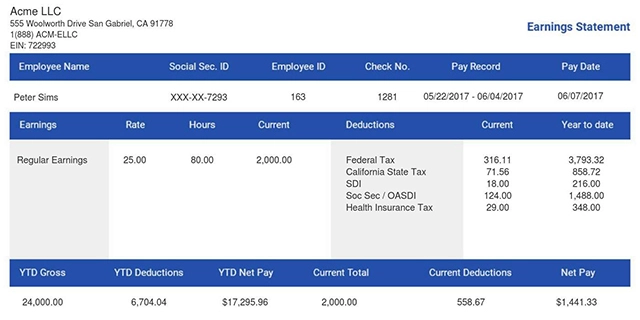
A good stub shows regular hours and overtime hours on separate lines. Each line gets its own rate and its
own total. A stub that buries 46 hours into one line at a blended rate is still arithmetic. It is also
useless to the employee, and it invites the exact dispute you were trying to avoid.
Both sides of this have practical stakes:
- If you run the payroll, the stub is your proof that hours were sorted and paid correctly. It is also
what a lender or a state agency will ask your employee for. An unreadable stub reflects on you.
- If you worked the hours, the stub is how you check your employer's math. Multiply your overtime hours
by the stated rate. Confirm that rate is one and a half times your regular rate. Confirm any bonus paid
that week was folded into the regular rate. Then check the year-to-date column against what you expect.
This is also where individual workers get left out. Maybe you are hourly and picking up extra
shifts. Maybe you are self-employed and logging a heavy month for a lender. You still need clean pay
records, and no employer is running overtime software for you. Knowing
what a pay stub should look like
is the difference between a document a landlord accepts and one that gets questioned. At year end the same
figures roll up into the W-2, and our guide to
reading a W-2 walks
through it box by box.
Preventing Unplanned Overtime
Preventing overtime is a scheduling problem. Overtime software can support the fix but cannot make it for
you. Here is what works, in order of how early it acts:
- Schedule against the threshold. See projected weekly hours while you build the schedule, not after.
Most unplanned overtime is scheduled overtime that nobody added up.
- Alert before, not after. Configure overtime alerts at a point where a manager can still swap a
shift, typically several hours before the threshold rather than at it.
- Gate the exception. An overtime approval step makes extra hours a decision rather than a discovery,
and it gives your written overtime policies something to attach to.
- Check your overtime settings at the edges. Early clock-ins and late clock-outs add up quietly. Punch limiting closes that
gap, and it is where most unauthorized overtime originates rather than in dramatic extra shifts.
- Look at the pattern. The most useful insight in any of these tools is a trend line, not a total. If
the same three people run over every week, the problem is staffing, not discipline. Ask that question before you spend more on tools. Our piece on
gets into where the line usually sits.
One honest warning about a heavily marketed feature. Automatic clock-out at shift end stops the punch,
not the work. If the employee kept working after the system clocked them out, the hours still happened and
the wages are still owed. Now you also have a record that says otherwise. Use
it as a prompt, not as a cost control, and make sure managers know the difference.
Getting Overtime Data Into Payroll
This step decides whether the rest of it mattered. Overtime software can figure a week perfectly and
still cut a wrong check if the handoff drops or mislabels the hours. What actually has to move across the payroll integration:
- Hours split by pay type, with regular, overtime, and double time separated rather than totaled, and
attached to the right jobs or projects where you cost work that way
- The rate applicable to each pay type, including any regular-rate adjustment for that period
- Period boundaries that match your payroll calendar, split correctly when a workweek spans two pay
periods
- Approval status, so unapproved time does not silently flow through
- Employee identifiers that match between systems
Two failure modes are worth watching for. The first is the workweek versus pay period mismatch. Overtime
is figured on the workweek. Payroll runs on the pay period. A biweekly cycle holds two separate workweeks,
and each one has to be judged on its own. Say an employee worked 45 hours in week one and 35 in week
two. Adding those to 80 and calling it no overtime is wrong. Week one owes 5 hours of overtime. Our
explainer on
whether overtime is calculated weekly or biweekly
covers this in more depth.
The second is silent mapping drift. When someone adds a new
pay code in payroll and the export mapping is
not updated, hours land in the wrong bucket without any error message. Check the first three cycles line by line after any
integration change, before you trust it.
How to Choose Overtime Software
Ignore the feature checklists for a moment and answer these in order.
How complex are your rules, honestly? This is the question that should drive the whole purchase,
because it is the only one where overtime software products genuinely differ. One state, one threshold, mostly salaried-exempt staff means
your needs are light and almost any tool will do. Multiple states, union rules, shift differentials, or
nondiscretionary bonuses change that. Then rule-engine depth is the only thing that matters, and you
should weight everything else near zero.
Where do hours come from? A field crew, a retail floor, and a hybrid office each need a different way
to clock in. Match it to where your people actually are, not to the demo.
What does it have to talk to? Confirm the payroll integration is a supported, maintained connection
and not a CSV export that someone has to babysit every cycle.
What happens in a dispute? Ask to see the edit history during the trial. If the vendor cannot show
you who changed a punch and when, keep looking.
What does it cost against what it prevents? Per-user pricing on a small hourly team can cost more
than the overtime it saves. Compare the yearly price against the labor costs of the errors you are
actually making. Ignore any vendor case study built on a company far larger than yours.
Who runs it? An overtime management system that needs a full-time admin is a poor fit for a
ten-person shop where the owner also runs payroll on a Sunday night. Match the workload to the person who
will carry it.
Run a real trial. Set up your genuine rules. Run one full pay cycle beside your current process. Compare
the two outputs line by line. A tool that survives that is worth buying. A tool that only looks good in a
demo is a subscription you will resent.
For very small teams, the right answer is sometimes no purchase at all. Say you have three hourly
employees in one state on a simple 40-hour rule. A tidy timesheet software workflow, or even a
well-kept spreadsheet, will do the job. Buy the tool when the rules outgrow the spreadsheet, not before.
When the Software and the Paycheck Disagree
Overtime software is confident by design. It can still be confidently wrong. When the numbers do not
match, what you do next depends on which side of the payroll you are on.
If you are the employee:
- Pull your own record of hours for the period in question, including any notes about shift swaps
- Compare it against the hours and rate printed on your stub, line by line
- Recalculate the overtime premium yourself, including any bonus paid that week
- Raise it in writing with your manager or payroll contact, with the specific dates and the specific
difference
- If it is not fixed in house, the Wage and Hour Division of the U.S. Department of Labor takes
complaints. The records your employer must keep become the evidence
If you are the employer:
- Pull the audit trail for that period before you reply, with every edit and who made it
- Check the rules that were live in that period. They may not be the rules live today
- Verify the regular rate used, especially in any week with a bonus or a differential
- Correct and document. A fixed stub with a plain explanation settles most disputes on the spot
- Fix the setup that caused it. If it hit one employee, it probably hit a group
Most of these disputes come down to two things. A bonus that was not folded into the regular rate, or a
workweek boundary applied unevenly. Both are setup problems. Both are cheaper to find in a check of your
own books than in a claim.
Key Takeaways
- Overtime software captures hours, applies rules, warns before thresholds, and feeds payroll. It does
not make compliance calls for you.
- Federal overtime is 1.5x the regular rate over 40 hours in a workweek for nonexempt employees, and the
regular rate includes nondiscretionary bonuses.
- Several states add daily thresholds. When daily and weekly rules collide, the employee gets the higher
result.
- Keep payroll records three years and wage-computation records two years. Any accurate timekeeping method
is legal.
- New for 2026: qualified overtime pay goes in W-2 box 12 with code TT. Generally only the legally
required premium portion qualifies for the deduction.
- The pay stub is where all of it becomes checkable. Regular and overtime hours belong on separate lines.
Conclusion
Overtime software earns its keep in the gap between "we tracked the hours" and "we paid them correctly."
The tracking is the easy half. The rules, the regular rate, the records, and the handoff to payroll are
where money is won or lost. No product page will walk you through those before you buy. Pick a tool against your messiest week. Test it beside your current process for one full cycle. And keep
owning the compliance calls yourself.
Employers have to document overtime for a team. Workers have to prove their own extra hours to a landlord
or a lender. Both end up needing the same thing: a record clear enough for someone else to verify.
Create a professional, accurate pay stub in minutes at ThePayStubs.com
with overtime hours and rates itemized exactly the way they should be.
You Might Also Like
- 1. Enter Your Information

- 2. Select Your Favorite Theme

- 3. Download Your Stub!

 By
By