

How To Calculate Monthly Income: The Complete 2026 Guide
 By
By
Knowing how to calculate monthly income is one of the most practical financial skills you can develop. Lenders check it before approving a mortgage. Landlords use it to determine whether you can afford the rent.
And when you're building a budget, your monthly income is the starting point for everything else. Use our pay stub generator to instantly document your gross earnings.
The tricky part is that the formula changes depending on how you get paid. A salaried employee takes a different approach than someone paid hourly, and both differ from a freelancer with variable income.
This guide shows you how to calculate monthly income for every pay type so you can find your number fast.
Key Takeaways
-
Gross monthly income is your total earnings before taxes and deductions
-
Salaried workers: divide your annual salary by 12
-
Hourly workers: hourly rate x weekly hours x 52 / 12
-
Biweekly workers: paycheck amount x 26 / 12
-
Your pay stub shows your gross pay directly. Check the "Gross Earnings" line.
- Key Takeaways
- What Is Gross Monthly Income?
- How To Calculate Gross Monthly Income (By Pay Type)
- How To Calculate Monthly Income From a Weekly Paycheck
- How To Calculate Monthly Income From a Biweekly Paycheck
- How To Calculate Monthly Income as a Freelancer or Self-Employed
- How To Find Gross Monthly Income on Your Pay Stub or Documents
- Why Gross Monthly Income Matters
- Gross Monthly Income vs. Net Monthly Income
- You Might Also Like
- To Wrap Up
What Is Gross Monthly Income?
Gross monthly income is the total amount you earn in a single month before any deductions. This includes federal and state taxes, Social Security, Medicare, health insurance premiums, and retirement contributions. It also covers all income sources, such as:
- your regular wages or salary
- overtime pay
- bonuses
- commissions
- freelance work
- investment dividends
What is my monthly income, exactly? It's every dollar you earn in a month before the government and your employer take their share. For example, if your monthly salary is $3,000 and you earn $500 from a side job, your gross monthly income for that month is $3,500.
Lenders and landlords use gross income, not take-home pay, because it reflects your full earning capacity before any voluntary deductions. For personal budgeting, you'll work with net income, which is what actually lands in your bank account.
How To Calculate Gross Monthly Income (By Pay Type)

To calculate gross monthly income, you need to know your pay frequency and apply the matching formula. There are four most common approaches. The steps below walk you through each scenario, from an annual salary to an hourly rate. For a deeper breakdown of all three timeframes, see our guide on how to calculate your hourly, weekly, and monthly income.
Annual Salary
For salaried employees, learning how to calculate monthly gross income from an annual salary is simple. Divide your yearly pay by 12.
Formula: Annual salary / 12
Example: A nurse earning $55,000 per year has a gross monthly income of $4,583. A retail worker earning $36,000 per year earns $3,000 per month. For context on what annual income means in broader financial terms, the linked guide covers it in detail.
This is also how to calculate my monthly income quickly if you know your offer letter or employment contract figure.
Hourly Wage
For hourly employees, first calculate weekly pay, then scale it up to a monthly figure.
Formula: Hourly rate x weekly hours x 52 / 12
Here's how to calculate weekly pay:
Multiply your hourly rate by the number of hours you work per week. That's your weekly gross.
Then, to calculate the weekly income into a monthly total:
Multiply the weekly gross by 52 for the annual figure, then divide by 12. This approach to calculate weekly income is also how to figure out gross monthly income for any hourly role.
Example: If you earn $15 per hour and work 40 hours per week.
$15 x 40 = $600 per week.
$600 x 52 = $31,200 annually.
$31,200 / 12 = $2,600 per month.
If your hours vary, use your typical weekly average. That gives you a stable total monthly income figure for loan applications and budgeting.
Biweekly Paycheck
Biweekly pay means 26 paychecks per year, not 24. This is one of the most common sources of confusion when calculating monthly income.
Formula: Biweekly paycheck x 26 / 12
Example of how to calculate monthly income from biweekly paycheck.
$2,400 x 26 = $62,400 annually
divided by 12 = $5,200 per month.
Quick shortcut: multiply your biweekly figure by 2.1667.
Semimonthly Pay (Twice a Month)
Semimonthly pay arrives on fixed dates, giving you exactly 24 paychecks per year.
Formula: Semimonthly paycheck x 2
Example: If each paycheck is $2,500, your gross monthly income is $5,000.
How To Calculate Monthly Income From a Weekly Paycheck
To calculate monthly income from a weekly paycheck, multiply your weekly gross pay by 52 (weeks per year), then divide by 12 (months). For example, if you earn $900 per week.
$900 x 52 / 12 = $3,900 per month.
A quick shortcut: multiply your weekly gross pay by 4.333.
Knowing how to calculate gross monthly income from weekly paycheck amounts requires the x 52/12 method, not the common x 4 shortcut. Since months aren't exactly four weeks long, multiplying by 4 instead of 4.333 underestimates your monthly income by roughly $75 to $100 per month on a typical weekly paycheck.
You also need to understand how to calculate monthly income from weekly paycheck amounts that vary week to week. To get this, average your last 4 to 6 weeks of gross pay, then multiply that average by 4.333. The weekly-to-monthly conversion using 4.333 gives you the accurate figure, whether your hours are fixed or variable.
How To Calculate Monthly Income From a Biweekly Paycheck

To calculate monthly income from a biweekly paycheck, multiply your gross pay by 26 (biweekly pay periods per year), then divide by 12.
For example, $1,800 biweekly × 26/12 = $3,900 per month.
Note that there are 26 biweekly pay periods, not 24, because two months each year have three paydays.
Knowing how to convert biweekly to monthly income correctly is important because the common shortcut of multiplying by 2 understates your actual monthly earnings. Two months of the year have three paydays, so using x 26/12 gives you the accurate annualized figure.
To convert weekly pay to monthly pay, see the section above. To convert biweekly pay to monthly, use the x 26/12 formula or multiply by 2.1667 directly.
How To Calculate Monthly Income as a Freelancer or Self-Employed
If you're self-employed, add up your total gross income for the past 12 months and divide by 12 for your average monthly income. For loan applications, lenders typically use your Schedule C net profit from tax returns, averaged over the past 24 months. Tracking income monthly and generating pay stubs can help document earnings for lenders and landlords.
How to calculate my monthly income when income varies month to month? Use a 12-month average:
- Total annual gross revenue divided by 12.
This smooths out the peaks and valleys to show your true earning trend.
For loan applications, lenders don't just take your word for it. They'll want two years of tax returns and your Schedule C net profit (gross revenue minus business expenses). Some lenders also add back non-cash deductions, such as depreciation, when determining your qualifying gross monthly income.
Self-employed workers who need to document income for a rental application can create a professional pay stub in minutes. A pay stub clearly shows your gross monthly income in a format landlords and lenders recognize. For more on documentation options, see our guide on how self-employed workers show proof of income.
How To Find Gross Monthly Income on Your Pay Stub or Documents
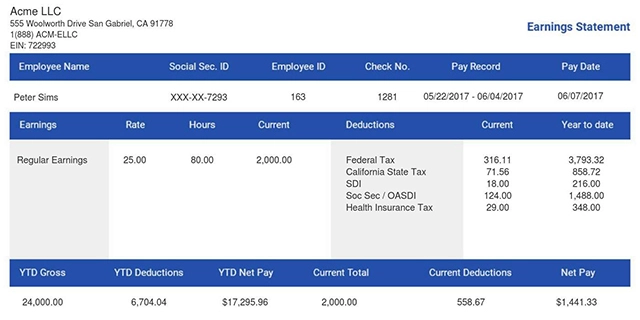
Knowing how to find gross monthly income quickly saves time when filling out loan and rental applications. Your gross monthly income is listed on every pay stub as "Gross Pay" or "Gross Earnings."
For annual figures, check Box 1 on your W-2 form and divide by 12. Your employment offer letter also states your annual salary. Divide by 12 to quickly find the monthly gross income.
Here's how to find monthly income on each document type:
1. Pay Stub
The "Gross Pay" or "Gross Earnings" line is your pre-deduction figure for that pay period. If you're paid biweekly, multiply by 2.1667 for your monthly total.
To find monthly gross income across multiple income sources, add each pay stub's gross amount and total them for the month. This is how to find monthly gross income when you have more than one employer or income stream. Not sure what a pay stub looks like? The linked guide shows every line item.
2. W-2 form
Box 1 shows your total wages for the year. Divide this by 12 for your monthly average. Note that Box 1 may be lower than your actual gross wages if you make pre-tax 401(k) contributions. Use our W-2 form generator if you need a copy of your W-2 quickly.
3. Employment Offer Letter
Your annual salary figure is in the offer letter. Divide by 12 to quickly find monthly gross income.
Why Gross Monthly Income Matters
Your gross monthly income is the number lenders, landlords, and government programs all rely on.
Loan Applications
Lenders calculate your debt-to-income (DTI) ratio. They total monthly debt payments divided by gross monthly income. Most mortgage lenders require a DTI below 43%. For personal loans, the typical ceiling is 35%. A higher gross monthly income improves your DTI and your approval chances.
Rental Applications
Landlords typically require gross monthly income equal to at least three times the monthly rent. Applying for a $1,500/month apartment means showing at least $4,500 in gross monthly income.
Government Benefits
Programs like Medicaid and SNAP use gross income thresholds for eligibility. Knowing your total monthly income can help you determine which programs you qualify for.
Taxes
Your total gross income determines your tax bracket and adjusted gross income (AGI), both of which affect your eligibility for deductions and credits. Understanding your FIT taxable wages helps you estimate what you actually owe.
Gross Monthly Income vs. Net Monthly Income
Before you can fully apply what you've learned about how to calculate monthly income, it helps to understand the difference between gross and net. Gross monthly income and net monthly income serve different purposes.
-
Gross Monthly Income: Your total earnings before deductions. This is what you report on loan and rental applications.
-
Net Monthly Income: Your take-home pay after all deductions. This includes taxes, Social Security, Medicare, health insurance, and retirement contributions. Net income is what reaches your bank account.
For most people, net income is 15 to 30 percent lower than gross income. Use gross for applications and financial comparisons. Use the net income for day-to-day budgeting and spending decisions.
You Might Also Like
To Wrap Up
Knowing how to calculate monthly income gives you a financial foundation for smarter decisions. Once you know how to calculate monthly income for your pay type, the math takes only seconds. Salaried workers divide annual pay by 12. Hourly workers multiply the rate by the weekly hours. This is then multiplied by 52/12. Biweekly workers multiply their paycheck by 26/12. And self-employed workers use a 12-month average of gross revenue.
Your gross monthly income is the number that opens doors to loans, apartments, and financial programs. If you're self-employed or a contractor, browse our pay stub templates to find one that clearly shows your gross monthly earnings in a format lenders and landlords recognize.
- 1. Enter Your Information

- 2. Select Your Favorite Theme

- 3. Download Your Stub!


 By
By