

Supplemental Pay: What It Means, Types & Tax Rules (2026)
 By
James Wilson
By
James Wilson Bonuses can have unexpected withholding. The withheld amount is often more than the tax you actually owe for that payment. Any excess withholding is typically 100% refundable when you file your annual Form W-2 tax return.
Nothing went wrong. That's how it works. Supplemental pay is any extra money you receive beyond your regular paycheck. It appears on a separate check, your Form W-2, or your paystubs.
This article explains the supplemental pay meaning, the types that qualify, the 2026 tax withholding rules that apply, and how these earnings show up on your pay stubs.
Key Takeaways
- Supplemental pay includes overtime, bonuses, commissions, and severance payments.
- Employers can withhold using two IRS methods. The first uses a flat 22% rate on a separate check. The second uses the same withholding as normal wages.
- Amounts over $1 million in a year are subject to a mandatory 37% withholding rate.
- PTO, vacation pay, and health benefits do not qualify.
- Your taxes will be fine. Extra withholding is reimbursed when you file your return.
What Is Supplemental Pay?
Supplemental pay (also called supplemental income) is extra income you receive beyond your normal hourly or salary rate. Withholding rules for these earnings differ from regular base salary. They apply in addition to regular income withholding. The term sometimes refers to variable pay, but this is always subject to federal income tax withholding rules.
We include all types of additional compensation in your calculations. Each one is reported on your paystubs based on the withholding rules for that type.
These items are part of your total compensation package. They count for taxation purposes. Non-cash benefits stay separate from supplemental wages. Examples include health, dental, and life insurance, as well as employer 401(k) contributions.
What Counts as Supplemental Pay?

The IRS outlines the rules in IRS Publication 15. Examples of additional compensation include the following:
Bonuses
Bonus income includes signing bonuses, referral bonuses, and retention bonuses. Performance-based wage income is the most common form. According to industry data, 51% of organizations offer formal incentive plans, typically in the form of annual bonuses.
Overtime Pay
The Fair Labor Standards Act (FLSA) defines overtime laws. Non-exempt employees receive 1.5 times their regular rate for overtime hours.
Supplemental pay includes overtime wages for hours beyond 40 per week (or 80 hours in fourteen days). These wages are processed as a separate check. That qualifies them within IRS rules.
Commissions
While bonuses are popular, they are not the only form of additional compensation.
Sales commissions, business development fees, and performance-based percentages also qualify. Unlike bonuses, commissions follow predetermined formulas. Employees can estimate earnings based on meeting goals.
Severance Pay
Payment per employment contract terms (even after employment ends) counts as supplemental income. Severance is subject to special withholding. Payments can come as a lump sum or in installments.
Accumulated Sick Leave Payouts
Unused sick leave payouts (at termination or year-end) are considered additional pay. Federal income tax withholding and the employee FICA portion (Medicare Tax) apply.
Whether the payout is contractually required or mandated by state law is irrelevant. What matters is that these are extra payments subject to supplemental withholding rules under the code. The Family Medical Leave Act (FMLA) permits such payouts.
Retroactive Pay and Back Pay
This addresses the timing between when a raise is effective and when it appears in paychecks. Underpayment corrections are treated as supplemental income for withholding.
Equity Pay and Other Payments
Stock options and stock grants count when exercised or vested. Back pay for moving expense reimbursements (if not excluded from income) and lump-sum vacation payments at termination also qualify.
What Doesn't Qualify as Supplemental Pay?
Not everything extra qualifies. The following items are not supplemental wages:
- Regular PTO and vacation pay paid during normal payroll cycles: Treated as regular wages.
- Stipends for job-related expenses: Such as a commuting stipend.
- Health insurance, dental, and other non-cash benefits
- Salary increases added to base salary: They become regular compensation.
Cash paid in a lump sum at separation for untaken PTO is different. That counts as a special payment.
Supplemental Pay vs. Regular Pay

| Feature | Regular Pay | Supplemental Pay |
|---|---|---|
| Timing | Every pay period, predictable | Event-driven, variable |
| Entitlement | Guaranteed for work done | Usually discretionary or performance-based |
| Purpose | Financial stability | Rewarding performance or special circumstances |
| Predictability | Fixed amount every two weeks | Varies based on performance or events |
| Tax handling | Standard W-4 withholding | Flat 22% rate or aggregate method |
| Examples | Base salary, hourly wage | Bonuses, commissions, overtime, and severance |
Regular pay is money earned for work performed. You can rely on it every two weeks. Bonus money is for work beyond regular duties. It's paid for special circumstances.
Bonuses appear on your paystubs and annual summary for the year earned. They are included in taxable wages for that year.
How Is Supplemental Pay Taxed?
There are two methods for withholding on these wage payments. Employers can use the "Flat rate method" when payments under $1 million are made separately in the same calendar year.
When paid in the same period as regular wages, withholding is calculated using the aggregate method. This applies to the employee's current Form W-4 information. Payments exceeding $1 million in a calendar year are subject to mandatory 37% withholding.
Higher withholding amounts don't mean higher total tax liability. They ensure sufficient funds are set aside. Excess amounts will be refunded when you file your tax return.
Your Form W-2 shows each amount of additional compensation paid and withheld during the year.
The Two Federal Withholding Methods
Supplemental wage income faces withholding using one of two federal methods. A third mandatory method applies to amounts exceeding $1 million. In addition to federal withholding, employers must also consider payroll taxes.
- Flat rate method: Wages paid separately from regular payments are subject to a fixed 22% rate. For example, a $2,000 performance bonus on a separate check would result in $440 being withheld under this method.
- Aggregate method: Using the employee's Form W-4 status, total all special payments (like bonuses) and add them to regular earnings. Withhold as if that total were regular earnings using standard tables.
All amounts (such as performance bonuses) over $1 million in a calendar year are subject to mandatory 37% withholding.
FICA and State Taxes on Supplemental Pay
Employees are not taxed more on these wages. However, more is typically withheld upfront. This ensures sufficient payroll taxes (Federal Insurance Contributions Act contributions, plus Social Security and Medicare) are paid throughout the year. Federal unemployment tax also applies at the employer level.
Overpayments are refunded when you file your annual tax return. Employers use two federal withholding methods, which include the "Flat rate method" and the "Standard Form W-4 tables".
Many states, including California, assess their own withholding on certain employee compensation. The total rate usually equals the federal rate plus the state rate (if the state rate is less than or equal to the federal rate).
California assesses 6.6% on performance units in 2026. Combined with 22% federal withholding, the total reaches 28.6%. Another state with a higher rate could reach 30%.
Rules governing state withholding vary significantly. Employees in the United States should know both federal and state rules. Federal rules appear in IRS Publication 15. State rules live with the Department of Revenue for your state.
How Supplemental Pay Appears on Your Pay Stub
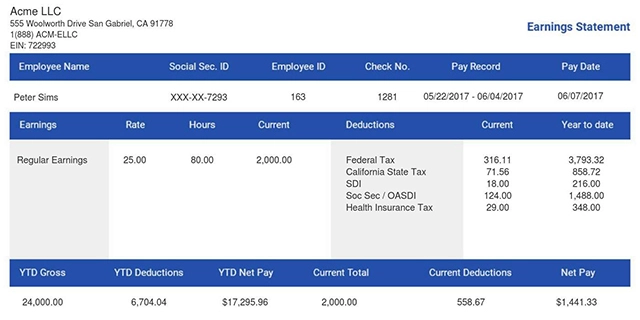
Extra earnings will be reported separately on your pay stub. They may have their own abbreviation or code. They appear on a separate line below your "Regular Earnings" (monthly salary or hourly wage).
Performance payments (e.g., Perf bonus) and regular bonuses appear separately. Other IRS Publication 15 payments also show separately:
- BONUS or PERF BONUS: Performance or signing bonus
- OT PAY or OT: Overtime compensation at a premium rate (1.5 times the regular rate)
- COMM: Commission payment
- SEV: Severance pay
- RETRO: Retroactive pay or back pay adjustment
In the Earnings section, the "Tax or Deductions" for that pay period may exceed the amount in "Earnings". This happens with performance or signing bonuses. The amount applies only to that specific pay period, not your total withholding for the year.
For self-employed individuals and independent contractors with fluctuating income, professional pay stubs serve as proof of income. They document commission, severance, or stock options. Use them for loan applications, rental approvals, or financial reviews.
Why Supplemental Pay Matters
For employers, variable pay is a powerful compensation tool. The key benefit is that there's no obligation to pay extra money when the company underperforms.
Incentive compensation plans are popular in the HR industry. According to SHRM research, over half of all organizations have formal plans. These plans positively affect employee performance. They recognize hard work and support employee retention.
Payments like these increase employee cash flow. They help with financial planning. They also play a large role in mortgage applications, rental verification, and personal loan approval. Lenders verify consistent income. Variable earners can provide employment verification documents.
Inform employees early by sending pay notices before they receive checks. Include the gross amount, the tax withholding method for federal income taxes, and the estimated after-tax amount. This takes two minutes and prevents emails asking why a check was so low.
You Might Also Like
- Paystub Generator for the Self-Employed
- Do Banks Verify Pay Stubs?
- W-2 vs Pay Stub: What's the Difference?
- What Is ER Health on a Pay Stub?
- Free Pay Stubs Online
Conclusion
Supplemental pay covers many forms of compensation beyond the standard salary. Most varieties require different withholding methods as mandated by the IRS. However, the net tax paid for all items would be the same regardless of the method. Understanding how items are withheld and how line items on pay stubs are calculated means no concern about tax amounts. To provide accurate checks, earnings must be properly coded within your payroll software. Employees should know when distribution occurs. Without that clarity, unexpected payments can lead to confusion rather than appreciation.
Looking for documentation of your earnings? Need a pay stub with health on it? A free pay stub generator online produces professional stubs within minutes. Thepaystubs.com has you covered.
- 1. Enter Your Information

- 2. Select Your Favorite Theme

- 3. Download Your Stub!

 By
By