

What Are Involuntary Deductions? Types, Laws & What To Do About Them
 By
By
Many workers may spot a strange line on their pay stub and wonder where their net pay went. Often, the answer is involuntary deductions.
These are mandatory deductions, also called paycheck deductions, that your employer must take out by law. You cannot opt out of them. Small business owners also face them when a court or agency sends a wage order for the first time.
This guide covers the types of involuntary deductions, the state laws that limit them, and what each side should do. Workers will learn how to read their pay stubs. Employers will learn how to handle payroll compliance effectively.
You can also create a clean, accurate pay stub that shows each deduction line at ThePayStubs.com.
Key Takeaways
- Involuntary deductions are amounts your employer must take from your pay by law. They include income taxes, child support, tax levies, student loan payments, and court-ordered garnishments.
- Tax withholdings, such as federal and state income taxes, Social Security, and Medicare, appear on every paycheck. Garnishments only show up when there is an active court order or government levy.
- The CCPA limits most creditor garnishments to 25% of disposable earnings, or the amount above 30 times the federal minimum wage. Child support orders can go higher.
- Workers cannot opt out of involuntary deductions, but they can dispute the order through the court or agency that issued it.
- Employers must process every valid order, notify the worker, and remit funds on time. Late or missed payments can lead to fines or contempt charges.
- Key Takeaways
- What Are Involuntary Deductions?
- Involuntary vs. Voluntary Deductions: What’s the Difference?
- Types of Involuntary Deductions
- Why Are Involuntary Payroll Deductions Required?
- Legal Framework: What the CCPA Limits for Involuntary Deductions Are
- State-by-State Garnishment Rules: Key Differences
- Prioritizing Involuntary Deductions When an Employee Has Multiple
- Employer Responsibilities for Managing Involuntary Deductions
- How Do Involuntary Deductions Appear on Your Pay Stub?
- What Should Employees Do if They See Unexpected Involuntary Deductions?
- You Might Also Like
- Conclusion
What Are Involuntary Deductions?
Involuntary deductions are amounts that the employer must take from your wages by law. They include income taxes, child support, tax levies, student loans, and court garnishments. Neither the worker nor the employer can opt out. The money goes to the IRS, a state agency, a court, or a creditor.
These deductions exist because a government, court, or agency has the legal power to collect a debt or a tax. The employer simply acts as the middleman. The wages are withheld each pay period and sent to the right place. This is very different from voluntary deductions, such as a 401(k) or a health plan, where the worker can join or leave at will.
For a small business owner, the first wage order can feel scary. However, the process is clear once you know the steps. The rest of this guide walks through it.
Involuntary vs. Voluntary Deductions: What’s the Difference?
The key difference is choice. Voluntary deductions are those that the worker signs up for, such as a 401(k), gym plan, or health insurance. The worker can stop them at any time. Involuntary deductions are required by law. The worker cannot stop them until the debt is paid or a court ends the order.
| Feature | Voluntary deductions | Involuntary deductions |
|---|---|---|
| Can the employee opt out? | Yes, anytime | No, until the order ends |
| Who authorizes them? | The employee | A court, the IRS, or an agency |
| Common examples | 401(k), health plan, life insurance | Child support, tax levies, garnishments |
| Appear on pay stub? | Yes | Yes |
| Pre-tax or post-tax? | Often pre-tax | Usually post-tax |
| Where does the money go? | Plan provider or vendor | Court, agency, or creditor |
Common voluntary deductions include:
- Health and dental insurance premiums
- 401(k) or 403(b) retirement plan contributions
- Life insurance
- Commuter benefits (parking, transit)
- Charitable contributions
These pre-tax deductions and post-tax deductions affect taxable income in different ways, but they are all chosen by the employee.
For workers, both types may show up on the pay stub. The difference is where the money is sent. Voluntary deductions go to the benefit provider. Involuntary deductions go to a court, agency, or creditor.
Types of Involuntary Deductions

Not all involuntary deductions are the same. Some apply to every worker. Others only kick in when a court order or debt notice arrives. The most common types are listed below.
Tax Withholdings
Tax withholdings are taken from every paycheck in the United States. This withholding tax is the largest set of involuntary deductions for most workers.
- Federal income tax: Withheld based on the worker's W-4 Form. The amount depends on filing status and federal tax brackets.
- State income tax: Withheld in most states. A few states, like Texas, Florida, and Nevada, have no state income tax.
- Local income tax: A few cities, such as Philadelphia, New York City, and Baltimore, charge their own local income tax.
- FICA taxes: Both worker and employer pay into Social Security (6.2% each up to the 2026 wage base of $176,100) and Medicare (1.45% each, plus a 0.9% surtax on high earners).
Workers cannot ask the employer to skip these. They are set by law.
Wage Garnishments for Child Support
Child support is the most common non-tax wage garnishment in the U.S. When a parent falls behind, the state child support agency instructs the employer to deduct money from the worker's paycheck.
Key facts for employers:
- A fixed amount is withheld each pay period.
- The amount may be based on gross or net income, depending on the state.
- Under the CCPA, child support garnishments can take up to 50% of disposable earnings if the worker supports another spouse or child. The cap rises to 60% if not.
- If a worker is more than 12 weeks behind, the employer can take an extra 5%.
Child support has the highest priority of any wage garnishment. It takes priority over other child support orders or creditor garnishments.
Tax Levies
A tax levy happens when a worker has unpaid federal or state taxes. The IRS or state then collects the debt straight from the worker's wages. This is not the same as the regular tax that comes out of every check. A tax levy is only used after taxes go unpaid and the worker has not set up a payment plan.
- Federal tax levy: The IRS sends Form 668-W to the employer. The form tells the employer how much to withhold. The amount is based on the worker's pay minus a small standard exemption. Federal tax levies are not capped by the CCPA's 25% rule.
- State tax levy: Each state sets its own rules. The amount is usually the worker's wages above a small minimum-wage exemption.
If you get a levy notice, call the IRS at 1-800-829-1040. You may qualify for a payment plan or a levy release.
Student Loan Garnishments
Federal student loans go into default after about 270 days without payment. Once a loan is in default, the U.S. Department of Education can use Administrative Wage Garnishment (AWG) to collect. No court order is needed.
Key limits:
- Up to 15% of disposable income.
- Workers must keep at least 30 times the federal minimum wage of $7.25 per hour, or $217.50 per week.
Important 2026 note: Federal student loan collection paused from March 2020 to October 2023. It has now resumed. If you had a garnishment before 2020 and have not had a new order, contact your loan servicer.
Bankruptcy Repayment Orders
Bankruptcy affects payroll in two ways. The Chapter type sets the rules.
- Chapter 7 bankruptcy: The worker's non-exempt assets pay off creditors. The employer is not asked to deduct money from wages.
- Chapter 13 bankruptcy: The worker keeps assets and pays creditors over 3 to 5 years. The court sends the employer a wage order. A fixed amount is sent to the bankruptcy trustee each pay period.
Chapter 13 orders can change over time. The employer may get one or more updated orders, so payroll teams should check each new notice.
Creditor Garnishments
A creditor garnishment happens after a creditor sues the worker, wins in court, and gets a judgment. Then the court tells the employer to take part of the worker's wages.
Key rules:
- The creditor must win a court judgment first. No judgment, no garnishment.
- Federal cap is 25% of disposable earnings, or the amount above 30 times the federal minimum wage.
- Some states give workers more protection.
- In states such as North Carolina, South Carolina, and Pennsylvania, most consumer debt cannot be garnished. Only child support, taxes, and student loans can.
- In Texas, consumer debt is mostly off-limits. Only tax, child support, and student loan orders are allowed.
- In California, it is 25% of disposable earnings, or the amount above 40 times the state minimum wage, whichever is less.
A worker's wages can only be taken with a real court order. If anyone asks an employer to start a garnishment without one, the employer should refuse and ask for the formal court papers.
Why Are Involuntary Payroll Deductions Required?
Involuntary deductions exist for two main reasons.
- To collect government taxes: FICA and income tax withholdings fund Social Security, Medicare, and other public programs. The law requires employers to take the right amount from each paycheck. If they fail, the IRS can hold them liable.
- To enforce debt repayment: When a worker owes child support, back taxes, or a defaulted student loan and does not pay, the law steps in. A court or agency can order the employer to take the money straight from wages. This protects the creditor and the children, spouses, or public programs that are owed.
Just because there is an involuntary deduction does not mean you did anything wrong. Most are basic taxes. Only court-ordered involuntary deductions point to a debt that needs review. If you spot one and don't agree with it, you can appeal through the court that issued the order.
Legal Framework: What the CCPA Limits for Involuntary Deductions Are

Federal Garnishment Caps Under the CCPA
The Consumer Credit Protection Act (CCPA) sets the federal limits on most non-tax wage garnishments. The U.S. Department of Labor enforces these limits.
The Two-Part Test
A creditor garnishment cannot exceed the lesser of either of the following:
- 25% of the worker's disposable earnings.
- The amount of weekly disposable earnings above 30 times the federal minimum wage ($7.25 per hour, or $217.50 per week in 2026).
What Counts as Disposable Earnings?
Disposable earnings are gross wages minus required withholdings, such as federal, state, and local income taxes, plus FICA. They do not subtract voluntary deductions like 401(k) or health insurance.
Below is a 2026 example:
| Worker pay | Disposable earnings | Max garnishment per week |
|---|---|---|
| $200 / week | Below $217.50 | $0 (none allowed) |
| $260 / week | $260 | Up to $42.50 (the amount above $217.50) |
| $800 / week | $800 | $200 (25% of disposable earnings) |
Child Support Exception
For child support and alimony, the cap is 50% of disposable earnings if the worker supports another spouse or child. It is 60% if not. If the worker is 12 or more weeks behind, an extra 5% can be added.
State-Specific Garnishment Rules
Federal law sets the floor. States can be stricter. Always check the law of the state where the worker lives or works before you process a non-tax garnishment.
States With No Consumer Debt Garnishments
- North Carolina: Consumer debt cannot be garnished. Only taxes, child support, alimony, and student loans are allowed.
- South Carolina: Same rules as North Carolina.
- Pennsylvania: Garnishment is allowed for taxes, student loans, and court-ordered support. Most commercial debts cannot be garnished.
- Texas: Consumer debt is mostly off-limits. Tax, child support, and student loan orders are allowed.
States With Modified Limits
- California: 25% of disposable earnings, or the amount above 40 times the state minimum wage, whichever is less.
- New York: 10% of gross income, or 25% of disposable earnings if income is above 30 times the state minimum wage.
- Alaska: Higher exemption tied to weekly income, with extra protection for sole earners.
- Hawaii: Tiered formula based on monthly income.
For employers: Garnishment rules vary a lot by state. Some states require their own forms or notices in addition to the federal order. Check before you process.
State-by-State Garnishment Rules: Key Differences
While other wage and hour rules are mostly federal, garnishment laws are not. Each state can set its own rules. So, what should a small business owner with workers in many states do?
The simple answer is that they should check the law of each state. Below is a quick guide to the most common ones:
| State | Consumer Debt Garnishment | Max % Allowed | Notes |
|---|---|---|---|
| North Carolina | Mostly prohibited | N/A | Only taxes, child support, and student loans |
| South Carolina | Mostly prohibited | N/A | Same as North Carolina |
| Pennsylvania | Restricted | Limited | Taxes, support, and student loans only |
| Texas | Mostly prohibited | N/A | Taxes, child support, and student loans only |
| California | Allowed | 25% or 40x state minimum wage | The lesser of the two |
| Florida | Allowed | 25% | Head-of-household exemption applies |
| New York | Allowed | 10% gross or 25% disposable | Uses state-specific formula |
| Alaska | Allowed | Set by weekly exemption | Higher exemption for sole earners |
Employer tip: When you get a wage order from an out-of-state court, follow the law of the state where the worker actually works. That is the law that controls the deduction.
Prioritizing Involuntary Deductions When an Employee Has Multiple
Sometimes a worker has more than one wage order at the same time. Payroll software lets you set the order in which each is paid. The federal priority is set by law.
The federal priority for wage garnishments is:
- Child support and alimony (highest priority, paid first)
- Federal tax levies (IRS Form 668-W)
- State and local tax levies
- Federal student loan garnishments (Administrative Wage Garnishment)
- Creditor garnishments (lowest priority)
- Bankruptcy repayment orders (handled by the trustee)
What if All Orders Together Exceed the CCPA Limit?
If the total of all orders exceeds the CCPA limit, the employer pays the higher-priority order first. The lower-priority order gets less, or sometimes nothing, until the higher-priority debt is paid off.
Example: A worker earns $600 in disposable income per week. There is a $200 child support order and a $100 creditor garnishment. Child support comes first and gets paid in full. Then the creditor garnishment is paid only up to the CCPA cap. If the total stays within 25% to 60% of disposable earnings, both can be paid. If not, the creditor must wait.
For employers: Keep a priority log. Track the date you got each order, who issued it, and the current status. This helps you stay in line with the law. If you skip a higher-priority order, you can be held in contempt of court.
Employer Responsibilities for Managing Involuntary Deductions
A wage order is not a request. You cannot ignore, delay, or refuse it. Here is how to handle one:
Verify and Process the Order
When you get a wage order, check the basics first:
- The worker's name, Social Security number, and date of birth match your records.
- The worker is still on payroll.
- The order is issued by a court or agency, not by a private debt buyer without legal authority.
- The order is current and not expired.
Once you confirm the details, calculate the deduction. Use the worker's disposable earnings (gross pay minus required tax withholdings) and apply the right CCPA cap. Use the right payroll code in your system so the deduction shows up clearly on the pay stub.
Notify the Employee
Tell the worker about the deduction before the first paycheck is changed. State the amount, the issuing agency, and how long the deduction will last. Keep the message short and factual. The worker is not on trial. Many people fall behind for reasons beyond their control, like a job loss or a missed payment from years ago.
A short email or a brief private meeting works well. Be clear and respectful. Workers have a right to know what is being taken from their pay and why.
Remit Funds Promptly
Send the funds quickly to the right place:
- Child support: To the state's child support enforcement unit.
- Federal tax levy: To the IRS at the address on Form 668-W.
- State tax levy: To the state revenue department.
- Creditor garnishments: To the court clerk or the address listed on the order.
Late Remittance Risks
An employer who sits on garnished funds can be held personally liable for the unpaid amount. The court can also issue contempt charges.
Keep Records and Report Changes
Keep a copy of every court order and every payment record. You may need them months or years later. Set up a separate file for each order, by worker.
Key Reporting Rules
- If the worker leaves the job, tell the issuing court or agency right away.
- Under the CCPA, you cannot fire a worker over a single garnishment in a single calendar year. Multiple garnishments in the same year do not have the same protection under federal law, though some states add more.
How Do Involuntary Deductions Appear on Your Pay Stub?
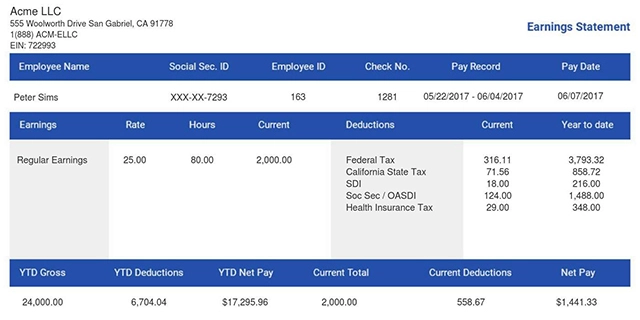
Involuntary deductions show up in the deductions section of your pay stub. Most use short codes. The same codes are used by most payroll systems, so they are easy to spot once you know them.
| Pay Stub Label | Meaning |
|---|---|
| FED TAX / FIT | Federal income tax |
| ST TAX / SIT | State income tax |
| SS TAX / OASDI | Social Security (FICA) |
| MED TAX | Medicare (FICA) |
| GARN | Wage garnishment (general) |
| CHSUP / CHLD | Child support garnishment |
| TXLVY / TXLEV | Tax levy (federal or state) |
| FDLVY | Federal tax levy |
| STULOAN / STUDLN | Student loan garnishment |
| BKRCY / BK13 | Chapter 13 bankruptcy repayment |
| CREDITOR | Creditor or judgment garnishment |
For Workers
Check the table first if you see an unfamiliar code. If you are still not sure, ask your HR or payroll team. You have a right to know what every deduction on your pay stub means.
For Small Business Owners
Clear pay stubs save time. When deduction codes are easy to read, workers ask fewer questions, and there are fewer payroll mistakes. You can build a pay stub with all the right codes at ThePayStubs.com.
What Should Employees Do if They See Unexpected Involuntary Deductions?
If a deduction shows up on your pay stub that you do not expect, do not panic. Take it step by step:
1. Check With HR or Payroll
Ask if a wage order is on file. If yes, get a copy. If no, the deduction may be a coding error, and HR can fix it.
2. Find Out Who Issued the Order
Look for the name of the court, the IRS, or the agency. The wage order will list a contact and a case number.
3. Contact the Issuing Authority
- IRS levy: Call 1-800-829-1040. Ask about a payment plan or a levy release.
- Child support: Call your state's child support enforcement office to review your case.
- Student loans: Call your loan servicer or the U.S. Department of Education at 1-800-4-FED-AID.
- Creditor garnishment: Contact the creditor or their attorney to ask about a settlement or payment plan.
4. Review Your Options
You cannot ask your employer to stop the deduction without a new court order. But you can:
- Set up an installment plan with the IRS or state to pause future levies.
- Ask the court to modify a child support order if your income has changed.
- File for a head-of-household exemption in states that allow it, such as Florida.
5. Get Help if the Amount Is Large
If a big share of your pay is being taken, talk to an employment attorney, a tax pro, or a nonprofit credit counselor. These pros can spot mistakes and help you fix them.
You Might Also Like
- What Does a Garnishment Look Like on a Pay Stub?
- Payroll Tax vs. Income Tax: What's the Difference?
- How to File Taxes With Your Last Pay Stub
- How to Tell the Difference Between a Real and a Fake Pay Stub
- How to Calculate W-2 Wages From Your Pay Stub
Conclusion
Involuntary deductions are a normal part of every payroll system. Both workers and employers benefit from knowing the types, the legal limits, and the right steps to take. With the right know-how, the process is clear and fair on both sides.
With a simple, easy-to-use pay stub builder, you can show every deduction in clean, plain language. Create a pay stub in just a few minutes at ThePayStubs.com.
- 1. Enter Your Information

- 2. Select Your Favorite Theme

- 3. Download Your Stub!

 By
By