

Operating Budget: What It Is and How to Build One (2026)
 By
By
An operating budget is the plan that tells you whether next year actually works on paper. It projects what you expect to earn and what it costs to keep the doors open, month by month. You find the shortfall in a spreadsheet instead of in your bank account. Most small businesses skip it because it sounds like corporate finance homework. The ones that build it start from their own pay stubs and bank records. They make smarter calls about hiring, pricing, and spending. This guide covers what goes into one and how it differs from a capital budget. You also get a six-step build process and a worked example with real numbers. The last part covers the payroll line that trips up most owners.
Key Takeaways
- An operating budget projects revenue and day-to-day running costs for one fiscal year, usually broken into months.
- The five standard parts are revenue projections, fixed costs, variable costs, semi-variable costs, and non-cash expenses.
- Payroll is the largest line for most employers. It costs more than gross wages, because employers pay part of the payroll taxes too.
- Budget 5% to 10% of monthly expenses for unexpected costs so one bad month does not break the plan.
- Compare your budget to actual results every month, then adjust. A budget you never revisit stops being useful by March.
- What Is an Operating Budget?
- What's Included in an Operating Budget?
- Operating Budget vs. Capital Budget: What's the Difference?
- How to Create an Operating Budget in Six Steps
- Operating Budget Example and Template
- Why Payroll Is the Line Item Most Budgets Get Wrong
- What Is an Operating Budget for a Nonprofit?
- How to Track Your Budget Against Actuals
- Common Budgeting Mistakes to Avoid
- Conclusion: Build Your Budget on Numbers You Can Document
What Is an Operating Budget?
An operating budget is a plan for one fiscal year, broken into months. It projects the revenue you expect to earn and the day-to-day costs of running your business. It covers rent, payroll, supplies, and software. It leaves out long-term buys like buildings or vehicles.
That operating budget definition matters for a practical reason. Because it only tracks recurring operations, your budget works as an early warning system. When a month projects a loss, you can see which line caused it. That gives you time to fix the problem. Self-employed readers get the same benefit on a smaller scale. The records they already use to show proof of income also feed the plan.
What's Included in an Operating Budget?

A complete budget has five parts: revenue projections, fixed costs, variable costs, semi-variable costs, and non-cash expenses such as depreciation. Fixed costs stay flat, variable costs move with sales, and semi-variable costs carry a base rate plus usage. A common approach is a buffer line worth 5% to 10% of monthly expenses.
Revenue Projections
Start with what you sell and what it costs customers. List each product or service with its price, then project units sold per month. Seasonality belongs here. If February is always slow, your budget should say so, not flatten the year into one average.
Fixed Costs
Rent, insurance, equipment leases, software plans, licenses, and salaried pay stay the same at any sales volume. Fixed costs are the easiest numbers to get right. They are also the hardest to change mid-year, so give them a hard look before you commit.
Variable Costs
Materials, shipping, card fees, hourly wages, and contractor work all rise and fall with sales. The cleanest way to budget variable expenses is as a percentage of revenue, using last year's ratio as your starting point.
Semi-Variable Costs
Some bills carry a flat base plus a usage charge. Utilities, phone plans with overage, and delivery services all work this way. Budget the base as fixed and estimate the usage portion of your semi-variable costs against projected sales volume.
Non-Cash and Non-Operating Expenses
Depreciation and amortization reduce profit without moving any money, so these non-cash expenses affect your books but not your cash flow. Interest on a loan sits outside normal operations as a non-operating expense. Both are worth a line so your budget matches what your accountant sees. For the payroll tax rates behind those lines, the IRS publishes current Social Security and Medicare withholding rates.
Operating Budget vs. Capital Budget: What's the Difference?
An operating budget covers recurring costs you pay to keep the business running this year, such as payroll, rent, and utilities. A capital budget covers one-time buys you will use for years. Think of a delivery van, a building, or a commercial oven. Those get planned separately.
The practical split comes down to timing. Operating vs capital budget decisions follow the same rule your tax return uses. Costs used up this year are operating. Assets that last beyond this year are capital. Capital budgets are typically approved once and funded from savings or financing, while your operating expense budget is reviewed every month. A capital budget vs operating budget mix-up is common, and it hurts. Drop a $30,000 truck into one month of operating costs and a healthy year looks like a disaster.
How to Create an Operating Budget in Six Steps

The budgeting process below works for a solo contractor and a twenty-person shop. Plan on two or three hours for a first pass.
Step 1: Start With Last Year's Numbers
Pull last fiscal year's profit and loss statement, plus bank and payroll records. Last year's data is the best guide you have. If you have no sales yet, use signed contracts and quoted supplier prices instead of guesses.
Step 2: Build Your Sales Budget
A sales budget projects units sold and revenue for each month. Build it by product or service line. Then adjust for known events: a planned launch, a seasonal peak, a contract ending in June. If you bill hourly, one billable hour equals one unit. It helps to know how to calculate your hourly, weekly, and monthly income before you project.
Step 3: Budget Your Direct Costs
Direct costs, or cost of goods sold, are what you spend to deliver the sale. That means materials, merchandise, subcontractors, and labor. Tie them to the sales budget so they scale on their own. If materials ran 30% of revenue last year, budget 30% this year unless you know a price is changing.
Step 4: Budget Your Operating Expenses
Now list your operating expenses by category and split each into fixed and variable. Annual bills go in the month you pay them. Spread them evenly and your cash flow plan will lie to you. If you pay a shift differential or regular overtime, budget it as a variable cost rather than folding it into salaries. Payroll belongs here too, and it deserves its own treatment, covered below.
Step 5: Add a Line for Unexpected Expenses
Every year brings costs you did not plan. Think of an equipment repair, a legal fee, a rush hire. Pad the budget in one of two ways. Set aside a flat annual amount and divide by twelve, or add 5% to 10% on top of monthly expenses. If you budgeted last year, the gap between budget and actuals is your padding number.
Step 6: Check the Profit and Adjust
Work out monthly net income. Take revenue, then subtract direct costs, operating expenses, and unexpected expenses. Then ask if that profit covers your debt payments, your taxes, and your own pay. If a month comes up short, cut variable expenses first. Then question fixed costs. Last, check whether you can raise revenue without raising costs at the same rate.
Operating Budget Example and Template
Here is a worked example for a three-person service business, shown as a first quarter. Every figure ties to the steps above.
| Line Item | January | February | March |
|---|---|---|---|
| Projected revenue | $28,000 | $26,500 | $34,000 |
| Direct costs (30% of revenue) | $8,400 | $7,950 | $10,200 |
| Gross profit | $19,600 | $18,550 | $23,800 |
| Payroll including employer taxes | $11,303 | $11,303 | $11,303 |
| Rent | $1,800 | $1,800 | $1,800 |
| Insurance | $450 | $450 | $450 |
| Software and phone | $260 | $260 | $260 |
| Marketing (variable) | $600 | $600 | $1,200 |
| Fuel and supplies (variable) | $900 | $850 | $1,100 |
| Buffer (7%) | $1,072 | $1,068 | $1,128 |
| Net income | $3,215 | $2,219 | $6,559 |
March carries a marketing push and higher supply use. It still produces the strongest month, because revenue rises faster than variable costs. February is the month to watch: a 5% revenue miss would cut that profit nearly in half.
Building a Small Business Operating Budget Template
This layout needs twelve monthly columns plus an annual total. Group the rows as revenue, direct costs, gross profit, fixed costs, variable costs, buffer, and net income. Add a second sheet for actuals so the comparison is built in. A spreadsheet handles this fine. Accounting software such as QuickBooks or Xero can pull in actuals for you.
Why Payroll Is the Line Item Most Budgets Get Wrong
Most guides list "salaries and wages" in a bullet and move on. That is where budgets break, because gross wages are not what payroll costs you. Say you pay $10,500 in monthly gross wages. The employer share of FICA adds 7.65% on top of taxable wages, or $803. That rate is 6.2% for Social Security plus 1.45% for Medicare. Budget $11,303, not $10,500, before federal and state unemployment tax and any benefits you cover.
Two more details catch small employers. The employer Social Security share has a cap. It stops at the first $184,500 of each employee's wages in 2026, per the Social Security Administration's contribution base. Medicare has no cap. A biweekly payroll also produces 27 paydays in some years rather than 26. That adds a full extra pay period of wages to the plan.
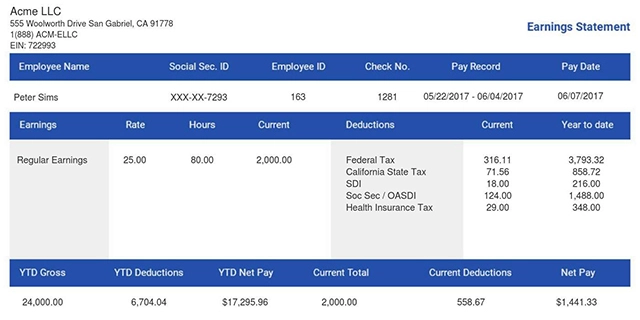
Build the payroll line from real pay records rather than memory. Gross wages, employer taxes, and hours worked all sit on the pay stubs you already issue. That makes them the most reliable input in the budget. Employers running more than a few people usually land on a paystub portal for exactly this reason.
What Is an Operating Budget for a Nonprofit?
A nonprofit budget projects annual revenue from donations, grants, program fees, and events. It weighs that against the cost of running programs and admin. It works like the business version, with two differences. Revenue is often restricted to specific uses. Boards usually vote to approve the budget before the fiscal year starts.
A non profit operating budget also splits program costs from admin and fundraising costs, and that ratio is the first thing funders check on your Form 990. Want a nonprofit operating budget template to copy? Take the business layout above and add a column that flags restricted versus unrestricted revenue. A good nonprofit operating budget example then breaks out costs program by program under the expense rows, so the board can see what each program really costs to run.
How to Track Your Budget Against Actuals
A budget only pays off when you compare it to reality. Each month, put actual results beside the plan. Then work out two numbers. Variance equals actual minus budget. Variance % equals variance divided by budget, times 100. If you budgeted $900 for supplies and spent $1,100, that is a $200 variance, or 22% over.
Set a threshold so you are not chasing noise. A workable threshold is 10% on any meaningful line, ignoring the rest. Recurring overages are the signal worth acting on. One bad month is usually timing. Three bad months is a pricing or spending problem. Operating budget adjustments made in month three cost far less than the same fix in month ten. Revising the plan mid-year is normal, not a sign of failure.
Common Budgeting Mistakes to Avoid
- Budgeting gross wages only and forgetting the employer half of payroll taxes.
- Spreading annual bills evenly across twelve months, which hides the cash crunch in the month they are actually due.
- Averaging revenue across the year when the business is clearly seasonal.
- Treating an ongoing contractor as a one-time cost rather than a recurring variable expense.
- Building the annual operating budget once and never opening it again.
- Leaving out a contingency line, which turns any surprise into an overdraft.
You Might Also Like
- What Is Gross Monthly Income?
- What Is Annual Income?
- Cost of Living by State
- The Best Business to Start With Little Money
- How to Create a Self-Employed Pay Stub
Conclusion: Build Your Budget on Numbers You Can Document
An operating budget is only as good as the records behind it. Revenue comes from invoices, direct costs from supplier bills, and the biggest line of all, payroll, comes from your pay records. Owners who keep clean records build budgets they can defend to a lender. Self-employed readers can prove income the same way. Start with last year's numbers, build the twelve months out, and check it monthly. Need to tighten your payroll records first? Create accurate pay stubs at ThePayStubs.com and give your budget a foundation you can stand on.
- 1. Enter Your Information

- 2. Select Your Favorite Theme

- 3. Download Your Stub!

 By
By