

How Does Salary Pay Work? A 2026 Paycheck Guide
 By
By
Your offer letter says $60,000 a year. Your first pay stub says $2,500, and the amount that reaches your bank is smaller still. Neither number is a mistake. So how does salary pay work? A salary is an annual promise delivered in equal pieces on a fixed schedule. The gap between those two numbers is where the confusion lives. This guide covers the per-paycheck math, how often salaried employees get paid, what comes out before the deposit lands, and the overtime rules. It also shows where a pay stub fits.
Key Takeaways
- Your annual salary is divided by the number of pay periods in the year, so the same $60,000 lands as $2,307.69 on one schedule and $2,500 on another.
- Biweekly means 26 paychecks a year and semi-monthly means 24. They are not the same thing.
- Gross pay is not take-home pay. Social Security, Medicare and income tax withholding come out first.
- Salaried does not automatically mean exempt. Salaried non-exempt employees still earn overtime past 40 hours.
- What Is Salary Pay?
- How Does Salary Pay Work, Paycheck by Paycheck
- How Is Salary Paid? Pay Frequency Compared
- How Salary Pay Works After Taxes Come Out
- Salary vs. Hourly Pay: What Actually Changes
- Salaried Employee Rules: Exempt, Non-Exempt, and Overtime
- What If a Salaried Employee Works Less Than 40 Hours?
- The Upside and Downside of Getting Paid Salary
- Proving Salary Income and Keeping Pay Records
What Is Salary Pay?
What's a salary? Salary pay is a fixed amount of compensation an employer agrees to pay for a job over a year, and it does not change with the hours you work in a given week. The figure is quoted annually, such as $60,000 a year, then split into equal paychecks across the year's pay periods under your employment contract.
What does salary mean day to day? The job sets your pay, not the clock, so a 36-hour week and a 44-hour week produce the same gross check. What is a salaried employee? Someone paid on that basis rather than by the hour, with the annual figure agreed before the first day. What does salaried mean for the rest of the offer? Full-time salaried employment usually carries benefits: paid time off, health insurance, retirement. The salary line alone understates what the job is worth, before any bonus.
How Does Salary Pay Work, Paycheck by Paycheck

Your employer divides your annual salary by the number of pay periods in the year to set each paycheck. A $60,000 salary paid semi-monthly is $2,500 of gross pay per period, 24 times a year. Under the federal salary basis rule, you receive that full amount for any week you perform work.
That division is the entire engine. It is how salary pay works at its simplest. How does a salary work when the calendar does not cooperate? The salary basis rule protects the number. If you worked at all during a week, your employer owes the full weekly salary. The week could run 34 hours or 54.
Two moments break the pattern, and both are normal. Your first paycheck is prorated because you started partway through a pay period. Your final one is prorated the same way. A mid-year raise splits a period too. How do salaries work then? Exactly as designed, even though the amount looks wrong. Switching employers mid-year splits the math the same way, since each job pays its own rate for the weeks you work there.
How Is Salary Paid? Pay Frequency Compared
Salary is paid on a set schedule: weekly (52 checks), biweekly (26 checks), semi-monthly (24 checks) or monthly (12 checks), usually by direct deposit. The annual total stays identical, and only the size and timing of each check change. Biweekly and semi-monthly are not the same thing: 26 checks versus 24.
Payday, pay cycle and pay period are three separate ideas.
| Pay schedule | Paychecks per year | Gross per check on a $60,000 salary |
|---|---|---|
| Weekly | 52 | $1,153.85 |
| Biweekly | 26 | $2,307.69 |
| Semi-monthly | 24 | $2,500.00 |
| Monthly | 12 | $5,000.00 |
Salary pay works the same on every line of that table; only the divisor changes. How often do salary workers get paid? That depends on the employer's payroll schedule. Biweekly pay lands every two weeks, so two months a year hold three paychecks. Semi-monthly pay lands on two fixed dates that suit rent. How do salary workers get paid? Almost always by direct deposit.
How Salary Pay Works After Taxes Come Out

What does salary pay mean for take-home? Less than the table suggests, because gross pay is the starting point, not the deposit. Social Security takes 6.2% of wages up to the 2026 wage base of $184,500. Medicare takes another 1.45% with no cap, plus 0.9% on wages above $200,000 a year, per the IRS withholding rates. Federal withholding follows your Form W-4, and most states add their own.
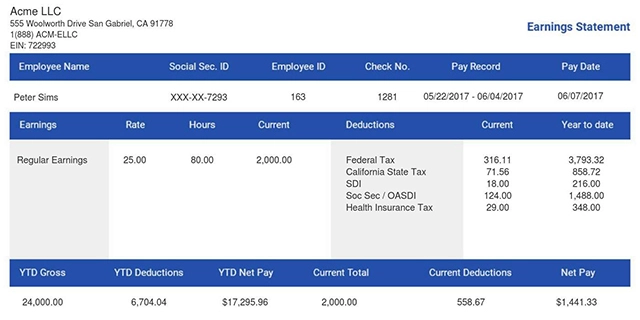
So how does salary work once withholding is applied? Run that $2,500 semi-monthly check through it: $155.00 to Social Security, $36.25 to Medicare. Federal and state income tax is withheld on top, along with pre-tax deductions for health insurance or retirement. Your pay stub itemizes each line, so it helps to know what a pay stub looks like.
Salary vs. Hourly Pay: What Actually Changes
| Salary pay | Hourly pay | |
|---|---|---|
| Pay is based on | The role | Hours worked |
| Overtime past 40 hours | Only if non-exempt | Always, at time and a half |
| Time tracking | Often no timesheet if exempt | Must clock in |
| Benefits | Usually included | Often limited |
The federal guidelines for salaried vs hourly employees come from one law: the Fair Labor Standards Act (FLSA). Classification decides the outcome, not the word in your offer letter, and it shapes what your annual income adds up to.
Salaried Employee Rules: Exempt, Non-Exempt, and Overtime
Salaried does not mean exempt. That assumption drives most of the back pay employers end up owing. A salaried non-exempt employee receives a fixed salary and is still owed minimum wage protections and overtime past 40 hours in a workweek.
Under federal salaried employee rules, exemption requires three things at once:
- Pay on a salary basis rather than an hourly rate.
- A salary of at least $684 per week, which is $35,568 a year.
- A job that passes the Department of Labor duties test for executive, administrative, professional, computer or outside sales work.
Highly compensated employees have a separate $107,432 threshold.
Treat higher figures in HR glossaries with caution. The 2024 rule that would have raised the threshold was vacated by a federal court on November 15, 2024. The Department of Labor republished the 2019 regulations on May 15, 2026. A job title alone never establishes exemption; job duties and pay level do. So do salary workers get overtime? Non-exempt ones do, and an overtime calculator shows what that overtime pay is worth.
What If a Salaried Employee Works Less Than 40 Hours?
An exempt employee who performs any work during a workweek is owed the full weekly salary, even after a 30-hour week. Employers may deduct only in narrow situations, such as full-day personal absences or unpaid disciplinary suspensions. A week with no work at all can go unpaid.
Do salaried employees get paid if they do not work for an entire week? Not necessarily. Partial days are different. An exempt employee who leaves at noon still gets the full day, and docking pay for a slow afternoon risks breaking the salary basis.
The Upside and Downside of Getting Paid Salary
What does it mean to get paid salary rather than hourly? Predictability, with a trade attached:
- Upside: a steady deposit you can budget against, benefits, and paid time off.
- Downside: no overtime in exempt roles, longer weeks, and a work-life balance you have to defend.
- For a small business: predictable costs, but misclassifying a non-exempt role is expensive to unwind.
Proving Salary Income and Keeping Pay Records
Salary pay works as proof of income only with a pay stub behind it. An offer letter proves little on its own. Landlords and lenders ask for recent stubs because a stub shows gross pay, deductions and the pay period behind the number. Employers carry the matching obligation: pay records for salaried employees are required even when nobody clocks in.
Need documentation of salary pay for either side? A stub sits on most proof of income checklists.
You Might Also Like
- How to Calculate W-2 Wages From a Pay Stub
- Payroll Codes Explained
- How to Get a Pay Stub From Direct Deposit
- State Pay Stub Laws
- What Paycheck Stubs Include
Conclusion
How does getting paid salary work once you strip it back? Salary pay works in three layers: the annual promise, the payroll calendar that slices it, and the withholding that decides what lands. Read those three and a paycheck stops being a surprise. When you need proof of that income, or records for the people you pay, create a pay stub with ThePayStubs.com in minutes.
- 1. Enter Your Information

- 2. Select Your Favorite Theme

- 3. Download Your Stub!

 By
By