

CA SDI Tax 2026: Rates, Who Pays, and Your Paycheck
 By
By
Find the CASDI line on a California pay stub and you'll see money leaving your check for something you never signed up for. That's the CA SDI tax, and in 2026 it takes 1.3% of every dollar you earn. There's no wage ceiling anymore, so it won't stop partway through the year the way it once did.
It isn't a mystery deduction, though. It buys you short-term wage replacement when illness, injury, pregnancy, or a new baby keeps you off the job. Below you'll find what the deduction is and how much should be coming out in 2026. You'll also learn how to spot it on your stub and your W-2, who qualifies to collect, and what employers owe. The last section compares California to the five other places running similar programs.
Key Takeaways
- The 2026 CA SDI tax rate is 1.3% of wages, and no wage ceiling applies.
- The deduction funds two programs: State Disability Insurance and Paid Family Leave.
- It appears on stubs as CASDI, CA SDI, SDI EE, or VPDI, and in Box 14 of your W-2.
- Benefits replace 70% to 90% of prior wages, up to $1,765 per week for as long as 52 weeks.
- Five other jurisdictions run comparable programs: New York, New Jersey, Rhode Island, Hawaii, and Puerto Rico.
- What Is CA SDI Tax?
- How Much Is CA SDI Tax in 2026?
- What Is SDI on My Paycheck?
- Who Pays CA SDI Tax and Which Wages Are Taxable
- Who Qualifies for SDI Benefits and How to File
- Employer Responsibilities for SDI Withholding
- Voluntary Plans: Can You Opt Out of CA SDI Tax?
- Is SDI Taxable Income?
- SDI Tax in Other States: NY, NJ, RI, HI, and PR
What Is CA SDI Tax?
CA SDI tax is California's State Disability Insurance deduction, a mandatory 1.3% withholding taken from employee wages in 2026. It funds two programs administered by the Employment Development Department: Disability Insurance for non-work-related illness or injury, and Paid Family Leave. Employees pay it; employers withhold and remit it but contribute nothing.
What is SDI? The acronym stands for State Disability Insurance, and the SDI meaning lands faster if you stop thinking of it as a tax at all. It's closer to an insurance premium collected through payroll. Every dollar flows into California's Disability Insurance Fund, which pays benefits back to workers who can't earn.
So what is SDI tax actually buying? Two things. Disability Insurance replaces part of your wages when a non-work-related illness, injury, pregnancy, or surgery keeps you off the job. Paid Family Leave comes out of the very same deduction. It covers time away to bond with a new child or care for a seriously ill family member.
That "non-work-related" qualifier is the detail people miss. What does SDI mean for an injury claim? It depends entirely on where you got hurt. Get injured on the clock and you're in workers' comp territory, a separate system your employer pays for entirely. The SDI tax meaning stops at what happens on your own time. The EDD administers both DI and PFL, and the same 1.3% covers the pair.
How Much Is CA SDI Tax in 2026?

The 2026 CA SDI tax rate is 1.3% of your wages, with no taxable wage ceiling. On $2,000 of gross pay, that is $26.00 withheld. Because California removed the wage cap on January 1, 2024, the deduction continues on every dollar you earn all year.
The rate has climbed two years running. Here's 2026 next to 2025, taken from the EDD's published contribution rates:
| Year | Withholding rate | Maximum weekly benefit | Taxable wage ceiling |
|---|---|---|---|
| 2025 | 1.2% | $1,681 | None |
| 2026 | 1.3% | $1,765 | None |
Check the Math on Your Own Stub
The arithmetic is a single multiplication. Take your gross pay for the period and multiply it by 0.013.
- $1,000 gross becomes $13.00
- $2,000 gross becomes $26.00
- $3,500 gross becomes $45.50
Someone earning $85,000 a year pays roughly $1,105 in SDI taxes over twelve months. Run your own number, then compare it to the SDI line on your stub. If the two don't match, ask payroll which wages they're running the rate against.
Why the Deduction No Longer Stops Mid-Year
Before 2024, the SDI tax California workers paid applied only up to an annual wage ceiling. High earners hit that cap, and the line simply disappeared from their stubs for the rest of the year. The ceiling was eliminated on January 1, 2024. Every dollar is now subject to withholding. That's exactly why a deduction you used to stop noticing in the fall now runs all twelve months.
What Is SDI on My Paycheck?
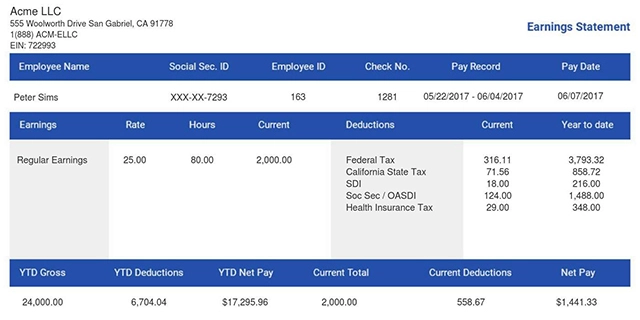
SDI on your paycheck is the State Disability Insurance deduction. California employers label it several ways: CASDI, CA SDI, SDI EE, SDI Employee Withheld, or CA disability employee tax. If your stub shows VPDI instead, your employer uses an approved Voluntary Plan. It appears in Box 14 of your W-2.
Payroll systems don't agree on what to call this line, which is the main reason people can't find it. Depending on who processes your pay, look for:
- CASDI or CASDI-E, the most common labels
- CA SDI or CA-SDI
- SDI EE or SDI Employee Withheld, where EE just means employee
- CA disability employee tax, spelled out in full on some systems
- VPDI, which signals a Voluntary Plan rather than an error
Wherever it lands, the line sits in the deductions column beside federal income tax, California income tax, Social Security, and Medicare. It's a separate payroll deduction from all four. Anyone asking what is SDI tax on my paycheck is usually looking right at it under an abbreviation they didn't recognize.
What Does SDI Mean on W2 Forms?
Come January, check Box 14, labeled "Other." Your SDI or VPDI contributions for the year appear there. They don't go in Boxes 3 through 6, where Social Security and Medicare amounts get reported. Box 14 is informational, so your employer uses it to pass along amounts that don't have a dedicated box of their own.
That figure matters at filing time, and it's one of several differences between a W-2 and a pay stub. If you itemize on your federal return, SDI you paid may count toward your state and local tax deduction. Check with a tax professional before claiming it.
Who Pays CA SDI Tax and Which Wages Are Taxable

Employees pay the CA SDI tax outright. Your employer withholds it and forwards it to the state, but unlike Social Security and Medicare, the employer matches nothing. It's your money funding your own potential claim.
Which wages count? All of them, now that the ceiling is gone. Regular pay, overtime, bonuses, and commissions all fall under the 1.3%.
A few groups sit outside the system: certain government employees covered by other plans, some employees of religious organizations, and most independent contractors. Self-employed Californians aren't stuck, though. They can opt in through Disability Insurance Elective Coverage. It lets business owners and sole proprietors buy into the same benefit pool their employees rely on.
Need pay documentation for a rental application or a loan while you're between payroll systems? Our pay stub templates make it quick.
Who Qualifies for SDI Benefits and How to File
Paying in is only half of it. To collect, you need to meet three conditions:
- You can't do your regular work for at least eight days
- You've lost wages because of it
- You paid into SDI during your base period
Weekly benefits run 70% to 90% of the wages you earned 5 to 18 months before your claim starts. In 2026 that tops out at $1,765 per week, and a claim can run as long as 52 weeks, for a maximum of $91,780. Covered reasons include non-work illness or injury, pregnancy and childbirth, elective surgery, and drug or alcohol rehabilitation. The Paid Family Leave side works the same way. Employees who need time to bond with a new child, or to care for a seriously ill family member, draw from the same fund.
One caution worth knowing before you file: Disability Insurance replaces income, but it doesn't protect your job. Separate laws like FMLA and the California Family Rights Act handle that. File through myEDD, the state's online portal, using SDI Online. Applying online beats mailing paperwork, which can add weeks.
Employer Responsibilities for SDI Withholding
Employers don't fund SDI, but they own the mechanics of it. That means registering with the EDD, applying the correct rate to every paycheck, and remitting alongside other payroll taxes.
Three things trip employers up:
- Applying a stale rate. The rate changed in January. Payroll running 1.2% into 2026 under-withholds every employee.
- Tracking a wage cap that no longer exists. There's no ceiling to stop at, so the deduction runs on all wages, all year.
- Labeling the line poorly. Employees can't reconcile a stub they can't read. Label it clearly, follow your state pay stub laws, and report SDI taxes correctly in Box 14 of the W-2.
Location doesn't get you out of it either. An out-of-state employer with California-based staff still owes SDI withholding for those workers, and still has to meet California's pay stub requirements.
Voluntary Plans: Can You Opt Out of CA SDI Tax?
Individual employees cannot opt out of CA SDI tax. Your employer, however, can replace the state program with an approved Voluntary Plan that matches or exceeds state benefits. The 2026 Voluntary Plan employee contribution rate is 1.2%. That is why some California pay stubs show VPDI rather than CASDI.
A Voluntary Plan has to be at least as good as the state plan on every benefit. A majority of the employer's California workforce also has to agree to it. Once approved, employees at that company contribute to the private plan instead of the state fund. Narrow exemptions exist beyond that, mostly for certain religious groups and specific categories of public employment, but they don't apply to the ordinary W-2 employee.
Is SDI Taxable Income?
California Disability Insurance benefits are generally not taxable, at either the federal or state level. Two exceptions matter. DI benefits paid in place of unemployment are federally taxable. Paid Family Leave benefits are also federally taxable and reported on Form 1099-G. California does not tax PFL benefits.
Keep the two halves separate in your head. The benefits you receive follow the rules above. The contributions you pay in are a different question, and those may be deductible as state taxes paid if you itemize.
SDI Tax in Other States: NY, NJ, RI, HI, and PR
Only six US jurisdictions require a disability program. California's is the priciest for employees by a wide margin.
| Jurisdiction | 2026 employee rate | Notes |
|---|---|---|
| California | 1.3% | No wage cap |
| Hawaii | Up to 0.5% | Capped at $7.50 per week |
| New Jersey | 0.19% | Employee share of TDI |
| New York | 0.5% | Capped at $0.60 per week |
| Rhode Island | 1.1% | Wage base of $100,000 |
| Puerto Rico | 0.6% total | Split evenly with the employer |
New York: DBL, Not PFL
New York's program is DBL, short for Disability Benefits Law. It takes 0.5% of wages capped at $0.60 per week, so no employee pays more than $31.20 a year. Employers cover the remaining premium.
The NY SDI tax meaning is narrower than California's, and one mix-up is worth flagging. New York runs a separate Paid Family Leave deduction at its own rate. Some payroll guides quote that PFL figure as the "NY SDI" rate. It isn't. The NY SDI meaning stops at short-term disability for your own illness or injury. So what is NY SDI tax on an employer's remittance schedule? Two separate lines, not one.
New Jersey, Rhode Island, and the Rest
The NJ SDI tax meaning is much the same, with far smaller numbers. New Jersey's Temporary Disability Insurance takes 0.19% from employees in 2026, and employers pay a share too. Employers who ask what is NJ SDI tax funding are looking at the same short-term wage replacement California provides.
The RI SDI tax, formally Temporary Disability Insurance, runs 1.1% on the first $100,000 of wages. That makes Rhode Island the closest match to California's employee-funded design. Hawaii caps its deduction at $7.50 per week and makes the employer pay the balance. Puerto Rico splits its 0.6% evenly between employer and employee on the first $9,000 of wages.
You Might Also Like
- How to Calculate W-2 Wages From a Pay Stub
- What Does a Pay Stub Look Like?
- How to Get a Pay Stub From Direct Deposit
- Paystub Generator for the Self-Employed
- Payroll Codes Explained
Conclusion
The CA SDI tax meaning comes down to a simple trade. You pay a small deduction every pay period. In exchange you get wage replacement of up to $1,765 a week when you genuinely can't work. In 2026 that deduction runs 1.3% of your wages with no ceiling, and it funds both disability and paid family leave.
Take one minute with your next stub. Multiply your gross by 0.013 and confirm the SDI line matches what the CA SDI tax should be costing you. If you're an employer, run the same check across your payroll before the next cycle. Need clean, accurate pay records with every deduction itemized properly? Our paystub generator builds professional stubs in minutes.
- 1. Enter Your Information

- 2. Select Your Favorite Theme

- 3. Download Your Stub!

 By
By