

What Is Compensation Strategy? A 2026 Employer Guide
 By
By
Most small employers don't decide their compensation strategy. They inherit one. The first hire's salary sets an informal benchmark. The second hire negotiates a little harder. Two years later you're explaining to a five-year employee why the person they trained earns more than they do.
So what is compensation strategy, and how do you build one before that conversation happens? It's the written set of rules behind every pay decision. That runs from the first offer to the numbers your pay stub generator prints each period. Those rules cover what a role is worth, what earns a raise, and where you sit against the market.
This guide walks through the definition, the four components, and the three market positions. It also covers a seven-step build process, what federal law requires, and the pay records that prove any of it.
Key Takeaways
- A compensation strategy is your written plan for how pay, raises, and benefits get decided across the organization.
- Benefits aren't a rounding error. They made up 30.1% of what private employers paid per hour worked in March 2026.
- Every strategy takes one of three market positions, and most real ones mix them by component.
- Federal law sets the floor on wages and requires you to keep the pay records that prove what you paid.
- A strategy nobody wrote down and nobody can evidence isn't a strategy.
- What Is Compensation Strategy?
- Why Your Compensation Strategy Matters
- What Are the Key Components of a Compensation Strategy?
- What Are the Three Main Types of Compensation Strategies?
- How to Build a Compensation Strategy in 7 Steps
- What Is an Example of a Compensation Strategy?
- Compensation Strategy Compliance: FLSA, Equal Pay and Pay Equity
- Documenting Your Compensation Strategy in Pay Records
- What Is Compensation Strategy for Small Teams and the Self-Employed?
- Common Compensation Strategy Mistakes to Avoid
What Is Compensation Strategy?
A compensation strategy is an organization's documented plan for how it pays people. It covers base pay, variable pay, benefits, and the rules that govern raises. The strategy sets salary ranges, defines what earns an increase, and positions the company against the market. It answers how pay gets decided, not just what any one person earns.
That last part is what separates it from a number. Ask a room of managers "what is a compensation strategy?" and most of them will answer with a salary figure. It isn't one. It's a decision framework. Its whole job is to make your next pay decision consistent with your last one.
The practical test is simple. Say two people doing the same work at your organization earn different amounts. Can you explain why in one sentence, using a rule you wrote down before either was hired? If yes, you have a compensation strategy. If you're reaching for the circumstances of each hire, you have a pattern of decisions instead.
Compensation Strategy vs. Compensation Philosophy vs. Compensation Plan
These three terms get used interchangeably, and they're not the same thing.
Your compensation philosophy is the why. It's the principle underneath everything. Something like "we pay for skill, not tenure," or "we'd rather be generous with time off than with salary."
Your compensation strategy is the how and the what. It turns that principle into an approach: benchmark twice a year, pay at the market midpoint, tie raises to a competency review.
Your compensation plan is the paperwork. It holds the actual ranges, the actual bonus criteria, and the actual benefits list.
Philosophy without strategy is a slogan. Strategy without a plan never reaches an employee.
Why Your Compensation Strategy Matters

Pay is the first filter most candidates apply, and the last reason many of them leave. Getting it right is how you attract and retain top talent. Getting it wrong shows up in employee satisfaction long before anyone resigns. That much is obvious. What's less obvious is how much of your compensation budget never appears as salary at all.
According to the U.S. Bureau of Labor Statistics, private industry employers spent an average of $46.60 per hour worked on employee compensation in March 2026. Wages and salaries accounted for $32.60 of that, or 69.9%. Benefits accounted for the remaining $14.01, or 30.1%. Nearly a third of what you spend on an employee shows up somewhere other than their salary line.
That reframes the exercise. Manage only salaries and you're running about two-thirds of your compensation spend while guessing at the rest. It also explains why a lagging salary can still be a competitive offer when the benefits behind it are strong.
There's an internal argument too. Without written rules, pay drifts. New hires get benchmarked against today's market. Existing staff stay anchored to the market of three years ago. Nobody notices until someone resigns. A compensation strategy is partly a retention tool, partly a budget ceiling, and mostly a way to keep yourself honest.
For employees, the logic runs in reverse. Knowing where your employer sits tells you whether your next raise comes from a market adjustment, a promotion, or not at all.
What Are the Key Components of a Compensation Strategy?
Four components make up most compensation strategies. Base pay is the fixed salary or hourly wage. Variable pay covers bonuses, commissions, and equity. Employee benefits include health insurance, retirement plans, and paid time off. Pay structures set job levels and salary ranges. A written compensation philosophy sits underneath all four and explains why they were set that way.
Base Pay
The fixed salary or hourly wage is what an employee can count on every period. Base pay is the foundation everything else sits on. It's also the number people compare when they talk to friends in the same field. Base salary is set by the role's scope, the skills it needs, and what the market pays for it.
Variable Pay and Performance-Based Incentives
This is the part of the package that moves. Bonuses, sales commissions, profit sharing, and equity compensation all count as variable pay. Performance-based incentives work best where output is genuinely measurable. Where it isn't, they tend to become an expected annual payment that motivates nobody and costs you anyway.
Employee Benefits and Non-Monetary Benefits
Health insurance, retirement plans, paid time off, and parental leave make up the indirect side of employee compensation. Non-monetary benefits sit alongside these employee benefits and cost less: flexible schedules, remote work, development opportunities. If you're comparing two offers, this is the category that most often decides it. It's also the one most people forget to price.
Pay Structures and Salary Ranges
Roles get organized into levels, and each level gets a salary range with a minimum, a midpoint, and a maximum. Pay structures are what make the strategy repeatable. Without them, every offer is a fresh negotiation, and every raise conversation starts from zero.
What Are the Three Main Types of Compensation Strategies?

The three main types are leading, meeting, and lagging the market. Leading pays above the market midpoint to win scarce talent. Meeting pays at the midpoint, the default for most employers. Lagging pays below it deliberately, offset by equity, flexibility, or benefits. Most real strategies mix positions by component.
Leading the Market
You pay above the midpoint to win candidates you'd otherwise lose. It works, and it's expensive. Most employers lead on one or two hard-to-fill roles rather than across the whole headcount. Leading everywhere means paying a premium for roles where you had no competition anyway.
Meeting the Market
You aim at the midpoint and stay there. This is where most employers land, and it's a perfectly good answer. It keeps your compensation packages aligned with industry standards. You also avoid a premium you'd struggle to sustain through a slow year.
Lagging the Market
You pay below the midpoint on purpose, because the money isn't there or you're spending it elsewhere. Lagging only works when it's paired with something real: better benefits, genuine flexibility, equity, or work people want to do. Lagging by accident, with nothing offsetting it, is just underpaying.
Here's the part the three-bullet version leaves out: almost nobody picks one position and applies it everywhere. A business might lag on cash salary to protect margin while leading on paid time off and schedule control. That's coherent as long as it's deliberate. What breaks is mixing without deciding. That means lagging on cash because you never benchmarked, and lagging on benefits because you never priced them.
How to Build a Compensation Strategy in 7 Steps
Building your compensation strategy is a sequence of decisions, and the order matters. Each step narrows the next one.
- Write down your compensation philosophy. One or two plain sentences about what you're actually paying for: skill, tenure, output, or reliability. It's what you'll fall back on every time a pay decision gets uncomfortable. Make it something you'd read out loud to your employees.
- Set your budget honestly. Work out what you can sustain, not what you can afford in a good quarter. Include the benefits load, not just salaries, because that's roughly a third of the real cost. A strategy your organization can't fund through a slow year isn't a strategy, it's an intention.
- Benchmark against the market. Pull salary surveys, industry reports, and live job postings for your roles, filtered to your region. Cost of living by state is a useful sanity check. Public salary data is noisy and skews toward whoever chose to report. Treat any single source as a data point rather than an answer. Three sources that roughly agree beat one that sounds precise.
- Set salary ranges before you make offers. For each level, decide a minimum, a midpoint, and a maximum, and write them down. This is the step people skip, and skipping it is expensive. Make the offer first and that offer silently becomes your range. Every future hire in that role then gets benchmarked against a number you never chose.
- Decide how variable pay works. Choose which roles get performance-based incentives, what triggers them, and what they're worth. Say it in numbers your employees can check themselves against. A bonus nobody can predict is a gift, not an incentive.
- Choose your benefits mix. Start with what your workforce actually uses rather than what looks impressive in a job ad. Health insurance and retirement plans carry the most weight for most people. Flexibility and development opportunities often cost less and land harder with a younger team.
- Write it down and tell your employees. An unwritten compensation strategy lives in one person's head and changes shape every time they're tired. Document the ranges, the raise criteria, and the review date, then explain the reasoning. Human resources professionals will tell you the explanation matters as much as the number, and they're right. Most pay complaints are really complaints about not understanding the rule.
What Is an Example of a Compensation Strategy?
Basecamp is a documented example. It pays everyone in the same role at the same level identically, targeting the top 10% of San Francisco market rates no matter where an employee lives. There are no negotiated salaries, bonuses, or stock options. Profit sharing sits on top. An early-stage startup does the reverse: below-market salaries offset by equity grants.
Neither is obviously right. Basecamp leads the market on cash and takes location and negotiation skill out of the equation. The startup trades certainty today for a share of an uncertain future. That suits people who want the trade and filters out everyone else.
What makes both of them strategies is that each is internally consistent. Each can also be explained to a candidate in about thirty seconds. The failure mode isn't picking the wrong position. It's having a compensation package that can't be explained at all.
Compensation Strategy Compliance: FLSA, Equal Pay and Pay Equity
Your strategy sits on top of a legal floor, and the floor isn't optional.
The Fair Labor Standards Act sets a federal minimum wage of $7.25 per hour, effective July 24, 2009. It also requires overtime pay of at least one and one-half times the regular rate. That applies to hours worked beyond 40 in a workweek. Many states set a higher minimum, and where they do, the higher rate applies. Check the state you employ people in, not the state your business is registered in. The same goes for state pay stub laws.
Then there's pay equity. The Equal Pay Act is enforced by the Equal Employment Opportunity Commission. It requires equal pay for jobs that need substantially equal skill, effort, and responsibility under similar working conditions. Differences are lawful only under a seniority system, a merit system, a system measuring quantity or quality of production, or a factor other than sex.
Here's the rule most articles on wage equity skip, and it has a real budget consequence. Say a pay audit turns up a gap you can't justify under one of those four exceptions. The statute doesn't let you close it by cutting the higher-paid employee's wage. You have to raise the lower one. Budget for that before you run the audit, not after.
All of which only matters if you can demonstrate it. Compliance you can't evidence is compliance you'll struggle to defend.
Documenting Your Compensation Strategy in Pay Records
Nobody on your team is going to read your compensation strategy document. They'll read their pay stub. That's the only place the strategy becomes visible to the people it applies to. It's where most of the trust is won or lost.
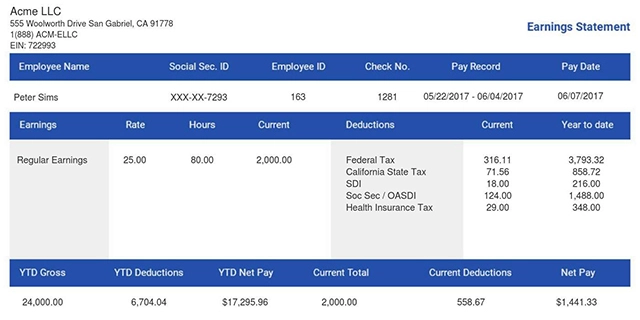
Federal law treats this as an obligation, not a nicety: employers must keep employee time and pay records under the FLSA. Practically, each pay period should produce a record showing the base rate and the hours worked. It should also list every variable pay line separately rather than bundled into one figure, plus the deduction codes applied.
Separating those lines matters more than it sounds. A bonus buried inside a single gross-pay number is a bonus your employee never sees you paying. You spent the money and got none of the retention value. It also leaves you reconstructing the arithmetic from memory next time someone queries their pay.
Don't have a payroll system producing that level of detail yet? A pay stub generator will produce properly itemized records in a couple of minutes.
What Is Compensation Strategy for Small Teams and the Self-Employed?
For a team of two or three, a compensation strategy is four decisions. Pick a market position. Write one salary range per role. Decide what triggers a raise, and set a review date. It's an afternoon's work, not an HR project, and the version that actually gets used.
Most guides here are written for HR departments, startups, or global enterprises, and none of that scales down cleanly. Keep the market position rough. Base the ranges on whatever local data you can find. Make the raise trigger concrete: a review date, a skill, or a revenue milestone.
If you're self-employed, the same thinking applies to paying yourself. Your salary or owner's draw is your compensation strategy. You'll need records of it the moment a lender or landlord asks you to prove your income. Deciding the number deliberately and documenting it every period beats reconstructing a year of transfers later.
Common Compensation Strategy Mistakes to Avoid
Four failures account for most of the damage. Each has a fix that takes less time than the problem it prevents.
- Writing the philosophy but never the ranges. A values statement about fair pay doesn't help the person making an offer on Thursday. Fix: one range per role, written down, before the next hire.
- Setting ranges once and never revisiting them. Markets move, and ranges that once helped you remain competitive quietly become historical fiction. Fix: an annual review date in the calendar, owned by a named person.
- Letting pay compression build. New hires come in at current market rates. Long-tenured staff stay where they started, until the gap closes or inverts. Fix: when you adjust a range, check everyone already inside it, not just the incoming hire.
- Keeping no record of how a decision was made. A year later, nobody remembers whether that raise was for performance, retention, or a market correction. Fix: one line of reasoning saved with each pay change.
The pattern across all four is the same. None of them are strategy problems. They're documentation problems wearing a strategy costume.
You Might Also Like
- What Are Paycheck Stubs and What Do They Show?
- Payroll Codes Explained
- Pay Period Breakdown: Weekly, Biweekly, Semi-Monthly and Monthly
- Using Pay Stubs for Loan Applications
- How to Acquire an Earnings Statement
Conclusion
So, what is compensation strategy when you strip it back? Not the salary number. It's the written rule that produced the number. That rule is what lets you defend the number a year later to an employee, an auditor, or yourself. Pick a market position on purpose, write one range per role, decide what earns a raise, and set a date to review it.
Then document what you actually paid. Federal law expects those records, and your employees read them every period. They're the only proof that the strategy on paper is the strategy in practice. A reliable paystub generator creates itemized pay records in minutes, for a team or for yourself.
Start this week with one role. Write the range, write the reason, and you're ahead of most employers your size.
- 1. Enter Your Information

- 2. Select Your Favorite Theme

- 3. Download Your Stub!

 By
By