

What Is Payroll Integration? Types, Benefits, and How to Set It Up
 By
By
Your time clock says one thing. Your payroll system says another. Someone reconciles the two by hand, usually on a Friday afternoon.
That's the gap payroll integration closes. So what is payroll integration, exactly? It's the connection that lets payroll pull data straight from the systems that feed it, instead of someone re-typing it. That accuracy decides whether the numbers on your pay stub are right. Below you'll find the types (including the 180 and 360 setups people ask about), which systems to connect first, what setup involves in 2026, and what it costs. If you run payroll, it also decides how much of your Friday you get back.
Key Takeaways
- Payroll integration connects payroll to the systems that feed it, so hours, pay changes, and deductions transfer automatically instead of being entered twice.
- A 180 integration sends data one way into payroll. A 360 integration syncs both directions.
- Time tracking and accounting are the two systems most worth connecting first.
- Exporting a spreadsheet and re-uploading it is not integration, because a person still moves the data.
- What Is Payroll Integration?
- How Does Payroll Integration Work?
- Types of Payroll Integration: 180 vs 360
- What Systems Integrate With Payroll?
- Benefits of Payroll Integration
- Challenges and Costs to Plan For
- How to Integrate Payroll With Your Existing Systems
- What Payroll Integration Means for Your Pay Records
What Is Payroll Integration?
Payroll integration is a connection between your payroll system and the other software that feeds it, such as time tracking, HR, accounting, and benefits. Instead of entering the same hours, pay rates, and deductions twice, the data moves between systems automatically, so every payroll run starts from one accurate set of numbers.
Most small businesses start with the alternative: a time clock that produces a report, a person who reads it, and a payroll screen where the numbers get typed again. That works until someone mistypes 38.5 as 35.8. For an owner, integration removes that transfer step. For an employee, it's the reason the hours on a stub match the hours actually worked.
How Does Payroll Integration Work?

Payroll integration works by linking each source system to payroll through a built-in connection, a third-party connector, or an API. The source system holds the original record, such as hours worked or a benefit election. On a set schedule or in real-time, that data is mapped to matching fields in payroll and synced.
The mapping step matters more than most people expect. Your time system might call it "OT1" while payroll calls it "Overtime Premium," and something has to reconcile those names before a single hour transfers correctly. A payroll API integration handles this programmatically, which is why it's the most flexible option when your systems weren't built to talk to each other. Built-in connections are simpler but only work with the partners your provider already supports.
Types of Payroll Integration: 180 vs 360
Most payroll integrations fall into one of two shapes, and the difference is simply which way the data travels.
| 180 integration | 360 integration | |
|---|---|---|
| Data direction | One way, into payroll | Two way, in and back out |
| Common example | Time clock sends approved hours | Employee records stay matched across HR and payroll |
| Main limit | Edits made in payroll don't travel back | More mapping to set up and maintain |
A 360 payroll integration costs more effort up front because every field has to agree in both directions. It pays off when two systems both hold employee data that changes often, like a raise entered in HR that has to reach payroll before the next run.
One distinction worth drawing: true payroll integration means the systems move the data themselves. Exporting a CSV every other Thursday and re-uploading it is a file transfer with extra steps, because a person still has to remember to do it.
What Systems Integrate With Payroll?

The systems most often integrated with payroll are time and attendance, HR or HRIS platforms, accounting and ERP software, benefits and retirement providers, and expense tools. Time tracking is usually connected first because hours drive gross pay, and accounting is a close second because every payroll run posts to the general ledger.
| System | What flows into payroll | Why it's worth connecting |
|---|---|---|
| Time and attendance | Hours, overtime, PTO taken | Hours drive gross pay, so errors here reach every stub |
| HR or HRIS | New hires, pay changes, terminations | Keeps one employee record instead of two |
| Accounting and ERP | Payroll totals posted to the general ledger | Closing the books stops being a manual entry |
| Benefits and retirement | Deduction amounts and contribution rates | Elections change mid-year and payroll has to follow |
| Expense management | Approved reimbursements | Pays them out with regular wages |
Accounting software is where most small businesses feel the difference first. A QuickBooks payroll integration posts each run to the right accounts automatically, which is the difference between a five-minute close and an afternoon of journal entries. A Xero payroll integration does the same job if that's the ledger you keep. On the benefits side, a 401k payroll integration keeps contribution rates and loan repayments current, so a rate change doesn't sit unapplied for a pay cycle. Larger setups add SSO so people aren't managing separate logins for every system.
Benefits of Payroll Integration
- Fewer manual data entry errors. Every hand transfer is a chance to transpose a number. Removing the transfer removes the error.
- Faster payroll processing. Approving hours replaces rebuilding them, which is most of what shortens a payroll run.
- Cleaner reconciliation. When payroll posts to the general ledger directly, your payroll data and your financial statements agree without anyone chasing the difference.
- Better compliance footing. Accurate, consistent hour records are what FLSA recordkeeping rules require employers to keep, and integrated systems produce them as a byproduct.
- Current deductions. Benefit and retirement changes reach payroll on time instead of a cycle late.
For a finance team, the win is that the numbers reconcile themselves. For an employee, it's quieter but more direct: PTO balances match what the app showed, and overtime lands in the right period.
Challenges and Costs to Plan For
Integrating payroll isn't free or automatic, and three problems cause most of the trouble.
Duplicate employee records. When both HR and payroll believe they own the employee list, one new hire becomes two records with slightly different names, and the second one gets its own paycheck. Decide which system is the source of truth before connecting anything.
Pay-period boundaries that don't line up. A time system running Monday to Sunday feeding a payroll cycle that ends Wednesday will strand hours in the wrong period every single run.
Deduction codes that only exist on one side. A new benefit set up in the benefits platform with no matching code in payroll simply won't transfer, and it fails quietly.
On cost, expect a per-employee-per-month add-on, a one-time setup fee, or both, plus internal time for mapping and testing. Ask your payroll provider specifically whether the connection is included or billed separately.
How to Integrate Payroll With Your Existing Systems
- List what you re-type today. The system whose numbers you enter by hand most often is the one to connect first.
- Pick the source of truth for each field. Hours come from time tracking, pay rates from HR, and only one system gets to be right.
- Check what your current payroll application already supports. A built-in connection to software you own beats payroll integration software you have to buy and configure.
- Clean the data before you connect it. Duplicate records and stale terminations transfer just as reliably as good data.
- Run parallel for one cycle. Process payroll the old way and the new way, then compare totals before you trust the connection.
- Test the year-end path. Integrated payroll data feeds your employment tax deposits and reporting, so confirm the totals hold up before January, not during it.
Three questions separate real payroll integration software from a badge on a pricing page: does it write data back or only read it, can you map your own deduction codes, and does it support your pay frequency? A tool that only handles semi-monthly is no help if you run weekly.
What Payroll Integration Means for Your Pay Records
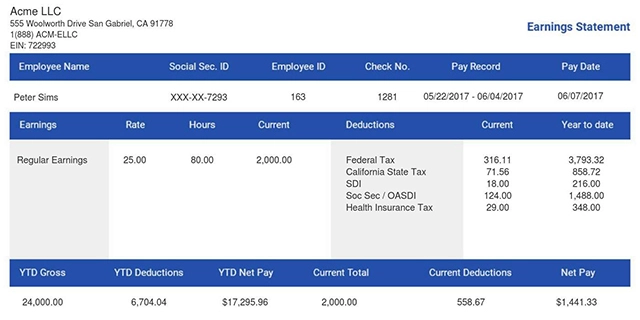
This is the part that gets skipped. Integration is what determines whether the hours, overtime, and deduction lines on a stub are correct in the first place, because every one of those figures arrives from another system.
For employers, it also shapes what you can produce on request. Connected systems keep hours, earnings, and deductions consistent across payroll and HR, so a records request or a state pay stub requirement doesn't turn into an archaeology project.
For employees, the move is simple: after any payroll or timekeeping change, check your next stub against your own hours. A mapping mistake shows up as a wrong rate or missing deduction, and it's easiest to fix in the same pay period. If you need clean pay documentation your employer's system can't produce, our pay stub templates cover it.
You Might Also Like
- Payroll Codes Explained
- Who Is Responsible for Payroll?
- How to Get a Pay Stub From Direct Deposit
- Employment Verification and Proof of Income Documents
- Payroll vs Compensation: What's the Difference?
Conclusion
Payroll integration connects payroll to the systems that already hold your data, so hours, pay changes, and deductions move on their own. Decide whether you need one-way or two-way sync, connect the system you re-type from most, and confirm the totals before you rely on it. The payoff is a shorter payroll run and records that hold up.
Need professional pay documentation without waiting on a payroll system? Use our paystub generator to create accurate pay stubs in minutes.
- 1. Enter Your Information

- 2. Select Your Favorite Theme

- 3. Download Your Stub!

 By
By