

Pay Period 2026: How Many You Get and When You Actually Get Paid
 By
By
Almost every payroll question comes down to two things: how many times you get paid this year, and how long you wait after the work is done. Your pay period decides both. It is the window your employer measures work in. It shapes your paycheck size, your overtime, your tax withholding, and the wait between finishing a shift and seeing the money. If you need clean documentation of any of it, ThePayStubs.com generates it in minutes.
This guide covers how long each pay schedule runs and exactly how many 2026 holds. That includes the Thursday quirk that hands some people a 27th paycheck. It also covers when the money lands after a period closes, what to expect at a new job, and the rules employers must follow.
Key Takeaways
- A pay period is the window work is measured in. The payday is a separate, later date.
- 2026 normally gives you 52 weekly, 26 biweekly, 24 semimonthly, or 12 monthly pay periods.
- Because 2026 starts and ends on a Thursday, it holds 53 Thursdays, so Thursday payers can get 53 weekly or 27 biweekly paychecks.
- Biweekly is the most common length, at 43.0% of private establishments in the BLS February 2023 snapshot. That is a plurality, not a majority.
- Pay frequency never changes your overtime, because federal rules require each workweek to stand alone.
- Federal law sets no pay frequency. State law does, and it differs sharply by state.
- What Is a Pay Period?
- How Long Is a Pay Period?
- How Many Pay Periods Are in 2026?
- If You Get Paid Every Friday, When Does the Pay Period Start and End?
- When Do I Get Paid After the Pay Period Ends?
- How Long Does It Take to Get Paid at a New Job?
- Where the Pay Period Shows Up on Your Pay Stub
- Pay Period Rules Employers Must Follow
- Does Pay Frequency Change Your Overtime or Taxes?
- How to Choose the Right Pay Period
What Is a Pay Period?
A pay period is the block of time your employer measures work in, with a fixed start date and end date. It is not the day you get paid. Hours worked inside that window are totaled, taxed, and paid out later on the payday assigned to that period.
That distinction is where most confusion starts. Every one of them has three dates attached: the start, the end, and the payday that settles it. For the definition on its own, see our guide to what pay periods are. If the vocabulary keeps tripping you up, we also cover the difference between a payday, a pay cycle and a pay schedule.
How Long Is a Pay Period?

Most US pay periods run one week, two weeks, half a month, or a full month. Two weeks is the most common single length, covering 43.0% of private establishments in the BLS February 2023 snapshot. Length is set by your employer within state limits, not by federal law. Each produces a very different rhythm.
Weekly Pay Periods: Start and End Dates
This is the shortest common schedule and the tightest possible link between doing the work and being paid for it. The typical weekly pay period start and end date pairing is Sunday through Saturday, or Monday through Sunday. Payday lands a few days after the close. That is 52 paychecks a year.
Weekly dominates in construction, where 65.4% of establishments use it. For hourly workers it makes rent and groceries easier to time. For the business it means running payroll 52 times instead of 26, which is real administrative cost.
Biweekly Pay Periods
A biweekly period is 14 days, always ending on the same weekday, paid every other week, producing 26 paychecks in a normal year. Because 26 payments do not divide evenly into 12 months, two months each year hold three paydays instead of two. Those three-paycheck months are a budgeting windfall for employees and a cash-flow spike for employers.
Biweekly is the most common arrangement in the country, which is why two week pay questions come up so often. It also keeps overtime simple, because each of the two workweeks inside the period is still calculated on its own.
Semimonthly Pay Periods
This one splits the calendar month in half: the 1st through the 15th, then the 16th through the last day. That is 24 pay periods a year, always. So if I get paid on the 1st and the 15th what are the pay periods behind those checks? Usually the two halves of the previous month, shifted by the processing lag.
Semimonthly and biweekly get mixed up constantly, but they differ: semimonthly gives 24 fixed-date paychecks, biweekly gives 26 fixed-weekday ones. Semimonthly suits salaried staff whose bills are monthly, though it makes hourly overtime messier because the boundary can fall mid-workweek. Our breakdown of semi-monthly meaning covers the edge cases.
Monthly Pay Periods
A monthly period covers the full calendar month, 12 paychecks a year. It is the cheapest schedule to administer and the hardest one to live on, since a single missed payment leaves a month-long hole.
Monthly is less common in the US, and in many states it is not legal for ordinary hourly staff. It is legal in some: Idaho Code 45-608(1) requires wages "at least once during each calendar month," and Kansas Statute 44-314(a) is built the same way. Neither limits monthly pay to salaried employees.
How Many Pay Periods Are in 2026?
In 2026 you get 52 weekly, 26 biweekly, 24 semimonthly, or 12 monthly pay periods, with one exception. Because 2026 opens on Thursday, January 1 and closes on Thursday, December 31, it holds 53 Thursdays. Employers who pay weekly or biweekly on a Thursday get 53 or 27 paychecks instead.
Semimonthly and monthly are immune to this. Defined by calendar dates rather than weekdays, they are always 24 and 12 in every year. Only weekday-anchored schedules drift.
Does 2026 Have 27 Biweekly Pay Periods?
Only if your first biweekly payday of 2026 is Thursday, January 1. Counting forward every 14 days from that date lands the 27th payday on Thursday, December 31, still inside 2026. Every other biweekly weekday, including the common Friday payday, gets the usual 26.
The arithmetic is worth seeing, because this is the part people get wrong. A biweekly schedule needs 26 gaps of 14 days to cover 364 days. 2026 has 365 days and begins on a Thursday. So a Thursday schedule fits both ends into one year. January 1 and December 31 are both paydays, which makes 27. Shift the anchor to Friday and the first payday becomes January 2, the 26th lands on December 18, and the 27th falls in January 2027.
For employers, a 27th payday is a real budgeting problem, because an annual salary divided into 26 checks does not stretch to 27. On a Thursday biweekly schedule, 2026 has three-paycheck months in January, July, and December.
2026 Paydays by Payday Weekday
Here is the full 2026 picture, calculated directly from the calendar.
| Payday falls on | Weekly paychecks | First / last weekly payday | Biweekly paychecks | First / last biweekly payday |
|---|---|---|---|---|
| Monday | 52 | Jan 5 / Dec 28 | 26 | Jan 5 / Dec 21 |
| Tuesday | 52 | Jan 6 / Dec 29 | 26 | Jan 6 / Dec 22 |
| Wednesday | 52 | Jan 7 / Dec 30 | 26 | Jan 7 / Dec 23 |
| Thursday | 53 | Jan 1 / Dec 31 | 27 | Jan 1 / Dec 31 |
| Friday | 52 | Jan 2 / Dec 25 | 26 | Jan 2 / Dec 18 |
| Saturday | 52 | Jan 3 / Dec 26 | 26 | Jan 3 / Dec 19 |
| Sunday | 52 | Jan 4 / Dec 27 | 26 | Jan 4 / Dec 20 |
Biweekly counts assume the first payday of 2026 is the first occurrence of that weekday in January. If your employer's first 2026 payday is the second occurrence instead, drop the biweekly figure by one.
If You Get Paid Every Friday, When Does the Pay Period Start and End?

With a Friday payday, most weekly pay periods run Sunday through Saturday or Monday through Sunday, and they end the week before you are paid. That gap is processing time. So a Friday paycheck usually covers the week that ended the previous Saturday or Sunday, not the week you are finishing.
It is worth being concrete. So if you get paid every Friday when does the pay period end? In the most common US setup it ended six days earlier, on the Saturday before. Your Friday, March 13 paycheck covers Sunday, March 1 through Saturday, March 7. The week you are working right now gets paid next Friday.
Asked from the front: if you get paid every Friday when does the pay period start? Eight days before payday, under that same Sunday to Saturday setup. Put the two together, and if I get paid every Friday when does the pay period start and end? It runs Sunday through Saturday and closes six days before the Friday it is paid on. Some employers run Monday to Sunday instead, which shifts everything by a day but keeps the structure identical. Rather than guessing, check your stub: it prints the period start and end dates on it.
When Do I Get Paid After the Pay Period Ends?
Most employers pay two to ten days after a period closes, and your exact lag is set by your employer's payroll calendar. Federal rules require wages on the regular payday for the period covered. So the delay has to be steady and set in advance, not changed at will.
That lag is not your employer sitting on your money. Timecards get approved. Hours get sorted into regular or overtime. Withholding and deductions come off, and the payment has to clear the bank. The US Department of Labor's Handy Reference Guide to the FLSA puts it plainly: wages are due on the regular payday for the pay period covered.
Bank holidays are the usual thing that moves a payday, and most employers pull the payment forward rather than push it back. If deposit timing is what you are chasing, our guide to pay dates versus pay periods separates the two.
A common version of the question: if the pay period ends on Friday when will I get paid? Usually the following Friday, one week later. Your employer's payroll calendar is the only place that answer is guaranteed.
Do You Get Paid for the Day the Pay Period Ends?
Yes. The end date of a period is inclusive, so hours worked on that final day belong to that period and are paid on that period's payday. A period running the 1st through the 15th includes everything you worked on the 15th. The only common exception is when a shift crosses midnight into a new period, in which case the hours split across the boundary.
How Long Does It Take to Get Paid at a New Job?
Expect two to four weeks. You have to finish a full period first, then wait out the processing lag before the first payday you qualify for. If you start midway through a period, that first check is prorated to the days you actually worked, so it lands smaller than later ones.
Work an example. You start on a Wednesday, your employer runs biweekly periods ending on Saturdays and pays the following Friday. You catch the last four days of the period in progress, it closes ten days after you start, and payday arrives six days later. Just over two weeks, for four days of pay.
None of this is your employer withholding a paycheck, though it is often mistaken for that. We cover the real reasons in why jobs hold your first paycheck. Ask HR for the payroll calendar on day one so you know the date instead of guessing.
Where the Pay Period Shows Up on Your Pay Stub
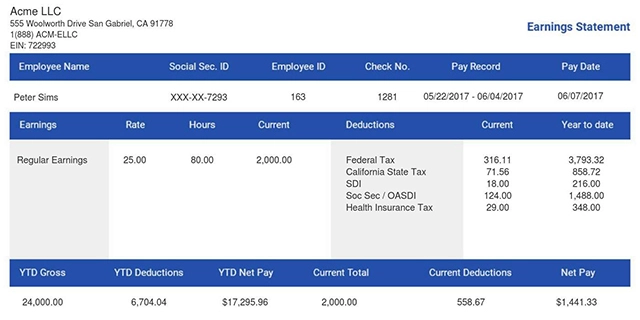
Every compliant pay stub prints the dates on it, near the top next to the pay date: a start date, an end date, and separately the date of payment. Read those three and the timing questions answer themselves.
Those dates anchor everything below them. Current column figures cover that window only. Year-to-date columns add up every period closed so far this year. When the two disagree, the period boundary is almost always why, and end of pay period simply means the last day counted in the current column.
For a business owner, this is where compliance gets decided. Pay stub content is regulated at state level rather than federal, which our roundup of state pay stub laws breaks down state by state.
Pay Period Rules Employers Must Follow
Employers, not employees, carry the compliance burden. The rules come in two layers. Federal law covers how wages are worked out and recorded. State law covers how often they must be paid.
Federal Rules Under the FLSA
Federal wage law is largely silent on pay frequency. The Fair Labor Standards Act requires wages on the regular payday for the pay period covered. But it does not tell an employer to pay weekly rather than monthly. That choice is left to the states.
What the FLSA does regulate tightly is records. Under 29 CFR 516, payroll records must be kept at least three years. The documents behind the wage math must be kept at least two. That covers time cards and records of additions to or deductions from wages. Worth knowing: the FLSA does not require an employer to hand out pay stubs at all. That obligation comes from state law.
State Payday Rules
State law is where pay frequency really gets decided. The differences are big:
- California. Labor Code 204(a) requires wages "due and payable twice during each calendar month." Work done the 1st through the 15th must be paid between the 16th and the 26th of that month, and work done from the 16th through month end must be paid between the 1st and the 10th of the following month. Labor Code 204(d) offers another route: a weekly, biweekly, or semimonthly schedule paid within seven calendar days of the period's close.
- New York. Labor Law 191 splits by job type. Manual workers must be paid weekly and no later than seven calendar days after the week the wages were earned. Clerical and other workers must be paid at least semimonthly.
- Texas. Labor Code 61.011 requires FLSA-exempt employees to be paid at least once a month and everyone else at least twice a month. If an employer never designates paydays, Section 61.012(b) sets them by default at the 1st and the 15th.
- Idaho and Kansas. Both permit monthly payment for ordinary employees, not just salaried ones.
The Department of Labor keeps a state payday requirements table, which is the usual starting point. Read it with the date in mind: it states it was last revised January 1, 2023, so verify anything critical against the state statute itself.
New York shows why that matters. In 2025 the state changed the remedy for manual-worker frequency violations. Under the amended Labor Law 198(1-a), liquidated damages no longer apply if the employer did pay on a regular payday at least semimonthly. A first violation is capped at the lost interest. It was signed as Chapter 56 of the Laws of 2025 on May 9, 2025. The federal table does not reflect it.
Final Paycheck Timing
Final pay is the strictest deadline in payroll, and it usually ignores the normal payroll calendar entirely. In California, a discharged employee is owed wages immediately under Labor Code 201(a). Someone who quits is owed within 72 hours under Labor Code 202(a), or right away if they gave 72 hours notice. Texas is more forgiving: Labor Code 61.014 gives six days after a discharge, and lets a voluntary departure wait for the next scheduled payday. Miss these and the penalty is typically waiting-time damages that dwarf the original amount.
Does Pay Frequency Change Your Overtime or Taxes?
No. Overtime is calculated per workweek, and federal rules bar averaging hours across two or more weeks no matter which pay basis you use. Withholding is calculated per payroll period, so each paycheck differs in size, but the annual amounts you earn and owe do not change.
On overtime, the rule is explicit. 29 CFR 778.104, titled "Each workweek stands alone," says the FLSA does not permit averaging of hours over two or more weeks, "regardless of whether he is paid on a daily, weekly, biweekly, monthly or other basis." A workweek is a fixed, recurring period of 168 hours. So a 45 hour week followed by a 35 hour week inside one biweekly period is 5 hours of overtime, not zero. The two cannot be netted against each other. To check your own numbers, our overtime calculator does the math.
Taxes work the opposite way round, because withholding is payroll-period based. IRS Publication 15-T for 2026 came out on December 3, 2025. It scales your wages up using the number of pay periods you have per year, works out the annual tax, then divides it back per paycheck. Its Table 3 lists the standard counts: 52 weekly, 26 biweekly, 24 semimonthly, 12 monthly. A weekly check has less withheld than a monthly one, but the yearly total lands in the same place.
The wrinkle is a 27th payday. Payroll systems that assume 26 under-withhold slightly across a 27-paycheck year, worth a mid-year check if 2026 gives you a Thursday biweekly schedule.
How to Choose the Right Pay Period
For a business owner this is a real decision. Four things should drive it.
Cash flow. Match payroll to when money actually arrives. If your customers pay on 30 day terms at month end, funding 52 payroll runs a year strains working capital in a way that 24 does not. If revenue comes in daily, as in retail or food service, weekly is affordable.
Industry norms. BLS data from February 2023 shows how sharply this splits: 65.4% of construction establishments pay weekly, while 63.6% of private education and health services establishments pay biweekly. Paying monthly where the industry expects weekly is a hiring disadvantage.
Administrative cost. Every payroll run carries processing time, review, and error risk, so moving from weekly to biweekly halves that load. Semimonthly holds the count at 24 and lines up with monthly accounting, at the cost of messier hourly overtime.
Your employees. Hourly and lower-wage staff feel pay frequency most sharply, and a long gap pushes people toward high-cost credit between checks. Salaried staff with monthly bills often prefer semimonthly, because the dates never move.
Check your state rules before deciding, because California, New York, and others narrow the menu. Changing frequency later means advance notice and, in some states, specific procedure, so it is easier to choose well now than to switch.
Whichever you pick, document it. Accurate pay records protect you in a wage dispute, and they are what employees need for proof of income when they apply for an apartment or a loan.
Conclusion
Your pay period is a small structural decision with an outsized reach. It sets how many paychecks land in 2026, how long you wait after the work is done, how overtime is measured, and how much is withheld each time. For 2026 the headline numbers are 52, 26, 24, and 12, with a Thursday exception that pushes weekly and biweekly payers to 53 and 27.
For employees, the fastest way to stop guessing is to read the period start and end dates printed on your stub. For employers, the safest setup is a schedule that fits your cash flow, meets your state's frequency rule, and is documented every period.
If you need professional pay stubs that show pay period dates, gross and net pay, and year-to-date totals clearly, create a pay stub with ThePayStubs.com. It takes about two minutes, the calculations are handled for you, and you can download the finished stub immediately.
You Might Also Like
- 1. Enter Your Information

- 2. Select Your Favorite Theme

- 3. Download Your Stub!

 By
By