

Vacation Policy for Small Business: 2026 Guide + Templates
 By
By
Two people just asked for the same week off, and you've got nothing written down to point at. Whoever you turn down is going to remember it. That's the moment most owners realize they need a real vacation policy for small business use, not a verbal understanding that shifts depending on who's asking. Writing it down also means the accrued balance can appear on every stub you issue with a pay stub generator.
Here's what surprises people: no federal law says you have to offer paid time off at all. But the second you write your rules down, that document becomes the agreement you're held to. Vague wording is the real risk, not the day count.
This guide covers what's normal for your size, what the law requires, the five structures, how to build yours, what it costs, how the time hits payroll, and templates you can copy today.
Key Takeaways
- No federal law requires paid vacation. Once you put a policy in writing, that policy becomes the rule you are held to.
- At businesses with 1 to 49 workers, 71% of employees get paid vacation, compared with 91% at companies of 500 or more.
- Ten days per year is the realistic starting point, and most workers land between 5 and 14 days after their first year.
- Accrued time off is a payroll liability, not just a calendar entry, so track the balance every pay period.
- What Is a Vacation Policy for Small Business?
- How Much Vacation Time Is Normal for a Small Business?
- Is Paid Time Off Required by Law?
- The 5 PTO Policy Structures Small Businesses Use
- How to Write a Vacation Policy for Small Business
- How Does Paid Time Off Work? PTO Accrual Explained
- How a Vacation Policy for Small Business Hits Your Payroll
- Mistakes That Turn a Vacation Policy Into a Wage Dispute
- Vacation Policy for Small Business Templates You Can Copy
What Is a Vacation Policy for Small Business?
A vacation policy for small business is the written rule that says how much paid time off employees earn, who qualifies, how they request it, and what happens to unused days. No federal law requires one. But once you write it down, it becomes the agreement you are held to, so the wording matters more than the day count.
You'll see two labels for the same thing. Paid time off is the catch-all bucket: vacation, sick days, and personal time from one balance. Vacation time means planned time away, kept separate from sick days. The paid time off meaning gets blurry because plenty of businesses use one word for both. Sorting out PTO vs vacation time comes down to one question: one shared balance or two?
Neither setup is unusual: about 51% of private industry workers are on a consolidated plan with a single bucket. A single bank is simpler to track, while separate buckets stop people burning vacation days on the flu and make sick leave compliance easier. Extended absences are a separate question, handled through a longer leave of absence rather than the vacation bank.
How Much Vacation Time Is Normal for a Small Business?

Ten days is the realistic starting point. Bureau of Labor Statistics data from March 2025 shows 71% of workers at establishments with 1 to 49 employees get paid vacation, versus 91% at companies with 500 or more. After one year of service, 31% of private industry workers receive 10 to 14 days and another 31% receive 5 to 9.
That 20-point gap is the real competitive problem: you're competing with the employer down the road on whether the job comes with time off at all.
After five years, the most common band moves up to 15 to 19 days. Only about 10% get 20 or more days in year one, so four weeks is an outlier, not a benchmark.
Industry matters more than the national average. In leisure and hospitality, only 46% of workers get paid vacation; in manufacturing and financial activities, it's 96%. Run a cafe, and offering any paid vacation puts you ahead of half your local hiring competition. Check the BLS paid vacation data before setting your number.
Now the figure nobody publishes: cost. One employee earning $20 an hour with 10 days off is 80 hours of wages for time not worked, or $1,600 a year. A team of five runs about $8,000. That's what a vacation policy for small business actually costs, and it's worth weighing against the price of replacing someone. Applicants aren't comparing your number to your budget anyway. They're comparing it to the average vacation time in USA workplaces they've already been offered elsewhere.
Is Paid Time Off Required by Law?
No. The Fair Labor Standards Act does not require payment for time not worked, so no federal law makes you offer paid vacation. No state mandates paid vacation either, though many now require paid sick leave, which is a separate benefit. Where state law bites is on the way out: some states treat earned vacation as wages you must pay.
The Department of Labor puts it plainly. These benefits are "matters of agreement between an employer and an employee". No statute fills in your blanks, so your handbook is the contract, which is why a vacation policy for small business is worth wording carefully.
One myth worth clearing up: no state requires you to provide paid vacation days. Several require paid sick leave, and people mix the two up constantly.
Where states step in is time your team already earned. California is the clearest example: its Labor Commissioner treats earned vacation as wages that vest as work is performed, which makes a use it or lose it vacation policy illegal there.
There's a legal alternative most guides skip. California permits a reasonable accrual cap, so once a balance hits the ceiling, accrual pauses until the employee uses some. That bounds your liability without erasing anything earned. Renaming the benefit doesn't help: under the California vacation policy rules, a combined PTO bank carries the same requirements.
So is vacation time paid when someone quits? In those states, yes, at their final rate. Family and Medical Leave Act (FMLA) leave is unpaid, applies at 50 or more employees, and requires 1,250 hours in the prior year. And whatever you promise in writing, you owe, even where no payout law exists. Your documentation duties sit alongside state pay stub laws, which vary just as much.
The 5 PTO Policy Structures Small Businesses Use

Your structure decides how time appears in someone's balance. Five models cover almost every small business PTO policy, and choosing is mostly about cash flow and tracking effort.
| Structure | How Time Is Granted | Best For | The Catch |
|---|---|---|---|
| Accrual | Earned gradually each pay period | Hourly teams, retail, restaurants | Tracking fractions of hours |
| Front-loaded | Full balance on day one of the year | Stable teams, salaried staff | Someone can use it all in January and leave |
| Unlimited | No fixed balance | Salaried, remote, results-based roles | People take less, not more, without guidance |
| Rollover | Unused time carries over, usually capped | Seasonal businesses | Balances compound into a real liability |
| Use it or lose it | Unused time expires at year-end | Simple year-end accounting | Illegal in some states, including California |
Accrual is the default for most small employers because cost arrives in step with the work. An unlimited PTO policy sounds generous and often backfires: with no number to anchor to, cautious employees take less than before, which is how burnout builds on the teams least able to absorb it. Read up on what unlimited PTO actually means before you offer it. Going unlimited? Publish a floor, such as 15 days encouraged per year with at least one full week.
The rollover question arrives every December. Does vacation time roll over at your business? Answer it in writing now, with a cap like 40 hours, or you'll answer under pressure later. A PTO accrual policy with a stated cap is the safest structure in almost every state.
How to Write a Vacation Policy for Small Business
Six decisions turn an informal understanding into a vacation policy for small business. Answer each in writing, and your paid time off policy is done.
Step 1: Decide Who Qualifies
Say plainly which classifications are covered. Many small employers limit time off to people working 30 or more hours a week, then prorate for part-timers at 20 or more. If you already budget headcount by full-time equivalent, use that same threshold here so the two never conflict. Excluding part-time staff is legal in most states, including California, but only if your policy names the excluded group specifically. Silence creates disputes.
Step 2: Set the Amount
Start at 10 days if you're building from nothing, then add tiers so the benefit rewards staying. A common ladder rewards years of service: two weeks for the first five, three at six to ten years, four after that. Count paid holidays separately from the vacation bank.
Step 3: Set the Waiting Period
New hires typically wait 30 to 90 days before using time off. A waiting period is legal, and California allows one covering even the entire first year, provided it isn't a disguise for time actually earned. State the length in days.
Step 4: Write the Request Rules
Require two weeks of notice for planned time off and same-shift notice for illness. Name the approver. Then answer what everyone forgets: when two people want the same days, who wins? Pick a rule, first request or seniority, and write it down. Decide who arranges coverage, add blackout dates, and keep a time off request policy template in the handbook.
Step 5: Decide What Happens to Unused Time
Choose one: it rolls over up to a cap, it stops accruing at a ceiling, or you pay it out. State whether unused time gets paid at separation. Several states require it regardless, and where they don't, your written promise still binds you.
Step 6: Date It and Put It in the Handbook
Give the policy a version date in your employee handbook and have employees acknowledge it. Change it going forward, never retroactively against time already earned.
How Does Paid Time Off Work? PTO Accrual Explained
Under an accrual policy, employees earn time off gradually as they work. Divide the annual hours by your number of pay periods to get the rate. Ten days is 80 hours, so a biweekly payroll of 26 periods earns 3.08 hours each period, a semimonthly payroll earns 3.33, and a monthly payroll earns 6.67.
Run the number for your own pay frequency before publishing, then write the result into the policy. Otherwise someone recomputes it differently a year from now.
| Annual Grant | Weekly | Biweekly (26) | Semimonthly (24) | Monthly (12) |
|---|---|---|---|---|
| 10 days (80 hrs) | 1.54 | 3.08 | 3.33 | 6.67 |
| 15 days (120 hrs) | 2.31 | 4.62 | 5.00 | 10.00 |
| 20 days (160 hrs) | 3.08 | 6.15 | 6.67 | 13.33 |
An hourly alternative suits variable schedules: one hour of paid time off for every 30 hours worked. Part-timers accrue proportionally with no prorating math, which is why state sick leave laws lean on it: California's paid sick leave rules run on that exact 1-hour-per-30-hours rate. Say whether accrued vacation time starts building at hire or after the waiting period, and confirm your pay frequency before you lock the rate in.
Settle one more question early: whether PTO counts toward overtime. Paid hours generally aren't hours worked, so time off usually doesn't trigger overtime, but say so plainly.
How a Vacation Policy for Small Business Hits Your Payroll
Here's what almost no guide mentions: the moment a vacation policy for small business goes live, it becomes a payroll obligation, not just a calendar rule.
Paid time off is paid hours, not a bonus. Those hours run through payroll at the regular rate with normal withholding. If you're wondering how PTO is taxed, it's taxed exactly like the wages it replaces.
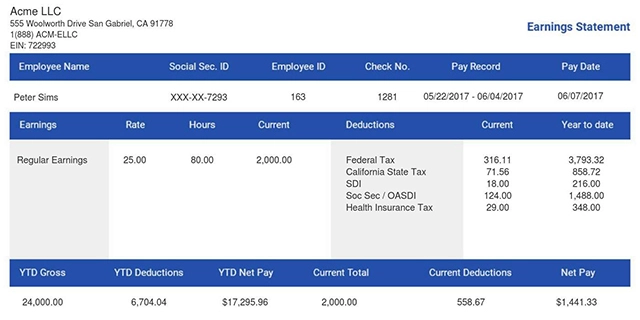
The running balance is what gets disputed. An employee who thinks they have six days left and hears they have three will escalate, and memory won't settle it. Showing the balance on the pay stub each period ends that argument and leaves a dated record, usually under one of the standard payroll codes such as PTO or VAC.
At separation or termination, unused time is money in states that treat it as earned wages. Does vacation time get paid out? In California and several others, yes, at the final rate of pay, and it belongs on the last check as its own line. One trap: if you let someone take vacation before earning it, you generally can't claw that advance back from their final paycheck.
Your records are your defense. In a wage claim, the employer with dated pay records stands in a very different position than one with a spreadsheet nobody updated. That's why a vacation policy for small business belongs in your payroll setup, not just your handbook.
Mistakes That Turn a Vacation Policy Into a Wage Dispute
Most disputes trace back to a clause nobody wrote. Four sentences prevent most of them.
- The waiting period. Without it, a two-week hire can request two weeks off. State the number of days.
- An accrual cap instead of forfeiture. Capping accrual is legal nearly everywhere; wiping balances at year-end isn't.
- The competing-request tiebreaker. A written rule is neutral. Your judgment call, however fair, looks like favoritism to whoever loses.
- The payout line. Say whether unused time is paid at separation. Ambiguity here turns a resignation into a claim.
One habit matters as much as any clause: apply a vacation policy for small business the same way every time. Consistent enforcement of an average policy beats loose enforcement of a generous one.
Vacation Policy for Small Business Templates You Can Copy
Three starting points. Swap the bracketed values for yours, then have someone outside the business read it for anything ambiguous. These PTO policy examples stay deliberately short, since the clearest policies usually are.
Template 1: Simple Accrual Policy
Full-time employees working [30] or more hours per week accrue paid time off at [3.08] hours per pay period, totaling [10] days per year. Accrual begins on the date of hire, and time may be used after [90] days of employment. Planned time off requires [14] days of advance notice and approval from [manager/owner]. Unused time carries over to a maximum balance of [80] hours, after which accrual pauses. Unused accrued time is paid out at the final rate of pay upon separation where state law requires it.
Template 2: Front-Loaded Policy
Full-time employees receive [15] days of paid time off on January 1 each year, prorated by start date in the first year. Time is available after [60] days. Requests require [14] days of notice, except for illness, which requires notice before the shift starts. Up to [40] hours may carry over into the following year. Blackout dates: [dates].
Template 3: Part-Time and Prorated Policy
Employees working at least [20] hours per week earn one hour of paid time off for every [30] hours worked, up to [40] hours per year. Time may be used after [90] days. Requests require [7] days of notice except for illness. Unused time carries over up to [20] hours.
Any PTO policy template still needs your numbers. A vacation policy for small business template works only once it matches your pay frequency and state, so run the accrual math first.
You Might Also Like
- What Payroll Processing Involves
- Overtime Calculator and How Overtime Pay Works
- Unpaid PTO: When Time Off Isn't Paid
- Negative PTO and How Balances Go Below Zero
- Setting a Pay Date That Works for Your Team
Conclusion
A good vacation policy for small business is judged on clarity, not generosity. Pick a structure you'll administer consistently, write down the six decisions, and check your state's payout rule before you publish. Ten days plus holidays matches what most workers get, and a stated accrual cap keeps the liability from compounding.
Then track it where your team can see it. Showing accrued and used hours on every pay stub prevents most balance disputes, and a paystub generator makes those records easy to produce each pay period.
- 1. Enter Your Information

- 2. Select Your Favorite Theme

- 3. Download Your Stub!

 By
By