

What Are Employment Verification And Proof Of Income Documents?
 By
James Wilson
By
James Wilson When a landlord, lender, or government agency needs to confirm your earnings, they don't take your word for it, they request an income verification form. Unlike a proof of income letter that you write yourself, an income verification form is a structured document that your employer or HR department fills out and signs on your behalf. It is the official record that ties your name to a verified salary, employment status, and job title.
Need supplemental pay documentation right now? You can create a pay stub in minutes at ThePayStubs.com to support your application while your employer processes the form.
Key Takeaways
- An income verification form is filled out by your employer or HR department, not by you, making it a verified, third-party document.
- It is different from a proof-of-income letter, which an applicant writes themselves.
- Common uses include rental applications, mortgage approvals, car loans, and government benefit programs.
- The Work Number (run by Equifax) is the largest automated income and employment verification service in the U.S., your employer may already be enrolled.
- Pay stubs are the most widely accepted supplemental document alongside a completed verification form.
- What Is an Income Verification Form?
- What Does an Income Verification Form Contain?
- How Employer Income Verification Services Work
- What an Income Verification Form Typically Contains, Employer Perspective
- How to Request Income Verification From Your Employer
- Income Verification for Self-Employed and 1099 Workers
- How Lenders and Landlords Use Income Verification Forms
- What Fields Does an Income Verification Form Contain?
- Common Mistakes to Avoid
What Is an Income Verification Form?
An income verification form is an official document completed by an employer or authorized HR representative that confirms an employee's current employment status, job title, and earnings. The key distinction: the employer fills this form out, not the applicant. That is what makes it a verified record, a neutral third party (your employer) is certifying your income in writing.
The document goes by several names depending on context:
- Wage verification form
- Employment verification form (EVF)
- Verification of employment (VOE) form
- Written Verification of Employment (WVOE), used specifically in mortgage lending
- Employer confirmation of income letter
Regardless of the label, the purpose is the same: to give a landlord, lender, government program, or legal proceeding a credible, signed record of what you earn and where you work.
Income Verification Form vs. Proof of Income Letter, What's the Difference?
This is one of the most common points of confusion, and the distinction matters.
| Document | Who fills it out | Signed by |
|---|---|---|
| Income verification form | Your employer / HR department | Employer representative |
| Proof of income letter | You (the applicant) | Yourself (sometimes notarized) |
A proof of income letter is a document you write yourself, often used by freelancers, self-employed individuals, or gig workers who do not have an employer to sign a form. It is a personal statement, not an employer-certified document.
An income verification form, by contrast, comes from your employer. You may fill in your own personal details at the top (name, SSN, date), but the income sections, salary, job title, hire date, pay frequency, are completed and signed by HR or a supervisor. This third-party signature is what lenders and landlords trust most.
What Does an Income Verification Form Contain?

A standard income verification form is divided into four core sections. Here is exactly what each one covers.
Personal Information (Completed by the Applicant)
- Full legal name
- Date of birth
- Current address
- Social Security Number (SSN) or Employee ID
- Date the form is completed
- Case number or member ID (required by many government programs in place of SSN)
Employer Information (Completed by HR)
This section is filled out by the employer's HR department or the employee's direct supervisor, not by the employee.
- Company legal name and address
- Supervisor or HR contact name and title
- Business phone number
- Date of hire
- Job title or position
Employment Status and Compensation (Completed by HR)
- Employment status: full-time, part-time, seasonal, temporary, or contract
- Hourly wage or annual salary
- Pay frequency: weekly, biweekly, semi-monthly, or monthly
- Average hours worked per week (for hourly employees)
- Gross income per pay period (before deductions)
- Overtime pay rate (if applicable)
- Bonuses or commission amounts (if applicable)
- Start date of current pay period
Signature Section
- Employer or HR signature: Certifies the employment and income data is accurate. Includes the signer's name, title, date, and contact number for follow-up verification.
- Applicant signature: Authorizes the employer to release the information and confirms that the applicant has reviewed the completed form.
Many forms, especially those used for government benefit programs, include a certification statement that any false information can result in denial of benefits, fraud charges, or civil penalties.
How Employer Income Verification Services Work
Most people assume income verification means asking HR to fill out a paper form. That is still common, but three main channels now exist depending on your employer's size and systems.
1. The Work Number (Equifax VOE)
The Work Number is the largest automated employment and income verification service in the United States, operated by Equifax. More than 2.7 million employers, including most Fortune 500 companies and many government agencies, have their payroll data enrolled in The Work Number database.
How it works:
- A lender, landlord, or government agency submits a verification request to The Work Number.
- The Work Number returns an automated Verification of Employment (VOE) or Verification of Income and Employment (VOIE) report instantly, using your payroll data from the enrolled employer.
- No manual form needs to be sent to HR. The report is pulled directly from payroll records.
For employees: You can check whether your employer participates at theworknumber.com and view your own income data on file. You can also place a "freeze" on your data to prevent unauthorized verifications.
For verifiers (lenders, landlords): The Work Number report carries more weight than a manually completed HR letter because it pulls directly from payroll, it cannot be altered by the applicant.
2. Direct HR Letter or Form
For employers not enrolled in The Work Number, the traditional process applies:
- The requesting party (lender, landlord) sends the income verification form to the applicant or directly to the employer.
- The applicant fills in personal details and routes the form to HR.
- HR completes the employer and compensation sections, signs the form, and returns it to the requesting party.
Turnaround is typically 3, 10 business days. Large companies often have a dedicated verification-of-employment line or an online portal (such as an HCM system like Workday or ADP) that generates official income verification letters automatically.
3. Pay Stub Verification Portals
Some lenders and property managers accept digital pay stubs directly through secure upload portals (Argyle, Pinwheel, Plaid Income). These services connect to an employee's payroll account with their permission and pull verified earnings data electronically, similar in principle to The Work Number but initiated by the employee.
What an Income Verification Form Typically Contains, Employer Perspective
When HR receives a request to complete an income verification form, they are confirming these specific data points on behalf of the company:
- Employment tenure: Start date and (if applicable) end date of employment
- Current job title: The official role as it appears in the HR system
- Employment classification: Full-time, part-time, or contract
- Current gross salary or hourly wage: Before deductions, this is the number lenders use
- Pay frequency: How often the employee is paid (weekly, biweekly, etc.)
- Year-to-date (YTD) earnings: Total gross earnings so far this calendar year
- Average hours per week (hourly employees only)
- Authorized signature and contact: The HR representative's name, title, and phone number so the verifier can call to confirm
Lenders and landlords cross-reference these employer-reported figures against the pay stubs the applicant submits. If the numbers do not match, the application stalls.
How to Request Income Verification From Your Employer
Follow these steps to get your income verification form completed without delays.
Step 1: Obtain the Correct Form
The requesting party (landlord, lender, government program) typically provides the specific form they want your employer to complete, it is usually a PDF download from their website or a link in your application portal. Do not assume any generic form will work; government programs especially require their own specific forms.
Step 2: Fill In Your Personal Section
Complete the applicant section at the top of the form:
- Your full legal name, address, Social Security Number, and the date.
- If the program assigns a case number (common in Medicaid, SNAP, Section 8), include it here.
Step 3: Submit the Form to HR Promptly
Bring or email the partially completed form to your HR department or direct supervisor. Include:
- The name and contact information of the requesting party
- The deadline for submission
- Any specific instructions (fax number, upload link, return address)
The sooner HR receives the request, the sooner your application can move forward.
Step 4: HR Completes the Employer Sections
Your HR department or supervisor fills in the job title, hire date, salary or hourly rate, pay frequency, YTD earnings, and their own signature. They do not need any input from you for this section, they pull it directly from their payroll system.
Step 5: Verify the Figures Against Your Pay Stubs
When the completed form is returned to you (or sent directly to the requesting party), confirm that the gross income listed matches what appears on your most recent pay stubs. Discrepancies, even minor ones caused by overtime or bonuses, can trigger requests for additional documentation.
Step 6: Attach Supporting Documents
Most verifiers require pay stubs alongside the completed form. Standard requirements:
- Last 30 days of pay stubs (typically 2, 3 pay periods for biweekly employees)
- Most recent W-2
- Additional documentation for irregular income (bonus letters, commission statements)
Step 7: Submit to the Requesting Party
Send the completed form and supporting documents by the method specified: secure upload portal, fax, email, or mail. Keep copies of everything.
Income Verification for Self-Employed and 1099 Workers

If you are self-employed, a freelancer, or a 1099 contractor, you do not have an employer to complete an income verification form for you. In this case, verifiers typically accept a combination of:
- Tax returns: Form 1040 with Schedule C attached (most recent two years preferred)
- 1099 forms: From all clients or platforms you earned income from
- Bank statements: Covering the last 2, 3 months to show consistent deposits
- Profit and loss statement: Often required for mortgage applications
- Self-certification income statement: A written statement of your earnings; sometimes accepted when notarized
Self-employed individuals are in a fundamentally different position than W-2 employees because no payroll system records their income. A proof of income letter, written by you and supported by tax documents, is the closest equivalent to what an employer would complete for a salaried worker.
How Lenders and Landlords Use Income Verification Forms
Once a completed income verification form lands with a lender or landlord, here is what they do with it.
Rental applications: The property manager checks that the gross annual income is at least 2.5 to 3 times the monthly rent. A tenant applying for a $2,000/month apartment needs a verified gross income of $5,000, $6,000 per month. The employer-signed form is the most trusted source for this number; pay stubs serve as corroborating evidence.
Mortgage lending: Mortgage lenders use the income verification form, specifically the WVOE, together with pay stubs and tax returns to calculate your debt-to-income (DTI) ratio. Most conventional loans require a DTI below 43%. The Work Number is heavily used in mortgage processing because automated verifications reduce closing times.
Government benefit programs: Programs like Medicaid, SNAP, Section 8 housing, and WIC calculate benefit amounts or eligibility thresholds based on household income. Each program has its own specific form and income threshold. Many state programs (such as Oklahoma's SoonerCare or Florida Medicaid) require:
- A program-specific income verification form completed by the employer
- A 30-day consecutive earnings log listing all income sources
- Copies of recent pay stubs
Auto loans and personal loans: Lenders verify income to approve the loan amount and set the interest rate. For personal loans, a simple employer letter or The Work Number report often suffices. For larger auto loans, underwriters may request 30, 60 days of pay stubs plus the completed form.
Child support and legal proceedings: Wage verification forms completed by an HR department are standard evidence in child support calculations, alimony determinations, and custody cases because they carry an employer's signature and can be verified through payroll records.
What Fields Does an Income Verification Form Contain?
Beyond the four core sections described above, some specialized forms, particularly for state government programs, include additional subsections.
For Hourly and Salaried W-2 Employees
- Gross income per pay period
- Year-to-date gross earnings
- Pay schedule and next expected pay date
- Any scheduled pay increases
For Seasonal or Temporary Employees
- Expected end date of employment
- Whether the position is expected to be renewed
- Seasonal average weekly hours
For Commission and Bonus Earners
- Base salary (if any)
- Average monthly commission over the last 12 months
- Bonus amounts and frequency
What Pay Stubs Reveal That Forms Don't
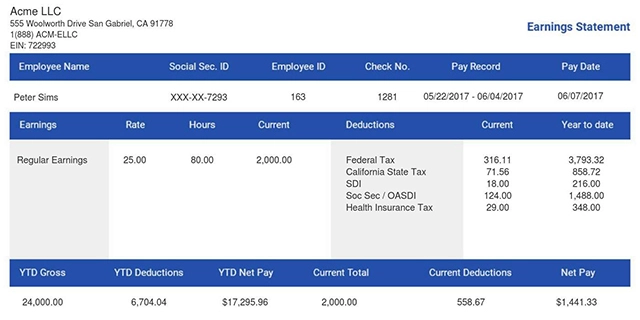
A completed income verification form gives a point-in-time snapshot. Your pay stubs provide the running record, pay period by pay period, of exactly what has been earned, withheld, and paid out. A pay stub shows:
- Gross earnings for the period and year-to-date
- Federal and state income tax withheld
- FICA deductions (Social Security and Medicare)
- Voluntary deductions (health insurance, 401(k) contributions)
- Net pay after all deductions
When a verifier compares the gross earnings on the income verification form to the gross earnings on your pay stubs, any discrepancy triggers a follow-up request. This is why matching these numbers before submission saves significant time.
If you are missing pay stubs or need documentation quickly, you can create a pay stub at ThePayStubs.com in about two minutes. The result is a professionally formatted pay stub that reports your income and all related deductions, ready to submit alongside any income verification form.
Common Mistakes to Avoid
Leaving fields blank: Do not leave any field empty. For sections that do not apply to you, write "N/A." A partially completed form will be rejected without review.
Reporting net income instead of gross: Lenders and landlords base their calculations on gross income (before deductions). Reporting your take-home pay instead understates your earnings and can result in unnecessary denial.
Submitting outdated pay stubs: Most verifiers require pay stubs from the last 30, 60 days. Pay stubs older than 3 months are typically rejected. Government programs often require the last 90 days.
Not verifying figures match: Before submitting, confirm the gross income on the completed form matches your most recent pay stubs to the dollar. Small discrepancies caused by overtime or bonuses need to be explained with documentation.
Routing to the wrong person: Large employers often have a dedicated HR verification team or a third-party service (like The Work Number). Sending the request to your direct manager can cause delays. Confirm the correct contact before submitting.
Not keeping copies: Save copies of your completed form, all pay stubs, and any supporting documents. You may need to reference them if the verifier requests clarification.
Conclusion
An income verification form is one of the most important documents in any loan, rental, or government benefit application, and what sets it apart from other proof-of-income documents is that your employer fills it out, not you. Whether that means HR completing a paper form, The Work Number generating an automated VOE report, or a digital payroll portal pulling verified earnings, the result is the same: a third-party certified record of what you earn.
Understanding how these forms work, what they contain, who fills them out, and how automated services like The Work Number fit in, puts you in a stronger position to move through applications faster and avoid documentation delays.
When you need pay stubs to accompany your income verification form, create a pay stub at ThePayStubs.com in minutes. Our professionally formatted stubs report gross earnings, deductions, and net pay exactly as verifiers expect to see them, ready to submit alongside any income verification form, rental application, or loan request.
You Might Also Like
- 1. Enter Your Information

- 2. Select Your Favorite Theme

- 3. Download Your Stub!

 By
By