

Payroll for Nonprofits: A Complete 2026 Guide
 By
By
Nonprofits exist to serve their communities. But the payroll rules are strict. A 501(c)(3) must withhold taxes, file forms, and pay staff on time. Miss a step, and penalties add up fast. This guide explains payroll for nonprofits in plain terms. You will learn which taxes apply, how to set up payroll, and how to stay compliant. You will also see how to make a pay stub for your staff. Need one now? You can create professional pay stubs in minutes with ThePayStubs.com.
Key Takeaways
- Payroll for nonprofits follows the same federal tax rules as any other employer.
- A 501(c)(3) must withhold Social Security and Medicare. This holds true even though it pays no federal income tax on its revenue.
- Most 501(c)(3) groups are exempt from FUTA. You need an IRS determination letter to claim it.
- Form 990 is usually due May 15 for calendar-year nonprofits. Skip it for three straight years, and the IRS automatically revokes your tax-exempt status.
- Grant-funded salaries must be tracked by funding source. Keep timesheets to prove the split.
- Nonprofit employees can get pay stubs for rentals or loans from ThePayStubs.com.
What Is Payroll for Nonprofits?
Payroll for nonprofits is the process of paying staff at a tax-exempt organization. A 501(c)(3) pays no federal income tax on its revenue. But it still acts as an employer. So it must withhold and pay certain payroll taxes. These include Social Security, Medicare, and federal income tax on employee wages.
The work is much like for-profit payroll. You withhold the same taxes. You issue the same W-2 forms. You keep the same records. Every nonprofit organization with staff must run payroll this way.
One thing is different: how you report wages. A for-profit reports total wages on its tax return. A nonprofit splits each wage across three areas on Form 990. These are programs, management, and fundraising. This split is the heart of fund accounting for a tax exempt nonprofit.
501(c)(3) groups include charities, schools, and religious organizations. They all have staff. They all run payroll for nonprofits the same basic way.
Do Nonprofits Pay Payroll Taxes?

Yes. A 501(c)(3) must withhold and pay payroll taxes on staff wages. Payroll for nonprofits always includes FICA, which covers Social Security and Medicare. Most groups skip federal unemployment tax. But many still owe state unemployment tax. Strong payroll tax compliance keeps your group safe from fines.
FICA Taxes for Nonprofits
FICA has two parts. Both the employer and the employee pay each part.
- Social Security: 6.2% of wages, up to $184,500 in 2026. Each side pays 6.2%.
- Medicare: 1.45% of all wages. There is no wage cap.
A higher Medicare rate applies to top earners. Workers pay an extra 0.9% on wages above set limits. The limits are $200,000 for single filers and $250,000 for joint filers. For married people who file apart, the limit is $125,000. The employer does not match this extra 0.9%.
On a pay stub, these lines show up apart. Social Security and Medicare each get their own row. The same is true for payroll deductions at any nonprofit.
Churches and some religious groups can opt out of withholding federal income tax. Students who work at their own school may also be exempt. For everyone else, withholding applies.
FUTA Exemption for 501(c)(3) Organizations
Most 501(c)(3) and 501(c)(4) groups are exempt from FUTA. FUTA is the Federal Unemployment Tax Act. Exempt groups do not file Form 940. To claim this, keep your IRS determination letter on file. It proves your tax-exempt status.
State unemployment tax is a separate matter. This tax is often called SUTA, short for the State Unemployment Tax Act. Many states let nonprofits choose how to pay it. You can pay the standard rate like other employers. Or you can pick the reimbursable method. Under that method, you only repay the state for benefits your former workers actually claim.
Skipping payroll taxes is risky. The IRS can apply the Trust Fund Recovery Penalty. This can equal 100% of the unpaid tax. Worse, it is personal. Board members and other responsible people can owe it themselves.
Nonprofit Tax-Exempt Status and Payroll Compliance
Tax-exempt status comes from Section 501(c)(3) of the tax code. It means your group pays no income tax on the revenue it receives. But it does not erase payroll duties. If you have staff, you must withhold and match their FICA taxes. In short, a tax exempt nonprofit still pays employment taxes.
Section 501(c)(3) also requires yearly reports. These are the Form 990 filings. They keep your status active.
IRS Forms Nonprofits Must File
Form 990 is your main report. The version you file depends on your size.
- Form 990: For groups with $200,000 or more in gross receipts, or $500,000 or more in assets.
- Form 990-EZ: For groups under both of those limits.
- Form 990-N: A short e-postcard for groups with $50,000 or less in gross receipts.
- Form 990-PF: For private foundations.
Form 990 is due on the 15th day of the 5th month after your fiscal year ends. A calendar-year nonprofit files by May 15. Need more time? Ask for a six-month extension with Form 8868. The extension delays the IRS filing only. It does not delay reports you owe to members or donors.
Your Form 990 must also report pay for your top staff. Keep this reasonable compensation in line with similar roles at other groups. Clear records and steady payroll tax filing make this easy.
What Happens If You Lose Tax-Exempt Status
Miss your Form 990 for three years in a row, and the IRS revokes your status automatically. It then posts your name on a public list. Once revoked, donors can no longer deduct their gifts.
To get your status back, you must reapply. File a new Form 1023 and pay the user fee. You also need a written reason for the late filings, called reasonable cause. Reinstatement takes time and money. It is far cheaper to file on time.
How to Set Up Payroll for Nonprofits

You can set up payroll for a nonprofit in four steps. Done in order, they keep payroll for nonprofits on track. Good payroll best practices start right here.
Step 1: Get Your Employer Identification Number
First, get an Employer Identification Number, or EIN. This is your federal tax ID. Apply free on the IRS website with Form SS-4. Online, you get your EIN right away.
You also need a state tax ID. Register with your state tax agency. In California, that is the Employment Development Department. In New York, it is the Department of Taxation and Finance. Most states process this in a few days.
Step 2: Classify Workers Correctly
Next, sort each worker into the right group. Getting this wrong leads to tax penalties. The IRS uses three tests for employee classification.
- Behavioral control: Do you control how and when the person works? If yes, they are likely an employee.
- Financial control: Do you set their pay and provide their tools? If yes, they are likely an employee.
- Type of relationship: Is there a contract? Do they serve other clients too? If not, they are likely an employee.
Volunteers need care as well. Volunteer classification turns on the size of any stipend. Pay a volunteer more than a small amount, and the IRS may treat them as an employee. A common line is 20% of normal pay for the same work.
Step 3: Collect Employee Paperwork
Now gather the right forms before the first paycheck.
- Form W-4: Sets federal income tax withholding.
- Form I-9: Confirms work eligibility. Store it apart from payroll records.
- State withholding form: Required in most states.
- Direct deposit form: Holds bank routing and account details.
Set a clear payroll schedule too. Decide if staff are paid weekly, biweekly, or monthly.
Step 4: Get Insurance and Enroll in EFTPS
Most states require workers compensation insurance. It covers staff who get hurt on the job, and nonprofit workers are included. You must also sign up for state unemployment insurance.
Then enroll in EFTPS. This is the free Electronic Federal Tax Payment System from the Treasury. Use it to send federal payroll taxes online. Pay on time. Late deposits draw penalties of 2% to 10%. For a small group, those fines hurt.
Best Payroll Software for Nonprofit Organizations
Regular accounting software often falls short for nonprofits. It can withhold taxes, but little else. It rarely tracks grant-funded salaries. It rarely splits wages across programs. The right nonprofit payroll software does both.
Look for a few key features:
- Grant salary tracking: Reports wages by the grant that funded them.
- Multiple schedules: Handles full-time, part-time, and seasonal staff.
- FUTA exemption: Knows your 501(c)(3) skips federal unemployment tax.
- Employee self-service portal: Lets staff view pay stubs and W-2 forms on their own.
Here are popular options for payroll software for nonprofit organizations:
| Software | Best For | Key Nonprofit Feature | Starting Price |
|---|---|---|---|
| Gusto | Small to mid-size nonprofits | Full-service payroll with FUTA handling | $40/mo + $6/employee |
| OnPay | Budget-minded groups | Automatic FUTA exemption, unlimited pay runs | $40/mo + $6/employee |
| Paychex | Larger organizations | 24/7 support and Form 990 reporting | Quote-based |
| ADP | All-in-one HR and payroll | Compliance alerts and integrations | Quote-based |
| Rippling | Fast-growing groups | Payroll, HR, and IT in one place | Quote-based |
Some groups skip software and outsource payroll instead. A provider then runs payroll for nonprofits on your behalf. This frees staff time but adds a monthly cost.
Grant Tracking in Nonprofit Payroll
Many nonprofits run on several funding streams. Each grant may limit how you spend it. That makes grant rules a real layer of payroll for nonprofits. You must tie part of each salary to the grant that pays for it. This is the job of grant tracking.
Say a federal grant funds part of a program. You must charge the right share of staff wages to that grant. You do this with fund accounting and a clear account code per grant. Careful payroll expense allocation keeps every dollar traceable.
Allocating Salaries Across Programs and Grants
Picture an executive director who splits her time. She spends 40% on admin, 30% on Program A, and 30% on Program B. Her salary must follow the same split. So must her payroll taxes.
Timesheets make this work. Staff log hours by program each pay period. You then apply those percentages to each paycheck. Federal rules require this proof. The Office of Management and Budget's Uniform Guidance (2 CFR 200) demands time-and-effort records. Keep timesheets at least three years after a grant ends.
What Grant Auditors Check in Payroll Records
A grant auditor compares time worked to wages charged. They review timesheets, expense reports, and payroll records. They look for common errors, such as:
- Staff shown at 100% on one program when they work on several.
- Hours charged to a single grant after a role has changed.
- Fringe benefits split differently from base pay.
Paid time off must follow the same split as regular pay. If you change how you track a salary, write down why. Consistent records keep audits smooth.
Pay Stubs for Nonprofit Employees
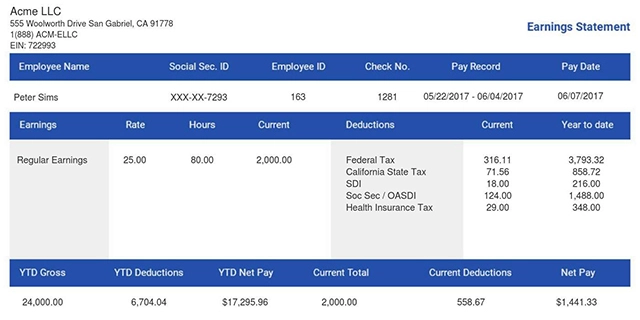
Nonprofit employees need pay stubs, just like any worker. A pay stub lists gross wages, tax withholdings, and net pay. It shows Social Security, Medicare, and retirement contributions on separate lines. In this way, payroll for nonprofits ends with a clear record for each worker.
Many nonprofit staff are part-time or hourly. Think program coordinators, case managers, and seasonal help. They often need proof of income for a rental, a mortgage, or a loan. But small groups with basic payroll may not hand out stubs.
That gap is easy to fill. You can create the exact pay stub nonprofit employees need with ThePayStubs.com. It builds a professional stub in under two minutes, with every deduction line in place. Stipended AmeriCorps members and part-time staff use it often.
Want to learn more about a paycheck? See our guide on pay stubs for loan applications. You can also learn to calculate W-2 wages from a pay stub.
Employee Benefits and Retirement Plans for Nonprofits
Even a small nonprofit can offer benefits. Retirement plans are common, and they are part of payroll for nonprofits too. The two main types are the 403(b) and the 457(b).
A 403(b) works much like a 401(k). Staff make pre-tax contributions, and the employer may match. These plans serve 501(c)(3) groups, public schools, and some religious organizations.
A 457(b) also allows pre-tax savings. It is offered by certain tax-exempt groups and government employers. Funds grow tax-deferred until withdrawal.
Retirement amounts show up in Box 12 of the W-2. Leave, such as paid time off, must follow the same program split as regular pay. Auditors check this too.
You Might Also Like
- 1099 Pay Stub: Should Independent Contractors Receive One?
- How to Acquire an Earnings Statement
- Paycheck Stubs: Templates and Samples
- How to Calculate Your Hourly, Weekly and Monthly Income
- Free Pay Stubs Online
Conclusion
Payroll for nonprofits is not simpler than business payroll. It is often harder. You juggle FICA withholding, FUTA exemptions, and grant rules at once. You file Form 990 each year and Form 941 each quarter. Strong payroll compliance and steady payroll processing keep it all on track.
Your staff still need proof of income for rentals, mortgages, and loans. A pay stub generator makes that simple. Create clean, professional pay stubs in minutes at ThePayStubs.com.
- 1. Enter Your Information

- 2. Select Your Favorite Theme

- 3. Download Your Stub!

 By
By