

What Is a Payroll Provider? Your 2026 Complete Guide
 By
By
Behind every paycheck is a system. It works out wages, takes out taxes, and keeps up with the rules. This work runs in-house or through an outside company. That outside company is a payroll provider. Business owners use one to pay their teams. Employees see them on every pay stub. Still asking: what is a payroll provider? This guide covers what they do, what they cost, and how to find yours.
Key Takeaways
- A payroll provider is an outside company that handles payroll, tax withholding, and compliance for businesses
- Services range from basic wage math to full tax filing, direct deposit, and year-end reporting
- Most charge a monthly base fee plus a set fee per employee per month
- To spot your employer's payroll provider, check the top or bottom of your pay stub
- Self-employed? You can make professional pay stubs for proof of income at ThePayStubs.com
What Is a Payroll Provider?
A payroll provider (or payroll company) is an outside company that runs payroll for an employer. Some act as a payroll service or payroll vendor. They handle Form 941 filings and tax rules for the employer. Together, they run payroll for a big share of US businesses, from one-person shops to large firms.
In plain terms, your payroll provider sits between your business and the IRS. It gathers employee data and works out wages. It takes out payroll taxes. It makes sure tax payments go out on time. A Paychex survey found that 64% of companies spend at least 11 hours a week on HR admin. That work includes payroll. A provider takes that load off your plate.
What Does a Payroll Provider Do?
A payroll provider runs the full payroll cycle. That means wage math, tax withholding, direct deposits, and tax forms like the W-2, 1099-NEC, and Form 941. Many also track tax compliance, run employee self-service portals, and handle year-end reporting.
Most full-service providers cover:
- Payroll processing: gross and net wage math each pay period
- Tax withholding: federal, state, and local taxes, plus FICA
- Direct deposit or printed checks
- Tax filing: quarterly Form 941, plus year-end Form W-2 and Form 1099-NEC
- Payroll deductions: 401(k), health insurance, and wage garnishments
- Time and attendance tracking
- Employee self-service: view pay stubs, update Form W-4, manage direct deposit
Types of Payroll Service Providers

Payroll services vary a lot by provider. They range from fully automated to fully hands-on. The right fit depends on your team size and needs:
- Full-service payroll provider (PSP): handles it all, including tax filing and compliance
- Payroll software: you run payroll with automated tools; it costs less but takes more hands-on work
- Professional Employer Organization (PEO): a co-employment setup. The PEO handles payroll, HR, and benefits under its own EIN
- Employer of Record (EOR): for global teams; the EOR is the legal employer in other countries
Most small businesses start with a full-service provider or payroll software. A PEO makes sense as teams grow and HR gets more complex.
What Is a Payroll Provider Good For?
It mostly comes down to time and accuracy. Businesses that outsource payroll get back hours once lost to manual math and tax research. Here's what you gain:
- Accuracy: automated math cuts costly payroll errors
- Compliance: providers track federal and state tax law changes all year
- Time savings: less admin work each pay period
- Expert support: real payroll specialists, not just software
Are you self-employed? Then you handle your own payroll taxes and don't need a provider. Still, you'll need professional pay stub records for loans, rentals, and proof of income.
How to Choose a Payroll Provider

The right payroll provider fits your budget, works with your tools, and handles compliance with no shortcuts. Check these five things:
- Services: basic payroll, or a full HR suite with benefits, onboarding, and compliance support?
- Integrations: make sure it works with your accounting software, like QuickBooks or Xero
- Pricing: most charge a base fee plus a per-employee fee; always ask for an itemized quote
- Support: 24/7 access should be standard, not an add-on
- Tax compliance: check that the provider pays federal taxes through EFTPS, as the IRS advises
Watch for these red flags: IRS notices about late tax deposits, repeated pay stub errors, or support that won't respond.
How Do I Find My Payroll Provider?
To find your employer's payroll service, look at your latest pay stub. The provider's name and logo are usually right there. Common ones include ADP, Paychex, Gusto, and Paycom. Can't find it on the stub? Ask your HR or payroll team: "What payroll provider do we use?"
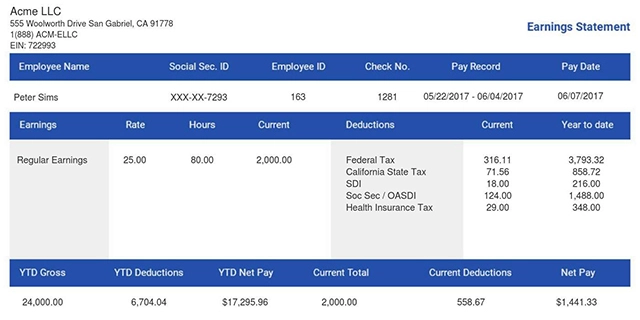
While you're looking, check the rest of the stub. It should show your employer's name, gross pay, an itemized list of all deductions, net pay, and year-to-date totals. If any are missing, ask your HR team or payroll provider for a corrected stub.
You Might Also Like
- 1099 Pay Stub: Should Independent Contractors Receive a Pay Stub
- How to Calculate Tax on 1099 Misc Income
- Proof of Income Documents: 6 Instances You'll Need a Pay Stub
- Pay Stubs for Loan Applications
- DoorDash Pay Stubs
Conclusion
Knowing what is a payroll provider helps on both sides. Owners can pick the right partner. Employees can spot errors on their pay stubs. The right provider handles the details, so you don't have to.
Need professional pay stubs for proof of income, employee records, or your books? ThePayStubs.com makes accurate, IRS-compliant pay stubs in under two minutes.
- 1. Enter Your Information

- 2. Select Your Favorite Theme

- 3. Download Your Stub!

 By
By