

How to Pay Myself From My LLC: 2026 Owner's Guide
 By
By
The money sitting in your business account is yours. Getting it into your personal account, though, isn't just a transfer. Knowing how to pay myself from my LLC comes down to two things: how many members the LLC has, and how the IRS taxes it. Those two facts decide your method, your tax bill, and your paperwork.
There are three separate methods, not one, and picking the wrong one costs you money in April. This guide covers all three, plus the pay records a paystub generator can create. You'll also find the tax on each method, how much to pay yourself, and how to prove that income later.
Key Takeaways
- Single-member LLC owners take an owner's draw. There is no payroll and no withholding.
- Multi-member LLCs use profit distributions, guaranteed payments, or both, as set by the operating agreement.
- An LLC taxed as an S corp must run payroll and pay the owner a reasonable W-2 salary first.
- You owe tax on your share of the profit whether or not you actually withdraw it.
- Every payment needs a record. A bank transfer with no paper trail causes problems at tax time and when someone asks you to prove your income.
- How to Pay Myself From My LLC: The Three Options
- How to Pay Myself From My LLC as a Single-Member Owner
- How Do I Pay Myself in an LLC With Multiple Members?
- How to Pay Myself From My LLC After an S Corp Election
- How Much Should I Pay Myself From My LLC?
- What Taxes Do I Owe When I Pay Myself From My LLC?
- LLC Payroll: Running Payroll for Yourself and Your Team
- How to Pay Myself From My LLC and Keep Clean Records
- How to Prove Your Income as an LLC Owner
- Conclusion: Start Paying Yourself From Your LLC the Right Way
How to Pay Myself From My LLC: The Three Options
Your tax classification decides your payment method. You don't get to pick based on preference, and that's the single rule behind everything else here. Paying yourself LLC profits works differently from paying an employee: you're an owner taking your own money, not a worker earning wages.
So how do LLC owners pay themselves? Owners can pay themselves three ways:
| LLC Type | Default Tax Treatment | Payment Method | Who Pays the Tax |
|---|---|---|---|
| Single-member | Sole proprietorship | Owner's draw | You, on net profit |
| Multi-member | Partnership | Distributions, guaranteed payments | Each member, on their share |
| Elected S corp | S corporation | W-2 salary, then distributions | You, with payroll tax on salary only |
| Elected C corp | C corporation | W-2 salary, then dividends | Company at 21%, then you |
Quick version, by structure:
- How to pay yourself single-member LLC: take an owner's draw from profits.
- Multi-member LLC: take a distribution, a guaranteed payment, or both.
- S corp election: run payroll, pay yourself a salary, then take distributions.
The rest of this guide covers how to pay myself from my LLC under each structure, including the tax implications and the records to keep.
How to Pay Myself From My LLC as a Single-Member Owner

If you're the only member, the IRS treats your LLC as a disregarded entity for tax purposes. It doesn't see you and the business as separate taxpayers, so you can't be your own employee and there's no salary to run.
Instead you take an owner's draw. Write yourself a business check or move funds from the business account to your personal account. Nothing is withheld, and the draw isn't a deductible business expense.
Owners often ask, "Can I pay myself from my LLC any time I want?" Yes, within limits. The business covers its obligations first, and the draw gets recorded properly. That's how to pay yourself in an LLC with one member, and mechanically it really is that simple.
Here's the part most guides skim: you're taxed on the profit, not on the draw. If your LLC nets $80,000 and you only take out $50,000, you still owe tax on the full $80,000. Leaving money in the account doesn't defer anything. You report it all on Schedule C with your personal Form 1040.
A solo consultant might take a draw twice a month, never touch payroll, and still keep pay stubs for self-employment income. An owner with two employees runs payroll for the team but still pays herself by draw. Same LLC, two different systems running side by side. That split is a normal part of how to pay myself from my LLC once staff are involved.
How Do I Pay Myself in an LLC With Multiple Members?
In a multi-member LLC, you take profit distributions based on your ownership percentage, guaranteed payments for the work you do, or both. Your operating agreement sets the timing and amounts. The LLC files Form 1065, and each member receives a Schedule K-1 reporting their share of income.
The two methods do different jobs. A distribution follows ownership, so a 40% member gets 40% of what's distributed, and it only happens when there are profits. A guaranteed payment is fixed compensation for work performed, paid even if the LLC lost money that period. Guaranteed payments are deductible by the LLC and taxable to you as ordinary income.
Have the operating agreement spell out how often distributions happen and whether a member vote is required. Without those provisions, your state's default rules fill the gap, and they're rarely what the members would have chosen.
One tax trap catches partners every year. Of everything in how to pay myself from my LLC, this is what surprises people most. You owe tax on your allocated share, not on what you withdrew. If the LLC earns $100,000 and you own half, you're taxed on $50,000 even if you only took $20,000 out.
How to Pay Myself From My LLC After an S Corp Election

Filing Form 2553 changes everything. You become a W-2 employee of your own company. The LLC runs payroll, withholds income tax and FICA from your paycheck, and pays the employer share on top.
The upside sits above your salary. Distributions to S corp owners aren't subject to self-employment tax. That changes how to pay yourself with LLC profits once the business is consistently profitable.
Here's the actual math, which most guides skip. Say your LLC nets $150,000 and you set a $90,000 salary. Self-employment tax applies to 92.35% of net profit rather than the whole number, so without the election you'd owe 15.3% on $138,525, about $21,190. Elect S corp status and you pay 15.3% on the $90,000 salary instead, about $13,770. That's roughly $7,400 saved. Now subtract what the election costs: a payroll service, a separate 1120-S return, and quarterly Form 941 filings. Those run $1,500 to $3,000 a year. The election still wins here, but by a few thousand dollars, not the life-changing number some articles imply. Below roughly $80,000 in profit, the costs usually swallow the savings.
Setting a Reasonable Salary
The IRS standard is what you'd have to pay someone else to do your job. Research comparable roles in your industry and region, write down what you found, and keep it with your records.
The pattern that triggers scrutiny is a token salary paired with a large distribution, because that's the shape of someone converting wages into untaxed profit. A $20,000 salary on $200,000 of profit invites questions. Document how you landed on your number before you need to defend it.
A C corp election works similarly for payroll. It adds a flat 21% corporate tax before any distributions, and you still pay personal income tax on what you receive. Most small LLCs skip it for that reason.
How Much Should I Pay Myself From My LLC?
There is no fixed percentage. Start by covering operating expenses and setting aside 25% to 30% for taxes. Pay yourself from what remains, keeping at least three months of expenses in the business. LLCs taxed as S corps must also meet the IRS reasonable salary standard.
Work it in that order and the number takes care of itself. Clear business expenses, move the tax reserve out, then look at what's left.
"How can I pay myself from my LLC without starving the business?" comes down to runway. Three months of operating costs is a reasonable floor, and seasonal businesses need more, because a good June doesn't fund a slow January.
Raise your own pay as revenue stabilizes, not after one strong month. If you have employees, their payroll clears before your draw does, every time.
What Taxes Do I Owe When I Pay Myself From My LLC?
Owners of pass-through LLCs pay self-employment tax of 15.3% plus regular income tax. That's 12.4% for Social Security, capped at the 2026 wage base of $184,500. Medicare adds 2.9% with no cap. Draws carry no withholding, so you pay through quarterly estimated payments.
That wage base matters more than most guides let on when you're working out how to pay myself from my LLC tax-efficiently. For 2026 it rose to $184,500 from $176,100 in 2025, which caps the Social Security portion at $22,878. Past that ceiling only the 2.9% Medicare piece continues. You also deduct half of your self-employment tax against gross income.
Self-employment taxes are the price of having no employer to split them with you, and they land on your personal tax return. Because nothing is withheld from a draw, the IRS expects you to pay as you go. Estimated payments kick in once you expect to owe $1,000 or more for the year, and they fall in April, June, September, and January. If a due date lands on a weekend or legal holiday, it rolls to the next business day. Pay at least 90% of this year's tax or 100% of last year's, whichever is smaller, and you're inside the safe harbor. One catch: if your prior-year adjusted gross income topped $150,000, that second figure rises to 110%.
One distinction decides how to pay yourself through an LLC efficiently. Draws are never deductible to the business. Guaranteed payments and W-2 salaries are, which also changes what shows up as federal income taxable wages on a paycheck.
LLC Payroll: Running Payroll for Yourself and Your Team
Two situations make it necessary: you hire employees, or you elect corporate tax treatment. Under default rules with no staff, you don't need it at all.
Once you do, the setup is the same either way. Get an EIN and pick a pay schedule you can hold to. Then withhold income tax and FICA from each paycheck, file Form 941 quarterly, and issue W-2s at year end. The deductions show up under standard payroll codes on every stub you produce.
The mechanics of how to pay yourself from your LLC change once payroll is running. Your pay becomes a scheduled, withheld, documented paycheck instead of a transfer you initiate. That reshapes how to pay myself from my LLC month to month. For an owner who has been drawing informally for years, it's the biggest practical adjustment.
If you have a team, you're already doing this for them. Adding yourself to an existing payroll run is a much smaller step than starting from nothing.
How to Pay Myself From My LLC and Keep Clean Records
Moving the money takes a minute. Documenting it correctly protects you later, and it's the step almost every guide leaves out. This is how to pay yourself with an LLC without creating problems down the line.
- Keep a dedicated business account. Bring your EIN and formation documents to the bank if you haven't opened one.
- Check what's actually available. Subtract expenses and your tax set-aside before deciding the amount.
- Transfer the funds. ACH, business check, or online transfer all work, though direct deposit leaves its own paper trail.
- Label it immediately. Record it as an owner's draw or distribution, never as a business expense.
- Log the details. Date, gross amount, payment type, period covered, and a running year-to-date total.
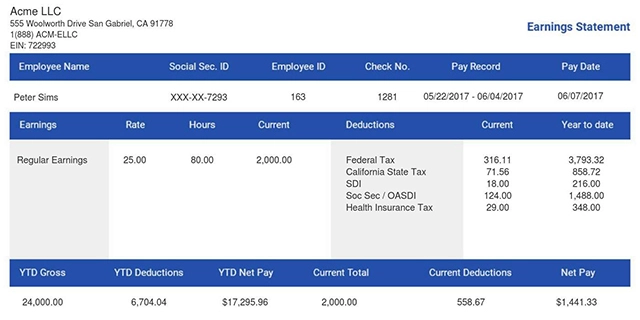
That fifth step is the one people skip. Owners tend to picture paying myself from my LLC as the transfer alone. A bank memo reading "transfer" tells a lender or an auditor nothing about the payment. A proper pay record carries the period and the year-to-date figure, and that's what turns a withdrawal into documented compensation.
Two habits make this painless. Pay yourself on the same two dates every month so the pattern is consistent and provable. Move the tax set-aside into a separate savings account at the moment of the draw, not at quarter-end when it's already been spent. Accounting software like QuickBooks can categorize the transfer as an owner's draw automatically, keeping your equity account clean.
There's more at stake than tidy books. Running personal costs through the business account is the exact evidence used to argue an LLC isn't a genuine separate entity. That's how owners lose the liability protection they formed the LLC to get.
How to Prove Your Income as an LLC Owner
Here's the problem nobody warns you about. Pay yourself by draw for two years, then apply for a mortgage, and the lender asks for pay stubs you don't have. There's no W-2 either. The question shifts from how do I pay myself as an LLC owner to how do I prove it. Working out how to pay myself from my LLC is only half the job.
What actually works depends on your method:
- Owner's draw: Schedule C from your return, business bank statements, and pay records you generate yourself.
- Guaranteed payments: your Schedule K-1, which shows the amount as ordinary income.
- S corp salary: your W-2 and payroll pay stubs, the cleanest documentation of the three.
A tax return alone often isn't enough. Underwriters want recent income, and your last return can be fifteen months old. That gap is where self-employed proof of income applications stall.
Building the record as you go solves it. Need pay documentation for a lease, a loan, or your own files? Learn how to create a self-employed pay stub for each payment you take.
You Might Also Like
- How to Read a W-2 Like a Pro
- Freelancing for Beginners: 1099 vs W-2
- Should Independent Contractors Receive a 1099 Pay Stub?
- Employment Verification and Proof of Income Documents
- State Pay Stub Laws
Conclusion: Start Paying Yourself From Your LLC the Right Way
Three things decide how to pay myself from my LLC. Your structure sets the method, the method sets the tax treatment, and both determine the records you keep. Single members draw, multi-member LLCs distribute, and S corps run payroll first.
Set the amount from real cash flow and move your tax reserve the same day you pay yourself. Write down every payment as it happens rather than reconstructing it under deadline.
That last piece is where a pay stub generator earns its keep. Create accurate pay records for yourself and your team in a couple of minutes. You'll have the documentation ready the day someone asks.
- 1. Enter Your Information

- 2. Select Your Favorite Theme

- 3. Download Your Stub!

 By
By