

Nevada Overtime Laws in 2026: Daily Pay Rules and Exemptions
 By
By
Most states owe you overtime after 40 hours in a week. Nevada can owe it after 8 hours in a single day. That one difference is why Nevada overtime laws trip up so many paychecks, and why a worker can be underpaid for months without noticing. If you're an hourly employee in Reno or Las Vegas, or you're the one running payroll for a small crew, the rules hinge on a single number: $18.00 an hour. Either way, accurate pay stub records are how you prove what was actually worked and paid.
Here's what this guide covers: the two overtime triggers and who they apply to, how the 24-hour workday actually works, the calculation the state says you must use when both triggers fire, who's exempt, and how to check your own pay stub for mistakes.
Key Takeaways
- Nevada's minimum wage is $12.00 per hour as of July 1, 2026, which sets the daily overtime threshold at $18.00 per hour.
- Employees earning under $18.00 an hour get overtime after 8 hours in a workday or 40 hours in a week.
- Employees paid $18.00 or more only earn overtime after 40 hours in a week.
- Daily and weekly overtime don't stack. You're paid whichever calculation is greater.
- A workday runs 24 hours from the moment you clock in, not from midnight.
- Nevada OT laws never require double time, and a salary alone doesn't make anyone exempt.
- What Are Nevada Overtime Laws?
- How Nevada's 8-Hour Daily Overtime Rule Works
- Daily or Weekly Overtime, Not Both
- How to Calculate Overtime in Nevada
- The 4/10 Schedule and What It Really Changes
- Who Is Exempt From Overtime in Nevada?
- How to Check Your Pay Stub for Correct Overtime
- Recordkeeping and Penalties for Nevada Employers
- Common Mistakes Under Nevada Overtime Laws
What Are Nevada Overtime Laws?
Nevada overtime laws require 1.5 times an employee's regular wage rate under NRS 608.018. Workers paid less than $18.00 per hour earn overtime after 8 hours in a workday or 40 hours in a week. Workers at or above $18.00 earn overtime only after 40 weekly hours. Nevada requires no double time.
That $18.00 figure isn't arbitrary. It's exactly 1.5 times the state minimum wage of $12.00 per hour, confirmed in the Labor Commissioner's 2026 Minimum Wage Bulletin posted June 29, 2026. Nevada scrapped its old two-tier wage system on July 1, 2024, so there's now one rate for everyone regardless of whether an employer offers health benefits.
The wage you earn decides which version of the law you live under. Below $18.00, both the daily and the weekly trigger apply to you. At $18.00 or above, only the weekly one does.
Overtime laws in Nevada are stricter than federal law here. The Fair Labor Standards Act only requires overtime past 40 hours a week and has no daily rule at all, the same baseline that governs the federal minimum wage. When state and federal standards differ, the one that pays the employee more wins. Neither Nevada overtime law nor the FLSA requires double time for long shifts, weekends, or holidays.
How Nevada's 8-Hour Daily Overtime Rule Works

The daily rule sounds simple until you define the word "day." Nevada overtime laws use a definition that surprises most people.
What Counts as a Workday in Nevada
Under NRS 608.0126, a workday is a 24-hour period of consecutive hours that begins when the employee begins work. This is the Nevada labor laws 24-hour rule, and it's not the calendar day. Clock in at 3:00 PM Monday and your workday runs until 3:00 PM Tuesday. Overnight shifts, doubles, and split shifts all get measured against that rolling window.
The Overlap Trap Most Employers Miss
Here's the part almost nobody explains. If you clock in earlier on the second day than you did on the first, those early hours fall inside the previous workday, and they can become overtime even in a short week.
The Labor Commissioner worked through exactly this in a July 2025 advisory opinion. An employee works Monday 11:00 AM to 7:00 PM, Tuesday 8:00 AM to 3:00 PM, then Wednesday 9:00 AM to 5:00 PM. The Tuesday hours from 8:00 to 11:00 AM still sit inside Monday's 24-hour workday, so those 3 hours are overtime. Wednesday's early hours overlap into Tuesday's workday too, but that one never passes 8 hours, so they stay regular. Total for the week: 23 hours worked, 20 regular and 3 at time and a half.
Three overtime hours on a 23-hour week surprises most managers. It's also why early-morning schedule changes are the quietest source of unpaid overtime in Nevada.
Daily or Weekly Overtime, Not Both
Nevada overtime laws can fire both triggers in the same week, and that overlap is where the real money gets decided.
When that happens, you don't add the two together. You calculate each one and pay whichever is greater. The Labor Commissioner settled this in a June 2025 advisory opinion, and the standard is plain: when in doubt, apply the overtime calculation that's more advantageous to the employee.
| Scenario | Hours worked | Daily OT | Weekly OT | Employer owes |
|---|---|---|---|---|
| Long shifts, few days | 44 | 10 hours | 4 hours | 10 hours |
| Slightly long days, six-day week | 44 | 2 hours | 4 hours | 4 hours |
Same 44 hours in both rows, very different bills. In the first, the daily hours pile up fast and dominate. In the second, the weekly total is the bigger number, so it governs. Employers who stack both figures overpay. Employers who only track weekly totals underpay. Both are common.
How to Calculate Overtime in Nevada

Every overtime hour is paid at 1.5 times the employee's regular rate, and that rate includes non-discretionary bonuses and commissions, not just base wages. Run the numbers with an overtime calculator if you want to check a full week fast.
Example 1: An Hourly Employee Under $18.00
Maria's regular hourly rate is $15.00 and she works a 10-hour shift.
- Regular pay: 8 hours x $15.00 = $120.00
- Overtime pay: 2 hours x $22.50 = $45.00
- Day total: $165.00
Example 2: An Employee at or Above $18.00
Devon earns $20.00 an hour and works 9 hours Tuesday. No daily overtime applies, because he's above the threshold. If his week totals 45 hours:
- Regular pay: 40 hours x $20.00 = $800.00
- Overtime pay: 5 hours x $30.00 = $150.00
- Week total: $950.00
Example 3: Folding a Bonus Into the Regular Rate
Maria earns a $60.00 production bonus in a 40-hour week. The bonus raises her regular rate before the multiplier: $600.00 in wages plus $60.00 equals $660.00, divided by 40 hours, giving a regular rate of $16.50. Her overtime rate that week is $24.75, not $22.50. Leaving bonuses out of the regular rate is one of the most expensive payroll errors in the state, and Nevada tightened this up recently: a November 2025 special session bill amended NRS 608.018 to tie regular rate overtime math to the federal rules in 29 C.F.R. Part 778. The same method applies when you calculate hourly, weekly, and monthly income from any pay rate.
The 4/10 Schedule and What It Really Changes
You'll read that a four-day, ten-hour agreement "waives" daily overtime. That's not quite right, and the difference matters.
Under NRS 608.018(1)(b), an employee and employer can, by mutual agreement, schedule 10 hours per day for 4 calendar days in a week. Notice what the statute doesn't say: it asks for mutual agreement, not a signed form. Plenty of guides add a "written agreement" requirement that isn't in the text. Daily overtime doesn't disappear either. The trigger simply moves from 8 hours to 10, because 10 hours is now the regularly scheduled workday. Work an 11th hour and overtime starts there.
A January 2025 advisory opinion applied the Commissioner's long-standing control test to this exact situation, and that test decides most close calls: who chose to change the schedule. If the employee asks to flex hours around and still works 40, no daily overtime is owed. If the employer drives the change, it risks daily overtime being recalculated from the 8-hour trigger on the days that ran long. In the Commissioner's own example, an employer that let someone work 12 hours on day one and then sent them home early later in the week owed 6 hours of daily overtime on a 38-hour week.
Put it in writing anyway. The statute doesn't demand it, but the agreement has to be genuine, and a documented schedule is what proves whose idea a change was months later. It should also line up with your pay period schedule.
Who Is Exempt From Overtime in Nevada?
NRS 608.018(3) exempts 16 categories from Nevada overtime laws, including bona fide executive, administrative, and professional employees, taxicab and limousine drivers, agricultural workers, railroad and airline employees, and businesses grossing under $250,000 a year. Salary alone never creates an exemption. Job duties must qualify too.
Everyone outside those categories counts as non-exempt employees who are eligible for overtime. Exempt employees are the exception, not the default, and the burden of proving an exemption sits with the employer.
The full statutory list also covers outside buyers, certain commissioned retail and service employees, motor carrier drivers and mechanics, local delivery drivers paid by trip rate, car and farm equipment salespeople and mechanics, employees under collective bargaining agreements that handle overtime separately, some public works workers, and live-in domestic workers who waive it in writing. Those last two categories are the only ones the statute requires to be agreed in writing.
Salaried Employees
Paying a salary doesn't exempt anyone by itself. The employee must clear both the federal salary floor of $684 per week and a duties test tied to real executive, administrative, or professional responsibilities. A salaried shift lead who mostly runs a register is almost certainly still owed overtime. Our guide to what makes an exempt employee walks through the duties test in detail.
Tipped Employees
Nevada allows no tip credit. Tips can't be counted toward the minimum wage, so a tipped worker's regular rate is their full cash wage, and overtime is calculated on that figure.
Commissioned Employees
The retail and service commission exemption is narrow. It requires both a regular rate above 1.5 times minimum wage and more than half of the employee's pay coming from commissions over a representative period.
How to Check Your Pay Stub for Correct Overtime
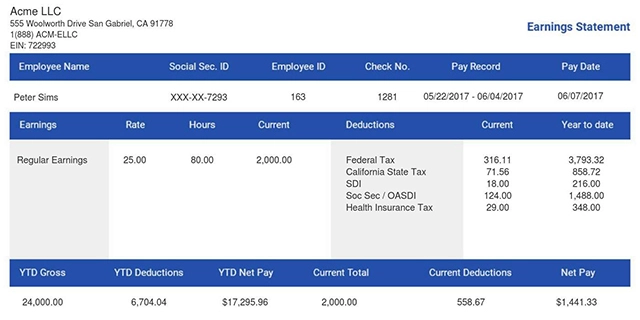
Nevada overtime laws only help if you can see them on paper. Pull your most recent stub and check three things.
First, find your gross pay and your regular hourly rate. Second, look for a separate overtime line with its own hours and rate. Third, confirm that rate is 1.5 times the regular one, not the same number.
Two failure modes account for most underpayments. The stub shows a 9 or 10-hour day but no daily overtime at all, which means your employer is tracking weekly totals only. Or overtime hours appear but get paid at base rate, which is a straight calculation error. Either one is worth raising immediately, because Nevada wage claims reach back only so far.
Employers, the same logic runs in reverse. Your pay stub is the evidence in a wage claim, so an explicit overtime line with hours and rate broken out is your best protection. If you're reconciling a stub against a W-2 later, the same line items matter when you calculate W-2 wages from a pay stub.
Recordkeeping and Penalties for Nevada Employers
Nevada overtime laws put the proof burden squarely on the employer. NRS 608.115 requires employers to keep, for each pay period, the gross wage, deductions, net wage, total hours worked each day, and the date of payment. Those records must be kept for two years, and an employee who submits a request has to receive the information within 10 days.
The daily hours requirement carries real weight in Nevada. A weekly total can't prove compliance with a daily overtime rule, so an employer without day-by-day records has no defense when a claim lands. Requirements vary by jurisdiction, so it's worth reviewing state pay stub laws wherever you operate.
The exposure is not trivial. Under NRS 608.195, violating the wage and hour provisions is a misdemeanor, and the Labor Commissioner may impose an administrative penalty of not more than $5,000 for each violation. On top of that, NRS 608.140 lets an employee who wins a wage suit recover reasonable attorney fees, provided they made a written demand at least 5 days before filing.
Common Mistakes Under Nevada Overtime Laws
Most of these come from applying federal payroll habits to Nevada OT laws, which are stricter. If you're unsure how your pay cycle affects the math, start with whether overtime is calculated weekly or biweekly.
- Tracking weekly hours only, which hides every daily overtime hour a sub-$18.00 employee earns.
- Starting the workday at midnight instead of at clock-in, per NRS 608.0126.
- Treating a 4/10 agreement as a full waiver of daily overtime rather than a shift to a 10-hour trigger.
- Adding daily and weekly overtime together instead of paying the greater of the two.
- Assuming salaried means exempt without applying the duties test.
- Leaving non-discretionary bonuses and commissions out of the regular rate.
- Offering comp time instead of overtime pay, which private employers generally can't substitute for wages owed.
- Not knowing which employees sit below $18.00, which makes the daily rule impossible to apply correctly.
You Might Also Like
- How Much Overtime Is Too Much?
- Does PTO Count Towards Overtime?
- Payroll Codes Explained
- How Many Hours Is Full Time and Why It Matters
- Can a Job Hold Your First Paycheck?
Conclusion
Three things decide almost every Nevada overtime question: whether the employee earns under $18.00 an hour, when their 24-hour workday actually started, and which calculation, daily or weekly, produces the bigger number. Get those right and the rest of Nevada overtime laws follow. Get them wrong and the gap compounds quietly, one shift at a time.
Accurate pay documentation is what turns these rules into something you can actually prove, for your own hours or for your whole team. Create clear, itemized records with our paystub generator in minutes.
- 1. Enter Your Information

- 2. Select Your Favorite Theme

- 3. Download Your Stub!


 By
By