

Biweekly Pay Stub: What It Shows and How to Read It
 By
By
Biweekly pay is the most common payroll frequency in the United States. Over 36% of businesses use it, according to the Department of Labor.
But when that deposit hits every other Friday, do you know what your bi weekly pay stub tells you?
This guide covers what each field means and how to calculate your earnings. It also explains how biweekly payroll compares to other pay schedules. You'll learn how to generate a biweekly paystub for proof of income using a pay stub generator.
Key Takeaways
- A biweekly pay stub covers a two-week pay period. Employees receive 26 per year
- Gross pay per stub = Annual salary ÷ 26, or hourly rate × hours worked over two weeks
- Standard fields include gross earnings, itemized deductions (federal tax, FICA, benefits), net pay, and YTD totals
- In 2026, Friday biweekly schedules have three-paycheck months in April and October
- Keep your two most recent consecutive stubs on hand. Landlords and lenders require them for income verification
- What Is on a Biweekly Pay Stub?
- How To Calculate Your Biweekly Pay
- Biweekly Pay Stub vs. Semi-Monthly and Other Pay Schedules
- Benefits of Biweekly Pay for Employees and Employers
- Tax Withholding on Your Biweekly Pay Stub
- How To Generate a Biweekly Pay Stub
- You Might Also Like
- Conclusion: Read It, Plan With It, and Generate One When You Need It
What Is on a Biweekly Pay Stub?
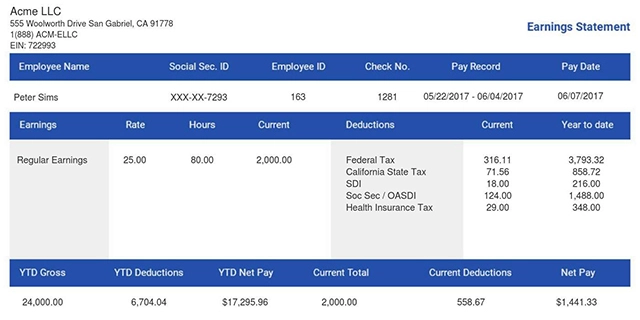
A biweekly pay stub covers a two-week pay period. It shows gross earnings, both regular and overtime pay. It lists all deductions such as federal and state income tax, Social Security at 6.2%, Medicare at 1.45%, and benefits. It also shows net pay and year-to-date totals for all payroll deductions and earnings.
Each stub shows a pay period date range. For example, March 3 to 16, 2026, covers an exact 14-day window.
Gross Earnings
Gross pay is the starting figure on every biweekly pay stub before any payroll deductions. For salaried employees, this amount stays the same each period. For example, a $52,000 annual salary produces $2,000.00 gross per stub ($52,000 ÷ 26).
For hourly workers, gross pay varies by the number of hours worked. For example, a worker earning $19.00 per hour who logs 80 hours gets $1,520.00 gross.
Deductions
Five categories typically appear on the withholding side of your biweekly pay stub:
- Federal Income Tax: Found using IRS Publication 15-T biweekly tables based on your W-4 filing status.
- Social Security: 6.2% of gross wages up to the 2026 wage base of $176,100.
- Medicare: 1.45% of gross wages with no cap.
- State and Local Income Tax: Varies by location.
- Benefits Deductions: Health insurance premiums, 401(k) contributions, and other pre-tax items.
YTD Totals
Year-to-date columns track total earnings and deductions since January 1. At pay period 13 of 26, your YTD gross should equal about half your annual salary. If it does not match, you can flag it with your payroll provider. Catching errors mid-year is far easier than fixing them in December.
How To Calculate Your Biweekly Pay
Two formulas cover both employee types:
1. Salaried employees
Annual Salary ÷ 26 = Gross Biweekly Pay
Example:
$65,000 ÷ 26 = $2,500.00 gross per stub
2. Hourly employees
Hourly Rate × Hours Worked in Two Weeks = Gross Pay
Example:
$22.00/hr × 80 hours = $1,760.00 gross per stub
Under the Fair Labor Standards Act (FLSA), non-exempt hourly workers earn overtime at 1.5x their regular rate for hours beyond 40 per workweek. That overtime pay shows as a separate line on the stub.
Net pay arrives in your bank account via direct deposit. It is lower than gross after all deductions are applied. Your biweekly pay stub shows both gross and net, so you can track where every dollar goes.
Keep in mind that 52 weeks do not divide evenly into 12 months. Two months each year carry three paychecks instead of two. In 2026, those months are April and October for Friday bi-weekly payroll schedules. That extra paycheck is worth planning for in your budgeting.
Biweekly Pay Stub vs. Semi-Monthly and Other Pay Schedules

Not all pay schedules work the same. The differences show up on each stub:
| Schedule | Pay Periods/Year | Gross Per Stub ($52K Salary) |
|---|---|---|
| Weekly | 52 | $1,000.00 |
| Biweekly | 26 | $2,000.00 |
| Semi-monthly | 24 | $2,166.67 |
| Monthly | 12 | $4,333.33 |
The key difference is that each biweekly stub is about 7.7% smaller than a semi-monthly stub ($2,000 vs. $2,167 on a $52,000 salary). That is not a pay cut. You get two extra stubs per year. Still, it is worth checking if your payroll frequency changes.
Semi-monthly pay lands on fixed calendar dates like the 1st and 15th. Biweekly pay always falls on the same weekday, no matter the date. Both structures appear clearly on their pay stubs.
Benefits of Biweekly Pay for Employees and Employers
For Employees and Individuals
A steady biweekly income makes budgeting and financial planning much simpler. Knowing your payday is every other Friday helps you schedule mortgage payments and automate savings.
For rental applications and mortgage pre-approvals, landlords and lenders often request two or three back-to-back biweekly pay stubs as proof of income. Consistent net pay across stubs signals stable employment. That is what approval decisions hinge on.
For Employers and Small Business Owners
Processing payroll 26 times per year is much more efficient than running it 52 times per year. Fewer cycles mean lower payroll costs, especially with providers that charge per run. Biweekly periods also align cleanly with FLSA overtime rules.
Small business owners who pay employees or pay themselves through their LLC benefit from clean biweekly pay stubs. SBA loans, business credit lines, and IRS compliance all rely on a solid payroll paper trail.
Tax Withholding on Your Biweekly Pay Stub

Your total annual tax bill does not change based on payroll frequency. Biweekly pay spreads withholding evenly across 26 periods. Employers use IRS Publication 15-T to find the federal income tax per stub based on your W-4 status and gross wages.
In 2026, the FICA rates withheld from each biweekly stub are:
- Social Security: 6.2% on wages up to $176,100
- Medicare: 1.45% with no wage cap (an additional 0.9% applies above $200,000 for high earners)
Only your employee share of FICA appears on your stub. Your employer matches the same amounts on their end. To adjust federal income tax withholding, submit an updated W-4. The change takes effect on your next biweekly stub.
How To Generate a Biweekly Pay Stub
To generate a biweekly pay stub, visit ThePayStubs.com. Enter your pay period dates (two-week range), employer details, gross earnings, and deductions. The tool calculates federal and state taxes, FICA, and net pay automatically. It then outputs a PDF with all required fields. The whole process takes under five minutes.
Here is a bi weekly pay stub example of who uses a generator and why:
- Self-employed contractors documenting biweekly income for rental applications or loan pre-qualification
- Small business owners providing professional pay stubs for hourly or salaried workers
- Freelancers who pay themselves on a regular biweekly schedule and need consistent income records
When submitting stubs as proof of income, include your two most recent biweekly stubs. Lenders and landlords look for consistent net pay, employer name and address, and YTD totals. A pay stub generator produces all of these in a format most places accept.
You Might Also Like
- How to Read a W-2 Like a Pro
- How to Get a Pay Stub From Direct Deposit
- Proof of Income If Paid in Cash
- Payroll Codes Explained
- How to Calculate Your Hourly, Weekly, and Monthly Income
Conclusion: Read It, Plan With It, and Generate One When You Need It
A biweekly pay stub is more than a pay record. It is proof of income, a payroll processing check, and a budgeting tool in one. ThePayStubs.com has you covered for both individual stubs and employer pay documentation. Use our pay stub generator to produce accurate biweekly pay stubs with all required fields in minutes.
- 1. Enter Your Information

- 2. Select Your Favorite Theme

- 3. Download Your Stub!

 By
By