

Is PTO Taxed? 2026 Tax Rates, Calculations & State Laws
 By
By
Many employees wonder, "Is PTO taxed when you receive a payout?" This question comes up often when you get paid for unused vacation time. Understanding "How much is PTO payout taxed?" can help you plan better when leaving a job or managing year-end finances.
The PTO payout tax rate determines how much money you'll actually receive. If you need pay documentation, our paystub generator can help.
This guide explains how PTO payouts are taxed. It shows you how to calculate PTO payout after taxes. The document also includes information about state laws effective in 2026.
Key Takeaways
- Is PTO taxed as income? Yes, the IRS treats PTO payouts as supplemental wages with a flat 22% federal withholding rate.
- PTO is not taxed at a higher rate than regular wages. The 22% shows the withholding method. It doesn't show your actual tax rate.
- You can calculate your PTO payout by multiplying unused hours by your hourly wage. Then subtract 22% for federal tax.
- Over 20 states require employers to pay unused PTO benefits to employees when they leave.
- The IRS may refund you at tax time if your withheld taxes are more than what you owe.
- Key Takeaways
- What Is a PTO Payout?
- Is PTO Taxed? Understanding the Tax Rate
- Is PTO Payout Taxed Differently Than Regular Wages?
- How To Calculate Your PTO Payout
- PTO Payout Laws by State
- When Is PTO Paid Out, and Is PTO Taxed the Same Way?
- Can You Avoid Taxes on a PTO Payout?
- You Might Also Like
- Conclusion
What Is a PTO Payout?
A PTO payout happens when an employer pays you cash for your accrued PTO that you didn't use. This includes vacation time, sick time, or any general PTO hours you’ve accrued but didn’t use. Companies offer PTO as a benefit. If you're self-employed or have proof of income if paid in cash, PTO rules work differently.
Employees may receive a PTO payout in the following situations:
- When you leave a job (voluntarily or through termination)
- When companies let you exchange unused year-end compensation for cash
- Upon retirement
- Through a PTO conversion or buyback program
The answer to "Does PTO get taxed?" depends on your situation. The short answer is yes. However, "Is pto taxed?" Always. All PTO payouts count as taxable income according to IRS rules.
Read more: Understanding Payroll Codes on Your Pay Stub
Is PTO Taxed? Understanding the Tax Rate


Yes, PTO payouts are taxed as income. The IRS classifies them as supplemental wages. These wages are subject to a flat 22% federal income tax withholding rate. The total federal withholding reaches 29.65% after you pay Social Security tax at 6.2% and Medicare tax at 1.45%.
The vacation payout tax follows the same rules the IRS applies to bonuses and commissions. According to IRS Publication 15, employers must withhold taxes from supplemental wages. They use either the flat 22% rate or the aggregate method based on your regular wages. To learn more about how taxes appear on your paycheck, check our guide on FIT taxable wages.
Your payout includes several withholding components:
- Federal Income Tax: 22% (supplemental wage method)
- Social Security: 6.2% (applies to earnings up to $176,100 in 2026)
- Medicare: 1.45%
- State Income Tax: Varies by state (California charges 6.6%, for example)
These deductions determine the taxes on PTO payout.
You might wonder, "Is PTO taxed at the state level too?" Yes. Most states with income tax also tax your PTO payout. They often use a similar supplemental wage rate.
Is PTO Payout Taxed Differently Than Regular Wages?
Understanding the difference between withholding rates and actual tax rates clears up common confusion. Many employees ask, "Is pto payout taxed at a higher rate?" The answer is no. PTO is not actually taxed at a higher rate than your regular wages. The 22% federal withholding serves as a standard method for supplemental wages. But it doesn't show your actual tax rate. Your real tax depends on your total annual income and tax bracket. The employee may receive tax refunds through the annual tax return process.
The tax rates in your PTO payout appear higher due to these factors:
- Withholding Estimate: The 22% shows estimated tax withholding, not your final tax bill.
- No Exemptions Applied: Your W-4 exemptions affect regular paychecks. They don't apply to PTO payouts.
- Combined With Regular Pay: Getting both on the same check can push you into a higher withholding bracket temporarily.
Is PTO taxed differently than your regular wages in the end? No. At tax time, your PTO payout adds to your total income. It's taxed at your marginal rate, just like other earnings. So, does PTO payout get taxed the same way at tax time? Yes, it all counts as combined income.
California employees may often wonder, "Is vacation time taxed at a higher rate?" The vacation payout tax rate California includes an additional 6.6% state tax. This brings the total withholding to about 35% before you receive your payout.
Read more: Gross Monthly Income: What It Means and How to Calculate It
How To Calculate Your PTO Payout

Your PTO payout calculation requires you to multiply your hourly rate by the hours in your unused PTO. This gives you the gross amount.
Then multiply by 0.78 to get your estimated after-tax amount. This accounts for the 22% federal supplemental tax. Salaried employees need to find their hourly rate by dividing their annual salary by 2,080.
Knowing how to calculate PTO payout can help you prepare for these payments. For more detailed income calculations, see our guide on how to calculate your hourly, weekly, and monthly income.
The following examples show the PTO payout calculator approach. The steps work for both hourly and salaried employees. These examples also demonstrate the PTO cash-out calculator method.
1. Hourly Employee Calculation
For example: Your hourly rate is $15, and you have 40 hours of unused PTO:
- Gross PTO Payout: $15 x 40 hours = $600
- Federal Tax (22%): $600 x 0.22 = $132
- Net Payout: $600 - $132 = $468
After subtracting FICA taxes, you get about $420. This accounts for Social Security (6.2%) and Medicare (1.45%). These combined rates represent the PTO cash-out tax rate employees face. You can use these numbers when you calculate PTO payout amounts.
2. Salaried Employee Calculation
For example: For a salaried employee earning $60,000 per year with 40 hours of unused PTO:
- Hourly Rate: $60,000 / 2,080 = $28.85 per hour
- Gross PTO Payout: $28.85 x 40 hours = $1,154
- Federal Tax (22%): $1,154 x 0.22 = $254
- Net Payout: $1,154 - $254 = $900
Our platform lets you create professional pay documentation through our pay stub generator tool. You can use the PTO payout tax rate calculator approach shown above to estimate your take-home amount.
PTO Payout Laws by State
Not every state requires employers to pay out unused PTO. Whether you get a payout depends on company policy and state laws.
States That Require PTO Payout
Over 20 states require employers to pay out accrued vacation time when an employee leaves. These PTO laws help compensate employees for their earned time. These states include:
- California
- Colorado
- Illinois
- Massachusetts
- Montana
- Nebraska
- New York
- Louisiana
- Maryland
- Rhode Island
California is particularly strict. Under the California Labor Code Section 227.3, vacation time counts as earned wages. Employees can never lose these wages. Employers must pay all accumulated vacation time when an employee's job ends.
Us-It-Or-Lose-It Policies
Some states allow use-it-or-lose-it policies. These PTO policies mean unused time disappears at year-end. However, these policies are banned in:
- California
- Montana
- Nebraska
In states without specific PTO laws, company policy governs the answer to "Are PTO payouts taxed the same as regular earnings?" Tax rules stay the same. But your ability to get a payout depends on where you live and your employer's policies.
When Is PTO Paid Out, and Is PTO Taxed the Same Way?
Is PTO taxed when paid out at different times? Tax rules for your payout stay unchanged regardless of timing.
- Upon Termination: Most states require this with the employee's final paycheck
- At Year-End: Some companies offer annual cash-out options
- During Employment: Employees can sometimes exchange paid time off for cash through conversion programs
- At Retirement: The system treats retirement benefits the same as termination benefits
The question "Is pto taxed?" has the same answer, no matter when you receive the payout. The PTO tax rate stays the same regardless of timing. But when you get paid can affect your overall tax situation for the year. If you're changing jobs, you may need to request a W-2 from your previous employer.
Can You Avoid Taxes on a PTO Payout?
You can't completely avoid taxes on a PTO payout. The IRS treats it as taxable income. The answer to how to avoid taxes on vacation payout is no. You can't skip them entirely. However, you can reduce your tax burden. Consult a tax professional for personalized strategies. Understanding this can help you avoid unintended tax consequences when planning your PTO cash-out.
These methods can help lower your overall tax bill:
- Time Your Cash-Out Strategically: Cash out PTO when your annual earnings are lowest.
- Boost Retirement Contributions: Increase your 401(k) contributions before the payout. This reduces your taxable income.
- Use Pre-Tax Accounts: Maximize FSA or HSA contributions to lower your tax burden.
- Understand Constructive Receipt: If you could have cashed out but didn't, the IRS may still count it as taxable income.
Be aware of the constructive receipt doctrine. Under IRS Section 1.451-2(a), you may owe taxes on PTO you could have cashed out. This applies even if you choose to carry it over. The IRS has rules to prevent people from avoiding taxes this way. Employers often require employees to make election choices before each year starts. Learning how to read a W-2 like a pro can help you verify your tax withholdings.
You Might Also Like
- How to Get a Pay Stub From Direct Deposit
- Self-Employed? Here's How to Show Proof of Income
- How Do You Get Your W-2 Online?
- What Is GTL on paystub?Group Term Life Explained
- What Does Year to Date Mean? YTD on Your Paystub Explained
- OASDI Tax: What It Means on Your Paycheck (2026 Guide)
Conclusion
Is PTO taxed? Yes. PTO payouts count as supplemental wages. They're withheld at a flat 22% federal rate plus FICA and state taxes. The good news is that this isn't necessarily your final tax rate. The flat 22% rate employers use for withholding often exceeds actual tax obligations. This results in refunds during annual tax filing. Knowing "How is PTO payout taxed?" can help you plan better. You can use the calculations above to estimate your after-tax amount. Check your state laws to understand your rights. Ensure you plan when you cash out to reduce tax expenses.
Our paystub sample templates give you a starting point. Whether you're an independent worker, switching jobs, or need documentation of earnings, you can create accurate pay stubs in minutes.
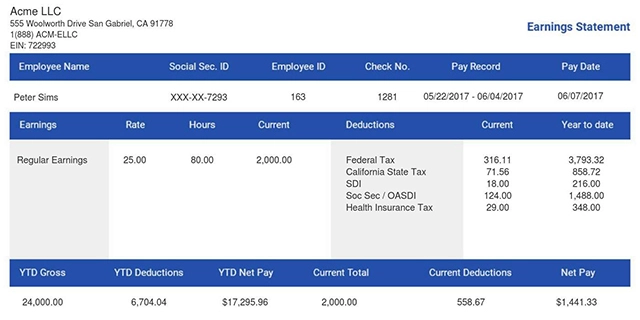
- 1. Enter Your Information

- 2. Select Your Favorite Theme

- 3. Download Your Stub!

 By
By