

What Does Year to Date Mean? YTD on Your Paystub Explained
 By
James Wilson
By
James Wilson When you examine your pay stub, you might find yourself asking about "What does year to date mean?" You're not alone. The YTD columns in the report can seem difficult to understand when you first see them.
These tools help you track your yearly financial income. You can use a paystub generator to generate expert-designed pay statements. These show your complete annual compensation.
Year-to-date (YTD) information appears on many financial documents. This includes pay stubs, investment statements, and business reports. Once you understand "What does year to date mean?", you can create budgets and plan your tax obligations. You can also detect payroll mistakes early.
This guide breaks down everything you need to know about YTD. You'll learn how to use it to your advantage.
Key Takeaways
- Year-to-date (YTD) tracks all activities from the first day of the calendar year (or fiscal year start) through today
- YTD on your pay stub shows total earnings, taxes, and deductions so far this year
- The YTD tracking system helps you plan finances and spot payroll errors early
- YTD resets to zero at the start of each new calendar or fiscal year
What Does Year to Date Mean?
The YTD period runs from the first day of January up to the current date. Some companies follow a fiscal year instead of the calendar year, so their YTD may begin on a different date. Your pay stub displays YTD information. This shows total earnings, taxes, and deductions for the current year.
Think of YTD as a running total. It updates every time you get paid. Paid biweekly? Your YTD grows 26 times per year. The YTD full form is simply "Year to Date." You'll see this abbreviation everywhere from paychecks to investment portfolios.
YTD appears in several places:
- Pay stubs and payroll records
- Investment account statements
- Business financial reports
- Tax documents and W-2 forms
The main point is that YTD begins on the first day of the calendar year. It continues until the present day. It shows a snapshot of cumulative activity for the year so far.
Calendar Year vs Fiscal Year YTD


Businesses use different methods to track their Year-to-Date performance. The key difference is between the calendar year and the fiscal year.
The calendar year YTD period covers the first day of January through the current date. Most individuals use this method. It's probably what your personal pay stub shows. The calendar year aligns with the standard January-to-December timeline that most employees follow.
A fiscal year works differently. A business can choose its own fiscal year start date. The fiscal year YTD begins from that date. For example, many retail operations often start in February or July. These months align with their expected sales patterns. Understanding both calendar and fiscal year tracking can help employees interpret pay stubs correctly.
Consider this example: A company starts its fiscal year on July 1. On October 31, their financial reports show four months of year-to-date data. A calendar year company on the same October 31 date would show ten months of data.
Why does this matter? Your pay stub YTD will reset at a different time if your employer uses a fiscal year. You should verify the system type with your HR department if you're not sure.
Types of YTD Calculations
Your pay stub contains multiple YTD performance indicators. Here's what each term means.
YTD Gross Pay
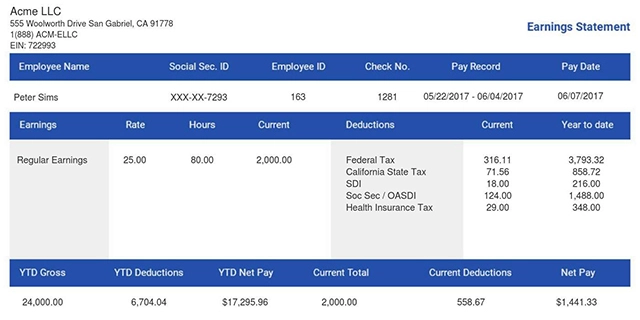
This shows your total earnings before any deductions. The compensation includes all forms of payment. This means your basic salary, overtime work, bonus payments, and commission earnings. If you received six paychecks each paying $3,000, your yearly gross income would total $18,000.
YTD Net Pay
This is the final amount you received after all deductions. The bank account received this money. YTD net pay equals YTD gross minus all taxes and deductions.
YTD Taxes
The document shows your complete federal, state, local, and FICA tax deductions. The breakdown reveals the complete amount for each tax category. Understanding FIT taxable wages can help you make sense of federal withholding amounts.
YTD Deductions
Your deductions fall into two categories:
- Pre-Tax Deductions: Include 401(k) contributions, HSA contributions, and health insurance premiums.
- Post-Tax Deductions: Include Roth 401(k) accounts, wage garnishments, union membership fees, and court-ordered wage seizures.
YTD Hours
For hourly workers, YTD hours track total hours worked since the beginning of the year. The system monitors both regular working hours and overtime shifts. This lets the employee verify total earnings from all worked hours.
Read more: How to Calculate Your Hourly, Weekly, and Monthly Income
How To Calculate Year-to-Date: Simple Steps

The calculation of "What does year to date mean?" is easy to understand once you know the basic principle.
The basic formula:
- Start with the value from the first day of the year (or fiscal year start)
- Add all values through the current date
- The total equals your YTD figure
Real-world payroll example:
Sarah receives $3,000 as her gross income during each biweekly payment period. By March 15, she has received six paychecks.
- YTD Gross Pay: $3,000 x 6 = $18,000
- Current Year Federal Tax at 22% Bracket: around $3,960
- Total FICA Contributions at 7.65% for the Year So Far: $1,377
- Remaining Net Pay After Deductions: $12,663
With each pay period, these YTD totals continue to increase. The December 31st numbers show your complete performance for the entire year. On the first day of the new year, the system resets all values to zero. Then it begins its new cycle of growth.
Our pay stub templates allow you to generate professional pay documentation. These serve as proof for loan applications and other requirements.
Read more: Proof of Income If Paid in Cash
What Does YTD Mean on Your Pay Stub?
Your pay stub shows your Year-to-Date (YTD) earnings, tax information, and deductions data. This covers the first day of January through your present pay date. Your yearly performance tracking shows labels like "YTD Gross," "YTD Federal Tax," and "YTD net pay."
Different payroll systems display YTD slightly differently:
- The ADP system (used by McDonald's, Marriott, and AutoZone) displays YTD data in a specific column.
- The earnings summary section of Workday (used by Target and Netflix) shows YTD information.
- The main pay statement from Paychex shows financial data, including year to date (YTD) information.
- The system in Gusto displays yearly total amounts at the top of the screen for quick access.
Understanding common payroll abbreviation codes can help you decode other confusing labels on your pay stub besides YTD.
Your final December pay stub YTD gross amount should equal Box 1 on your W-2. If the information doesn't match, reach out to HR for help before tax season begins. Learn more about how to read a W-2 to verify your information is correct.
What Does Year to Date Mean for Your Finances?
Tracking YTD gives you financial awareness that pays off in several ways:
Catch Payroll Errors Early
You need to review your projected YTD earnings by multiplying your pay rate by hours worked and the number of pay periods. Then, compare the total against the actual values on your pay stub. If the numbers do not match, investigate right away. Small errors can develop into major issues over time.
Plan for Tax Season
Review your YTD tax withholdings at the midpoint of the year. You may need to adjust your W-4 form. It might be taking out too much tax or not enough tax. This can result in either large tax bills or large tax refunds.
Track Budget Progress
The YTD income report displays your business's financial results from the beginning of the year. This determines your success in reaching your yearly targets. The performance tracking helps you adjust June expenses. This is easier than finding out in December that your goals are impossible to achieve.
Document Income for Applications
Lenders and landlords need YTD income documentation to verify your financial information. Knowing "What does year to date mean?" can help you explain your pay stub information to them. If you're self-employed, check out our guide on how to show proof of income.
For business owners, YTD reports help you check current spending against your yearly budget. This helps you make better choices about staff hiring and money management.
Common YTD Mistakes To Avoid
Now that you know "What does year to date mean?", watch out for these common mistakes:
- The exact difference between gross and net YTD can be confusing. Gross is before deductions. Net is what you take home. The loan application process demands your complete Year-To-Date (YTD) gross income, not your net income.
- Forgetting the reset. Your YTD returns to zero on the first day of the calendar year (or at the start of your employer’s fiscal year). A pay stub from late December will show much higher YTD than one from early January.
- Mid-year job changes. If you changed jobs during the year, your new employer shows only the payments they made during the current year through their YTD report. You need to merge your year-to-date earnings from all your employers for tax purposes. You may need to request a W-2 from a previous employer to have complete records.
- Treating YTD as final. YTD is incomplete until December 31. Your current YTD earnings don't represent your total annual compensation. You may receive salary increases and performance bonuses that will impact your projected earnings.
You Might Also Like
- How to Get a Pay Stub from Direct Deposit
- How to Get Your W-2 Online
- How to Tell the Difference Between a Real and Fake Pay Stub
- What Is GTL on paystub?Group Term Life Explained
- is pto taxed? 2026 Tax Rates, Calculations & State Laws
- OASDI Tax: What It Means on Your Paycheck (2026 Guide)
Conclusion
Understanding "What does year to date mean?" puts you in better control of your finances. The YTD figures on your pay stub show how much you have earned and how much has been withheld for taxes so far this year. Reviewing your YTD numbers throughout the year. This allows you to detect any discrepancies before the start of tax season. Regular monthly checks of your pay stubs will help you avoid future headaches.
You need official payment records to prove your freelance work and self-employment earnings. Use our pay stub generator to create accurate pay stubs in minutes.
- 1. Enter Your Information

- 2. Select Your Favorite Theme

- 3. Download Your Stub!


 By
By