

What FICA Stands For: Why Medicare Is Part of It (2026)
 By
James Wilson
By
James Wilson If you've ever had a pay stub and wondered about the FICA deduction, you're not alone. Many workers see both FICA and Medicare on their stubs and don't know why. FICA stands for the Federal Insurance Contributions Act. It is a payroll tax that funds two programs: Social Security and Medicare.
The FICA confusion won't go away. We hear it all the time, "I'm paying two taxes as an employee." Today, we'll explain what FICA stands for and how Medicare is included within it. Once you understand what FICA stands for and why Medicare is a part of FICA, your paycheck confusion will be gone.
Keep reading to learn about the 2026 FICA tax rates, how FICA vs Medicare tax rates differ, and what the "FICA/Med" line on your pay stub means.
Key Takeaways
-
FICA stands for the Federal Insurance Contributions Act. It's a federal payroll tax enacted in 1935
-
FICA has two parts: Social Security tax (6.2%) and Medicare tax (1.45%)
-
Medicare is part of FICA. The "FICA/Med" on your paystub is the Medicare portion of FICA
-
Employees and employers each pay 7.65% of wages (15.3% total combined)
-
Self-employed workers pay both halves themselves (15.3%) under SECA
- Key Takeaways
- What FICA Stands For
- Does FICA Include Medicare?
- The Social Security Component of FICA
- The Medicare Component of FICA
- Is FICA the Same as Medicare Tax?
- 2026 FICA Tax Rates and Limits
- Why Do I Pay Both FICA and Medicare?
- FICA for Self-Employed Workers (SECA)
- You Might Also Like
- Conclusion: What FICA Stands For in 2026
What FICA Stands For
FICA stands for the Federal Insurance Contributions Act, a U.S. federal law from 1935. Under this law, workers and employers both pay into two trust funds. Each fund is tracked on its own.
The first is the Old-Age, Survivors, and Disability Insurance (OASDI) program, also known as Social Security. It pays retirement, disability, and survivor benefits. The second is Hospital Insurance, also known as Medicare. Both the worker and the employer each pay 7.65% of wages (total 15.3%).
Congress created FICA as part of the Social Security Act in 1935. When it added Medicare in 1965, it built a hospital tax into FICA. Today, FICA funds two programs and applies to nearly all wage income.
The two programs that FICA stands for and funds include:
-
Social Security (OASDI): Retirement income, disability benefits, and survivor benefits for eligible workers and families
-
Medicare (Hospital Insurance): Medicare Part A hospital coverage for workers aged 65 and older and qualifying disabled individuals
The IRS requires employers to collect and pay FICA taxes on a set schedule. Standard employees cannot opt out.
Does FICA Include Medicare?
Yes, Medicare is part of FICA. The Federal Insurance Contributions Act collects two taxes:
- A 6.2% Social Security tax
- A 1.45% Medicare tax
When your paystub shows "FICA/Med" or "Fed MED/EE," that is the Medicare portion of your FICA payment. It is not a separate tax.
What is FICA Medicare? This is the Medicare part collected with Social Security under the Federal Insurance Contributions Act. Both taxes are deducted from the same paycheck. Once you know what FICA stands for, you'll see why both lines exist. Many people see both lines and think they are being charged twice. They are not.
FICA is the law, and it collects two distinct taxes:
-
Social Security tax: 6.2% of your wages, funding retirement and disability benefits
-
Medicare tax: 1.45% of your wages, funding hospital insurance
The federal government requires these to be reported separately. Adding both amounts gives you the total FICA taken from your paycheck.
Is Medicare part of FICA? Yes. You cannot have FICA without both parts. This can be very useful when you file taxes with your last pay stub and need to know which line is which.
What Is "FICA/Med" on Your Paystub?
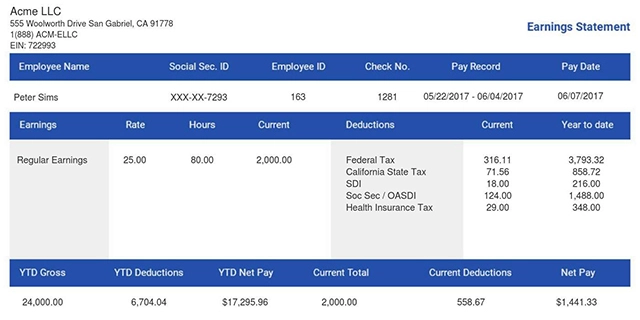
If you look at your pay stub, you'll see that FICA is typically broken out into two separate categories. The name may vary depending on your payroll vendor, but the most common formats are:
| Paystub Label | What It Is | Rate |
|---|---|---|
| FICA/SS or Fed OASDI/EE | Social Security portion | 6.2% |
| FICA/Med or Fed MED/EE | Medicare portion of FICA | 1.45% |
| FICA Med (alternate spelling) | Medicare portion on some older systems | 1.45% |
| SS Tax | Social Security (alternate label) | 6.2% |
| Medicare Tax | Medicare (alternate label) | 1.45% |
"FICA/Med" (also listed as "FICA med" on older payroll systems) refers to the Medicare portion of your FICA payment. Your employer may list this as "FICA/Med," "Fed MED/EE," or "Medicare Tax." All are the same 1.45% Medicare deduction. The two lines together show the total FICA deducted from your pay for the period. For more details on how paystub codes are structured, see our guide to payroll codes and what each label means.
The Social Security Component of FICA

Social Security is the larger of the two FICA components. The employee pays 6.2% of taxable wages, and the employer pays 6.2% of the employee's wages for a combined payroll tax of 12.4%.
Social Security has a wage base limit. The 2026 limit is $184,500, up from $176,100 in 2025. Once wages earned exceed $184,500 in a year, Social Security withholding stops. The max employee amount in 2026:
$184,500 x 6.2% = $11,439
This applies to FIT taxable wages and similar pay. Non-cash benefits not subject to FICA may be excluded.
Social Security FICA contributions fund three benefit types under the OASDI program:
-
Retirement benefits: Monthly income for workers aged 62 and older
-
Disability benefits: Income for workers who cannot work
-
Survivor benefits: Payments to spouses and dependents of deceased workers
Employees need 40 credits, roughly 10 years of work, to qualify for full Social Security retirement benefits.
The Medicare Component of FICA
The Medicare portion of FICA is 1.45% of all taxable wages. There is no wage base cap. You pay Medicare tax on every dollar you earn. The employer also pays 1.45%, for a combined rate of 2.9%.
What part of Medicare is funded by FICA? FICA taxes fund Medicare Part A (hospital insurance), which covers inpatient hospital stays, skilled nursing care, and hospice care. Medicare Part B and Part D are funded through premiums and general federal revenue, not FICA.
High earners owe an Additional Medicare Tax of 0.9% on wages above $200,000 (single) or $250,000 (joint). There is no employer match for this additional 0.9%.
Medicare is collected as part of your FICA through payroll. The FICA/Med tax line on your pay stub shows the 1.45% you paid for Medicare. It may also appear as Fed MED/EE.
Is FICA the Same as Medicare Tax?

No. FICA is the law that collects both Social Security and Medicare taxes. The 1.45% withheld for hospital insurance is the Medicare tax. FICA also includes the 6.2% Social Security tax. Therefore, Medicare is part of FICA, but FICA is not the same as Medicare alone.
Many people ask how FICA and the Medicare tax relate to each other. The answer matters:
-
FICA: Stands for Federal Insurance Contributions Act, the legal framework that collects both payroll taxes
-
Medicare tax: One of the two taxes collected under FICA, specifically 1.45% for hospital insurance
Is FICA the same as Medicare? No. The relationship goes one way. Medicare is part of FICA. But FICA is not the same as Medicare.
Is FICA and Medicare tax the same? No. Remember what FICA stands for. It's the law that covers both Social Security and Medicare. Treating FICA vs Medicare as equals gets the structure wrong. FICA is the statute. Medicare tax is one part of that statute.
Some payroll systems refer to the Medicare line simply as "Medicare Tax," which can cause confusion. Understanding the 4 main types of taxes helps clarify where FICA fits in the U.S. tax system. Whatever label is used, your total FICA always equals Social Security plus Medicare taxes.
2026 FICA Tax Rates and Limits
Here are the current FICA tax rates for 2026:
| Tax | Employee Rate | Employer Rate | Combined | 2026 Wage Limit |
|---|---|---|---|---|
| Social Security | 6.2% | 6.2% | 12.4% | $184,500 |
| Medicare | 1.45% | 1.45% | 2.9% | No limit |
| Additional Medicare | 0.9% | 0% | 0.9% | Over $200,000 |
| Total FICA | 7.65% | 7.65% | 15.3% | N/A |
The Social Security wage base increased to $184,500 from $176,100 in 2025, a cost-of-living adjustment of $8,400. The Medicare rate and the Additional Medicare Tax threshold are unchanged.
Pro tip: Check your FICA deductions each pay period. If FICA taxes are still coming out after your annual wages exceed $184,500, contact your payroll department right away.
Why Do I Pay Both FICA and Medicare?
You're not paying two separate taxes. FICA includes both Social Security (6.2%) and Medicare (1.45%) in a single 7.65% total. The federal government requires these to be shown on separate lines. This lets you and the IRS verify what was withheld for each program.
The answer to questions like, "Why do I pay FICA and Medicare as two separate lines?" is that the employer must report each FICA part separately. This is a transparency rule, not proof of double taxation.
The law requires separate tracking, which is why both appear on your stub. The employer splits the two so you and the IRS can verify each amount.
Your payments also earn you real future benefits:
-
Social Security contributions: Retirement income, disability coverage, and survivor benefits for your dependents
-
Medicare contributions: No-cost Medicare Part A coverage from age 65 on, after 10 or more years of payments
FICA for Self-Employed Workers (SECA)
Self-employed workers pay both the employee and employer shares of FICA on their own. The Self-Employment Contributions Act (SECA) sets this rule.
Under SECA, self-employed individuals pay:
-
12.4% Social Security tax on the first $184,500 of net self-employment income (2026 limit)
-
2.9% Medicare tax on all net self-employment income (no cap)
-
Total: 15.3% self-employment tax
The 0.9% Additional Medicare Tax also applies when net earnings exceed $200,000 (single) or $250,000 (joint).
One offset is that you can deduct 7.65% of your self-employment tax from gross income. This is reported on Schedule SE (Form 1040) and lowers your tax bill.
If you need to record your income, our 1099 form generator can help create accurate tax forms. You can also learn how to show proof of income when self-employed, which often means showing your FICA payments.
You Might Also Like
Conclusion: What FICA Stands For in 2026
FICA stands for the Federal Insurance Contributions Act. It always includes two taxes, which are Social Security (6.2%) and Medicare (1.45%). Together, they equal the 7.65% withheld from every paycheck, matched dollar-for-dollar by your employer. The separate "FICA/SS" and "FICA/Med" lines on your stub aren't two different taxes. They are two parts of one FICA total. In 2026, the Social Security wage base is $184,500. Medicare applies to all wages with no cap.
Your FICA payments fund real benefits you'll get in retirement and beyond. If you need pay records, our paystub generator calculates Social Security, Medicare, and state deductions for you.
- 1. Enter Your Information

- 2. Select Your Favorite Theme

- 3. Download Your Stub!


 By
By