

FSA for Childcare: 2026 Limits, Rules & Eligible Costs
 By
By
Childcare is often the second-biggest line in a family budget, right behind housing. An FSA for childcare is one of the few benefits that shrinks that bill before the IRS ever touches your paycheck. For 2026 it got noticeably bigger: the household cap jumped from $5,000 to $7,500, the first permanent increase since 1986. The deduction comes out of gross pay, so you'll see it on every pay stub.
Here's what an FSA for childcare covers and what the new limits mean for your paycheck. You'll also see how much you'll actually save and what to do at tax time.
Key Takeaways
- A dependent care FSA pays for care with pre-tax dollars, cutting both income tax and FICA.
- The 2026 contribution limit is $7,500 per household, but only if your employer adopts the increase.
- Eligible care expenses include day care, preschool, before and after school care, and day camp. Tuition from kindergarten up and overnight camp do not qualify.
- There is no rollover. Money left when the plan year closes is forfeited.
- Report the benefit on Form 2441 and check it against Box 10 of your W-2.
- What Is an FSA for Childcare?
- How Does Dependent Care FSA Work?
- Dependent Care FSA Eligible Expenses: What Qualifies
- The 2026 Dependent Care FSA Limit Jumped to $7,500
- How Much You Actually Save With an FSA for Childcare
- Who Qualifies for an FSA for Childcare?
- Dependent Care FSA Rules: Deadlines, Rollover, and Mid-Year Changes
- Dependent Care FSA vs Healthcare FSA vs the Tax Credit
- Tax Time: Form 2441, W-2 Box 10, and Your Pay Stub
- Offering an FSA for Childcare as a Small Business
What Is an FSA for Childcare?
An FSA for childcare is officially called a dependent care flexible spending account. It's an employer benefit that lets you set aside up to $7,500 in 2026 from your gross pay, before taxes, to cover care costs. Because contributions skip federal income tax and FICA, every dollar you route through it costs you roughly 30 cents less.
So what is dependent care FSA called on your benefits portal? Usually DCFSA. Plenty of parents just call it a childcare FSA.
The money never counts as taxable wages. That's the whole mechanism behind the FSA childcare benefit: savings land in every paycheck instead of arriving in April.
How Does Dependent Care FSA Work?

You elect an annual amount during open enrollment, and your employer splits it across your pay periods as a pre-tax payroll deduction. You pay your provider directly, then submit a claim with an itemized receipt for reimbursement. One catch separates it from a health FSA: you can only be reimbursed up to what has already been deducted.
That trips up first-time users: elect $7,500 in January, hit a $2,000 daycare bill in February, and you'll only be reimbursed as contributions accumulate.
Knowing how to use dependent care FSA money comes down to receipts. Before releasing funds, most administrators want:
- Provider's name and address
- Provider's tax ID number
- Dates of service
- Amount you paid
Some plans label the benefit a dependent day care FSA on claim forms, but the process is identical.
Dependent Care FSA Eligible Expenses: What Qualifies
The test is simple: the care has to let you work. That's what qualifies for dependent care FSA reimbursement, and schooling from kindergarten up falls on the other side of the line.
| Eligible | Not Eligible |
|---|---|
| Day care centers and in-home providers | Kindergarten tuition and any higher grade |
| Preschool and nursery school | Overnight camp |
| Before and after school care | Summer school and tutoring |
| Summer day camp, including specialty camps | Care by your own child under 19 |
| A nanny or au pair providing care | Care provided by someone you claim as a dependent |
| Adult day care for a disabled dependent | Care paid for while you weren't working |
| Agency placement fees | Food, activity fees, and supplies billed separately |
Two traps here cost real money. Kindergarten counts as education, so a daycare FSA claim for tuition gets denied even though the same provider's after-school program is fine. And your own kids can't be the provider: using an FSA for daycare run by your 18-year-old never qualifies, no matter how real the arrangement.
Dependent care FSA summer camp claims work only for day camps; the moment your child sleeps there, it's out. IRS Publication 503 governs all of this, and administrators follow it closely when reviewing an FSA daycare claim.
The 2026 Dependent Care FSA Limit Jumped to $7,500

The dependent care FSA limit 2026 sits at $7,500 per household, or $3,750 if you're married filing separately. That's up from $5,000 and $2,500, and it applies to plan years beginning on or after January 1, 2026.
Here's the part almost nobody mentions: the increase is permissive, not automatic. The law lets employers raise the cap but doesn't require it, and your company has until December 31, 2026 to amend its plan document. Confirm your FSA dependent care election ceiling at open enrollment, because your real cap may still be $5,000.
One more wrinkle: nondiscrimination testing can push your dependent care FSA income limit below the federal maximum if you're a highly compensated employee, sometimes mid-year.
How Much You Actually Save With an FSA for Childcare
Run the numbers with your own tax rate. At a 22% federal marginal rate plus 7.65% for Social Security and Medicare, you're avoiding 29.65% on every dollar you contribute. It lowers your adjusted gross income too.
- $7,500 election: roughly $2,220 in tax savings
- $5,000 election: roughly $1,480 in tax savings
These are estimates. State income tax isn't included because it varies, and it usually improves the number. The dependent care FSA benefits scale with your bracket: a 12% household saves less, a 32% household more.
Need proof of those pre-tax deductions for a lender or landlord? Our pay stub templates show every line.
Who Qualifies for an FSA for Childcare?
You qualify if your employer offers the benefit and the care lets you, and your spouse if married, work or look for work. The child must be under 13, or any age if a spouse or dependent cannot care for themselves. Your exclusion also cannot exceed whichever spouse earns less.
That earned income rule catches single-earner households off guard: if your spouse doesn't work, you generally can't use the account at all. The exception is a spouse who's a full-time student or unable to care for themselves. That spouse counts as earning $250 a month with one qualifying dependent, or $500 with two or more. Dependent care FSA eligibility also ends on your child's thirteenth birthday.
Dependent Care FSA Rules: Deadlines, Rollover, and Mid-Year Changes
There's no dependent care FSA rollover. Carryover, worth $680 in 2026, is a health FSA feature only. You forfeit any unused funds when the plan year closes.
Two optional deadlines soften that. A grace period gives you up to two and a half extra months to incur expenses; a run-out period extends your claim-submission window. Check your plan documents.
Your election locks for the plan year unless a dependent care FSA qualifying event occurs. A qualifying life event covers birth or adoption, marriage, or divorce. It also covers a change in your provider, the cost of care, or your employment status. Most plans give you about 30 days to file.
Dependent Care FSA vs Healthcare FSA vs the Tax Credit
| What it covers | 2026 cap | |
|---|---|---|
| Dependent care FSA | Childcare and adult day care so you can work | $7,500 household |
| Health FSA | Medical, dental, and vision costs | $3,400 |
| Child and dependent care tax credit | A percentage of care costs, claimed at filing | $3,000 one child / $6,000 two or more |
The dependent care FSA vs tax credit math changed in 2026, and not in the direction most articles assume. You can't claim both on the same dollar, and the credit's expense cap ($3,000 for one child, $6,000 for two or more) gets reduced by whatever you exclude through the FSA. So a full $7,500 election wipes out the credit completely, even with two or more kids. Elect $4,000 instead and a two-child family still has $2,000 of expenses left to claim. Worth running both ways before you lock in a big election.
Tax Time: Form 2441, W-2 Box 10, and Your Pay Stub
Your employer reports your contributions in Box 10 of your W-2. You then file Form 2441 to show the money went to qualified care. Skip that step, or claim more than you can substantiate, and the excess becomes taxable income.
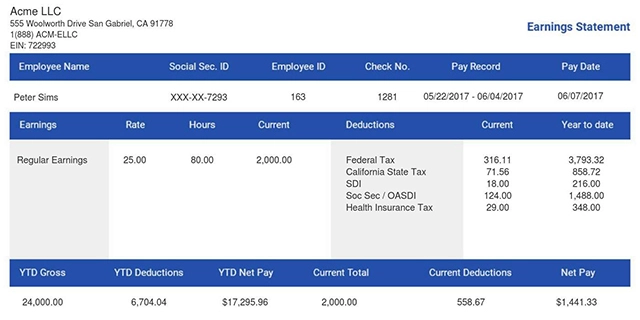
Your pay stub is where you catch a problem early. The contribution sits in the pre-tax deductions block and reduces both your taxable gross and your FICA wages. Compare the year-to-date dependent care deduction on your final stub against Box 10. Fixing a mismatch before you file beats amending afterward.
Offering an FSA for Childcare as a Small Business
The employer side has a real incentive. Contributions come out before FICA, so you skip your 7.65% match too. An employee electing the full $7,500 saves your business about $574 a year in payroll tax.
You'll need a Section 125 plan document, and adopting the 2026 increase takes an amendment. For a small team competing for working parents, it's one of the cheaper benefits to add.
You Might Also Like
- W-2 vs Paystub: How the Two Documents Differ
- How to Calculate W-2 Wages From a Pay Stub
- How Do You Get Your W-2 Online?
- What Does a Pay Stub Look Like?
- How to Get a Replacement W-2 Form
Conclusion
An FSA for childcare is close to free money if you're already paying for care. Elect what you'll realistically spend, confirm your employer adopted the $7,500 cap, and submit claims before the plan year closes. Forfeiture is the only real risk, and a quick mid-year check avoids it.
Need professional documentation of your earnings and deductions? Our paystub generator builds accurate pay stubs in minutes.
- 1. Enter Your Information

- 2. Select Your Favorite Theme

- 3. Download Your Stub!


 By
By