

Setting Up Payroll: A 9-Step Guide for 2026
 By
By
Hiring your first worker is exciting. Then payday shows up on the calendar, and you need a real plan to pay them. Setting up payroll takes some paperwork, but it isn't hard when you go in order.
Picture a food truck owner hiring a part-time cook. She needs a tax ID, a state account, new hire forms, a way to pay taxes on time, and a check stub maker for each payday. This guide shows you how to set up payroll for small business owners in nine clear steps, plus the rules for LLCs, S corps, and nonprofits.
Key Takeaways
- Get a free EIN from the IRS and register with your state before your first payday.
- Collect Form W-4 and Form I-9 from every new hire, and report new hires to your state within 20 days.
- Pick a pay schedule and a payroll system that fits the size of your team.
- Deposit payroll taxes on time and give each worker a pay stub every payday.
What Does Setting Up Payroll Involve?
Setting up payroll means getting your business ready to pay workers legally and on time. You'll get an EIN from the IRS, register with your state, collect Form W-4 and Form I-9 from each hire, pick a pay schedule, choose a payroll system, and set up tax deposits before your first payday.
The work falls into three parts:
- Accounts: your federal EIN, state tax IDs, and a bank account for wages.
- People: each worker's forms, pay rate, and bank details.
- Process: a pay schedule, a payroll system, and a tax calendar.
The steps below cover all three parts in order.
Setting Up Payroll Step by Step

Here's how to setup payroll in the order most new employers follow. Each step builds on the one before it.
Step 1: Get an EIN and Open Your Payroll Accounts
An Employer Identification Number (EIN) is your business's tax ID. The IRS uses it to track the payroll taxes you owe. You can apply for an EIN online with the IRS for free, and you'll usually get the number right away.
Next, open a separate business bank account for wages and tax payments. Keeping payroll money apart makes your records cleaner at tax time. Your bank can help you set up payroll account access, such as ACH transfers to pay workers.
Step 2: Register With Your State
Most states want employers to open a state unemployment insurance (SUI) account. If your state has an income tax, you'll also need a withholding account. Some cities and counties add their own payroll taxes, so check your state and local rules.
Step 3: Classify Your Workers
Not everyone you pay is an employee. Employees get a Form W-2 and have taxes withheld from each check. Independent contractors get a Form 1099-NEC and pay their own taxes. The difference depends on how much control you have over the work.
You also need to sort employees as exempt or non-exempt. Non-exempt workers earn overtime at 1.5 times their pay rate for hours over 40 in a workweek.
Step 4: Collect New Hire Paperwork
Paperwork is the heart of how to set up employee payroll. Each new worker fills out a few forms before their first paycheck:
- Form W-4: tells you how much federal income tax to withhold.
- State withholding form: needed in many states that have an income tax.
- Form I-9: proves the person can work in the U.S. You must finish it within 3 business days of their start date.
- Direct deposit form: bank routing and account numbers, if they want direct deposit.
You also need to report each new hire to your state's new hire directory. Federal law gives you 20 days, and some states want it sooner.
Step 5: Pick a Pay Schedule
Your pay schedule sets how often workers get paid. The common options are weekly, biweekly (every other week), semimonthly (twice a month), and monthly. Biweekly is the most popular choice in the U.S. Check your state's pay frequency law first, since some states require at least two paydays a month.
Step 6: Choose a Payroll System
You have four main options for how to set up a payroll system:
- Do payroll yourself: lowest cost, but you handle every calculation and deadline.
- Payroll software: figures taxes, pays workers, and often files forms for a monthly fee.
- Full-service payroll provider: handles payroll processing and tax filings for you.
- Accountant: a good fit if you already pay one for bookkeeping.
Most small teams pick payroll software. Payroll automation cuts math errors and sends reminders, so you don't miss a tax date.
Step 7: Set Up Payroll Direct Deposit
Direct deposit is faster and safer than paper checks. Ask each worker for a signed form with their bank routing and account numbers.
Your bank or payroll system then checks the account, which can take a few business days. Plan for that delay before the first payday. Some states limit whether you can require direct deposit, so keep a paper check option ready.
Step 8: Run Your First Payroll
Before you start payroll for real, do a practice run about a week early. Enter hours and pay rates, then compare the net pay to a quick hand calculation. Fix any wrong tax setting now, not after money leaves your account.
On payday, you run payroll, pay your workers, and save a record of every amount. Gross pay minus taxes and deductions equals net pay, the amount workers take home.
Step 9: Deposit and File Payroll Taxes
Each payday, you hold back taxes from wages and add your own employer share. Here are the main federal payroll taxes for 2026:
| Tax | Employee Pays | Employer Pays |
|---|---|---|
| Social Security | 6.2% on wages up to $184,500 | 6.2% on the same wages |
| Medicare | 1.45% on all wages (plus 0.9% over $200,000) | 1.45% on all wages |
| Federal income tax | Based on Form W-4 | None |
| FUTA | None | 6.0% on the first $7,000 per worker (often 0.6% after the state credit) |
You deposit these taxes through EFTPS, the Treasury's free online payment system. Most new employers deposit monthly. Then you file tax forms on a set calendar:
- Form 941: your quarterly federal tax return, due April 30, July 31, October 31, and January 31.
- Form 940: your yearly FUTA return, due January 31.
- Form W-2: sent to each employee and the Social Security Administration by January 31.
Add these dates to your phone calendar with a one-week reminder.
Payroll Setup Checklist
Use this list to gather everything before your first pay run.
| Item | What It's For | Where to Get It |
|---|---|---|
| EIN | Federal tax ID | IRS (online or Form SS-4) |
| State tax accounts | SUI and state withholding | State labor or revenue agency |
| Payroll bank account | Paying wages and taxes | Your bank |
| Form W-4 | Federal withholding | Each employee |
| Form I-9 | Proof of work eligibility | Each employee |
| Direct deposit form | Bank details | Each employee |
| Pay rates and job titles | Figuring gross pay | Offer letters |
| Workers' comp policy | Injury coverage (required in most states) | Insurance carrier |
| Benefit choices | Pre-tax deductions | Benefits provider |
Setting Up Payroll for Your Business Type

The core steps stay the same, but some business types have extra rules.
How to Set Up Payroll for LLC Owners
A single-member LLC is taxed like a sole proprietorship by default. As the owner, you don't pay yourself through payroll. You take owner's draws instead. To put yourself on payroll, the LLC must elect to be taxed as a corporation, and most small owners pick S corp status.
How to Set Up Payroll for S Corp Owners
S corp owners who work in the business are employees of the company. The IRS expects you to pay yourself a reasonable salary through payroll before you take distributions. That salary gets the same Social Security, Medicare, and income tax withholding as any worker's pay. Base the amount on what others earn for similar work.
How to Set Up Payroll for 1 Employee
The steps don't shrink with one hire. You still need an EIN, state accounts, a W-4, an I-9, and tax deposits. Low-cost payroll software can handle it for a small monthly fee.
How to Set Up Payroll for Nonprofit Organizations
Nonprofits run payroll much like businesses do. They still withhold income tax, Social Security, and Medicare from staff wages. One big difference is that 501(c)(3) groups don't pay FUTA. Many states also let nonprofits repay actual unemployment claims instead of paying a set SUI rate.
Payroll for Self-Employed Owners
Sole proprietors can't put themselves on payroll. Instead, you pay self-employment tax of 15.3% on your net earnings using Schedule SE. You also send quarterly estimated taxes with Form 1040-ES. If you hire help, follow the nine steps above for those workers.
How to Set Up Payroll in California
California has strict rules. You must register with the Employment Development Department (EDD) within 15 days of paying more than $100 in wages in a calendar quarter. The EDD handles four payroll taxes: unemployment insurance, employment training tax, state disability insurance, and personal income tax. Most California workers must also be paid at least twice a month, and California pay stubs have their own rules.
Common Mistakes When Setting Up Payroll
Most payroll penalties come from a few slips you can avoid:
- Misclassifying workers: calling an employee a contractor instead of a W-2 worker can lead to back taxes and fines.
- Missing the first deposit: tax deposit dates start with your first paycheck, not your first quarter.
- Skipping state registration: you can't file state returns without those accounts.
- Losing paperwork: missing W-4s or I-9s cause trouble in an audit.
Pay Stubs and Payroll Records
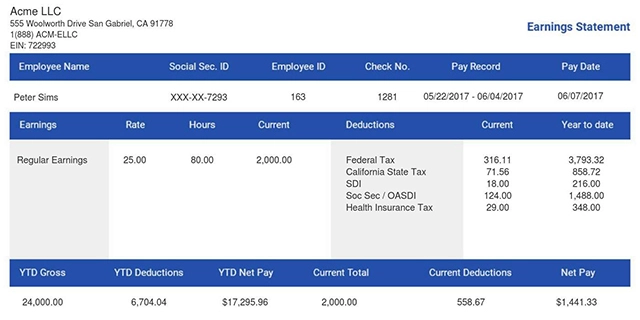
Pay stubs are the final piece of setting up payroll. Each stub shows a worker's gross pay, taxes, deductions, and net pay for the period. Many states require employers to hand one out every payday. Workers need stubs too. They use them as proof of income for an apartment, a car loan, or a credit card.
Keep payroll records for at least 4 years after the tax is due or paid, based on IRS rules. A digital folder for each worker makes this easy.
You Might Also Like
- Payroll Codes Explained
- What FTE Means for Payroll
- Understanding a Biweekly Pay Stub
- How to Read Pay Stub Deduction Codes
- What FICA Stands For
Conclusion
Setting up payroll comes down to three things: the right accounts, complete paperwork, and a tax calendar you follow. Get your EIN and state IDs first. Then collect W-4s and I-9s, choose your pay schedule and system, and test your first run before payday.
Every payday should end with a clear pay stub for each worker. Create accurate, professional stubs in minutes with our paystub generator.
- 1. Enter Your Information

- 2. Select Your Favorite Theme

- 3. Download Your Stub!

 By
By