

Reimbursements: How They Work and Tax Rules for 2026
 By
By
You paid for something your job needed. Maybe it was a client lunch, a tank of gas, or a box of printer paper. Now you want that money back. Reimbursements are how it comes back to you, and the way they are handled decides whether you pay tax on them.
The same rules matter on the other side of the desk. If you run a small business, a sloppy process can turn a simple payback into taxable wages, and in places like California it can also break state law. Clean records, whether from payroll software or a pay stub generator, keep the two apart.
This guide covers both sides. You will learn what the word means, how a claim moves from receipt to payment, and which costs usually qualify. You will also see when the IRS treats the money as income and how it appears on a pay stub. The last sections show how to set up a clean policy for your team.
Key Takeaways
- A reimbursement pays back a work cost you already covered. It is not extra pay.
- Under an IRS accountable plan, the money is tax-free and stays out of your wages.
- Prove each cost within 60 days and return any extra within 120 days.
- On a pay stub, a tax-free payback shows as its own line after taxes.
- Some states, including California and Illinois, require employers to pay back necessary costs.
- What Are Reimbursements? Reimbursement Meaning Explained
- How Do Reimbursements Work?
- Common Types of Reimbursements
- Are Reimbursements Taxable?
- How Reimbursements Show Up on a Pay Stub and W-2
- How to Set Up an Employee Reimbursement Policy
- Reimbursements vs. Stipends, Per Diems, and Direct Payment
- Common Reimbursement Mistakes to Avoid
- Conclusion: Handling Reimbursements the Right Way
What Are Reimbursements? Reimbursement Meaning Explained
Reimbursements are payments that pay you back for money you spent on someone else's behalf, usually your employer's. If you buy printer ink for the office or pay for a work hotel, the company returns that exact amount. A reimbursement is not a raise or a bonus. It only covers a cost you already paid.
So what is reimbursement in plain terms? It is a repayment, not a reward. The reimbursement meaning stays the same in almost every setting. An insurer can pay you back for a doctor visit. A client can pay back a contractor for materials. This guide focuses on the most common case: a worker who pays a business expense and gets that money back.
Two details set it apart from normal pay:
- The amount matches the cost. You get back what you spent, no more and no less.
- There is proof. A receipt, an invoice, or a mileage log backs up every claim.
People often mix up a refund and a reimbursement. A refund returns money to the person who bought something, like a store taking back a jacket. A reimbursement comes from a third party, such as your employer, for a cost you took on for them.
How Do Reimbursements Work?

Reimbursements work in five steps. You pay a business cost, keep the receipt, and submit an expense report with the date, amount, and business purpose. A manager approves it. Then payroll or accounts payable sends the money, often on your next paycheck as a separate, non-taxed line.
Here is how that looks in practice:
- You pay the cost. Use your own card or cash for something the job requires.
- You keep proof. Save the receipt. For driving, log the date, miles, and reason for each trip.
- You file a claim. Most companies use an expense reimbursement form or an app. Attach the receipt and note the business purpose.
- Your manager reviews it. They check that the cost is allowed under company policy and that the amount is right.
- You get paid back. The money arrives by direct deposit, a separate check, or a line on your next paycheck.
Picture a retail assistant manager who buys cleaning supplies before a store inspection. She pays $48, snaps a photo of the receipt, and submits it that evening. Her district manager approves it the next day. The $48 shows up on her next paycheck as its own line, under a separate payroll code.
The whole expense reimbursement cycle can take a few days or a few weeks. Your company policy should say which. If it does not, ask HR before you spend a large amount out of pocket.
Common Types of Reimbursements
Most claims fall into a handful of groups. Each has its own paperwork and tax rules.
Travel Reimbursement and Per Diem
Business travel is the classic example. Flights, hotels, rental cars, rideshares, and baggage fees usually qualify when the trip has a clear work purpose.
A travel reimbursement can be paid two ways. Some employers pay back actual costs from receipts. Others pay a per diem, which is a flat daily amount for meals and small costs. Per diem rates set by the federal government are tax-free for the employee. Any amount paid above those rates counts as taxable wages unless you return the extra.
Mileage and Gas Reimbursement
When you drive your own car for work, most employers pay you back per mile. The IRS standard mileage rate was 72.5 cents per mile from January through June 2026. The IRS then raised it to 76 cents per mile starting July 1, 2026, which is a rare mid-year change.
That rate is meant to cover fuel, wear, insurance, and repairs. That is why a separate gas reimbursement is less common for personal cars. It shows up more with company vehicles. For example, a small landscaping business might pay back crew leaders for fuel they buy for company trucks, with receipts attached. Either way, a mileage log with dates, trip purpose, and miles is what keeps the payment tax-free.
Office Supplies and Home Office Equipment
Office supplies are the everyday claim. Think paper, ink, postage, or a desk lamp for a job site.
Remote work has added a newer category. Some employers pay back part of a home internet bill, a work phone plan, or home office equipment like a monitor or a chair. Rules vary widely. Some companies pay a share of the bill. Others offer a flat monthly amount instead. Check what your employer allows before you buy.
Employer Tuition Reimbursement
Education help is one of the most valuable perks on this list, and it covers more than degrees: certifications and short courses often count too. Most companies run it as employer tuition reimbursement: you pay, pass the class, and get paid back. Under Section 127 of the tax code, an employer can pay up to $5,250 a year tax-free through a written educational assistance plan.
Two recent changes matter here. The One Big Beautiful Bill Act made student loan repayment a permanent part of that same $5,250 benefit. It also ties the cap to inflation starting in 2027. For 2026, the limit stays at $5,250.
Many programs attach strings. You may need a passing grade, or you may have to stay with the company for a set time. If you leave early, some plans ask you to pay the tuition reimbursement back. Read the agreement before you enroll.
Medical Reimbursement Through HRAs, HSAs, and FSAs
Medical reimbursement usually runs through a tax-advantaged account, not a regular expense report. The main options work differently:
- Health Reimbursement Arrangement (HRA). Only the employer funds it. Workers submit medical expenses, and the plan pays them back tax-free. A health reimbursement arrangement can cover premiums, copays, and other qualified costs.
- QSEHRA. A qualified small employer health reimbursement arrangement is built for businesses with fewer than 50 full-time workers. In 2026, the limits are $6,450 for self-only coverage and $13,100 for family coverage.
- HSA. A health savings account belongs to the worker and pairs with a high-deductible health plan. With an HSA reimbursement, you can pay yourself back for a qualified cost from any year after you opened the account. The 2026 contribution limits are $4,400 for self-only and $8,750 for family coverage.
- FSA. A health flexible spending account is funded by pre-tax paycheck deductions, up to $3,400 in 2026. An FSA reimbursement is usually a use-it-or-lose-it deal, though some plans let you carry over up to $680.
Each account is a health benefit with its own rules. For a worker, the key is to keep every receipt, even when you pay with the account's debit card.
Are Reimbursements Taxable?

Most reimbursements are not taxable if your employer uses an IRS accountable plan. That means the cost had a business purpose, you proved it within a reasonable period (60 days is the safe harbor), and you returned any extra within 120 days. If those rules are not met, the payment counts as taxable wages.
The tax treatment depends on the plan, not on the cost itself. The same $200 hotel bill can be tax-free for one worker and taxable for another.
The Three Accountable Plan Rules
The IRS lays these out in Publication 463. A plan must meet all three:
- Business connection. The cost must be one you paid while doing your job.
- Proof. You must show the amount, date, place, and business purpose within a reasonable period. The IRS treats 60 days after the cost as reasonable.
- Return of extra money. If you got an advance larger than what you spent, you must pay back the difference. The IRS treats 120 days as reasonable.
Meet all three, and the payment stays out of your taxable income. Your employer does not withhold tax on it, and it does not appear in your W-2 wages.
What Happens Under a Non-Accountable Plan
A plan that skips any of those rules is non-accountable. A common example is a flat $300 monthly "car allowance" with no mileage log.
That money is treated as wages. It goes into Box 1 of your W-2. Your employer withholds federal income tax, Social Security, and Medicare from it. It also counts toward state income tax in most states.
Taxable and Tax-Free Examples
| Payment | Usually taxable? |
|---|---|
| Hotel for a work trip, receipt submitted | No |
| Mileage at or below the IRS rate, with a log | No |
| Flat monthly allowance, no proof required | Yes |
| Tuition paid through a Section 127 plan, up to $5,250 | No |
| Tuition above $5,250 in one year | Yes, the extra amount |
| Gym membership paid back by the employer | Yes, in most cases |
So is tuition reimbursement taxable? Only the part above $5,250, unless the course qualifies as a working condition benefit. That applies when the class keeps up skills for your current job.
How Reimbursements Show Up on a Pay Stub and W-2
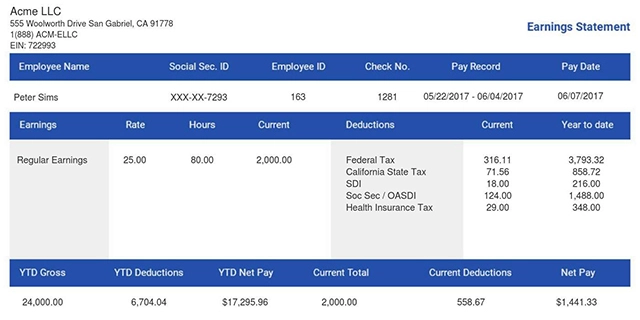
Most guides stop at the tax rules. What workers actually see is the pay stub, so it helps to know what a pay stub looks like line by line. Here is how it usually breaks down when the payback runs through payroll:
| Pay stub line | Amount | Taxed? |
|---|---|---|
| Regular pay | $2,000.00 | Yes |
| Federal, state, and FICA taxes | -$310.00 | N/A |
| Mileage reimbursement (accountable) | $145.00 | No |
| Net pay | $1,835.00 |
The tax-free amount is added after taxes are taken out. It does not change your gross pay or your year-to-date wages. A non-accountable allowance works the other way. It gets added to gross pay, and taxes come out of it.
On the W-2, accountable reimbursements usually do not appear at all. One exception is per diem or mileage paid above federal rates. The tax-free part goes in Box 12 with code L. The extra lands in Box 1 as wages.
This matters when you use pay stubs as proof of income. Landlords and lenders look at gross wages. A reimbursement line is not income, so it will not raise the amount you qualify for. If you create stubs for your own business or your team, keep reimbursements on their own clearly labeled line. That keeps your records accurate and easy to read.
How to Set Up an Employee Reimbursement Policy
A written policy protects both sides. Workers know what they can claim. Employers keep reimbursements tax-free and avoid disputes. Here is what a solid policy covers:
- Eligible expenses. List what qualifies, such as business travel, mileage, supplies, and training. List what does not, such as personal meals or traffic tickets.
- Spending limits. Set caps for hotels, meals, and equipment so workers know the range before they spend.
- Proof rules. Require receipts for costs over a set amount and a mileage log for driving.
- Deadlines. Ask for claims within 60 days and require extra advances back within 120 days. That matches the IRS safe harbors.
- Approval and payment. Name who approves claims and how fast the money goes out.
Employers can generally deduct the costs they reimburse employees for as ordinary business expenses. The accountable plan keeps the money out of wages, so there is no payroll tax on it either.
State Laws That Require Reimbursements
Federal law does not require employers to pay back most business costs. There is one limit. Under the Fair Labor Standards Act, unpaid work costs cannot push a worker's pay below minimum wage.
Several states go further:
- California. Labor Code 2802 requires employers to pay back all necessary costs a worker takes on to do the job. That includes a fair share of a personal phone used for work.
- Illinois. Employers must pay back necessary costs. Workers generally have 30 days to submit a claim.
- Iowa. Employers must pay approved costs within 30 days or explain the denial in writing.
- New Hampshire. Employers must pay back required job costs within 30 days after the worker submits proof.
Other states have narrower rules. If you have remote workers in several states, check each one, along with the state pay stub laws that control what each stub must show.
Reimbursements vs. Stipends, Per Diems, and Direct Payment
Reimbursements are not the only way to cover work costs. Many employers mix several methods.
| Method | How it works | Taxable? |
|---|---|---|
| Reimbursement | Worker pays, then gets the exact amount back with proof | No, under an accountable plan |
| Per diem | Flat daily rate for travel meals and lodging | No, up to federal rates |
| Stipend | Flat monthly amount, no receipts | Yes, in most cases |
| Company card | Employer pays the vendor directly | No, if used for business |
| Direct payment | Employer pays the bill before the worker spends anything | No |
Stipends are simple, but they usually count as wages. Some companies now bundle them into lifestyle spending accounts for wellness or home office costs. Those are taxable too. Direct payment and company cards keep the worker's own money out of it. Reimbursements sit in the middle. They take more paperwork, but they are tax-free when done right.
Common Reimbursement Mistakes to Avoid
Most problems come down to timing and paperwork. Watch for these:
- Late receipts. A claim filed after 60 days can lose its tax-free status. Snap a photo of each receipt the day you pay, and set a phone reminder at day 45.
- Mixing it into wages. Payroll teams sometimes add a payback to regular pay by mistake. That makes it taxable and scrambles the pay stub deduction codes workers rely on.
- Flat allowances without proof. A monthly amount with no receipts is a stipend, not a reimbursement.
- Personal costs. Commuting from home to your usual workplace is not a business cost. Neither is a personal meal.
- No written policy. Without clear rules, the same claim gets approved for one worker and denied for another.
You Might Also Like
- How to Calculate W-2 Wages From a Pay Stub
- Pay Stubs for Loan Applications
- Should Independent Contractors Receive a Pay Stub?
- ER Health on a Pay Stub
- W-2 vs. 1099: How to File Taxes When You Have Both
Conclusion: Handling Reimbursements the Right Way
Reimbursements are simple once the rules are clear. The money pays back a work cost, it needs proof, and it stays tax-free under an accountable plan. Keep receipts, file on time, and make sure the payment sits on its own pay stub line.
For employers, a short written policy saves hours of back-and-forth. It also keeps you on the right side of IRS and state rules. When you need clean pay records that show wages and reimbursements on separate lines, a paystub generator creates accurate stubs in just a few minutes.
- 1. Enter Your Information

- 2. Select Your Favorite Theme

- 3. Download Your Stub!

 By
By