

W9 vs W2: Key Differences for Employees and Contractors
 By
James Wilson
By
James Wilson If you've ever started a new job or picked up freelance work, you've probably been handed a tax form. Many workers wonder what it means. The W9 vs W2 question trips up millions of workers every year.
Both W-2 and W-9 are IRS forms tied to how you earn money. They serve completely different purposes depending on your employment type.
Whether you search for W2 vs W9 or the reverse, here's what you need to know to fill out the right form with confidence. You can also use a paystub generator to create professional income documentation.
Key Takeaways
-
A W-2 reports employee wages and taxes withheld, whereas a W-9 collects contractor tax identification info
-
Employees receive W-2s from their employer, while independent contractors fill out W-9s
-
A W-9 leads to a 1099 at year end, not a W-2
-
Misclassifying workers can trigger steep IRS penalties
-
The filing deadline for W-2 forms is January 31 each year
- Key Takeaways
- What Is the Difference Between a W9 vs W2?
- What Is a W-2 Form?
- What Is a W-9 Form?
- Is a W-9 the Same as a 1099?
- W-4 vs W-9: How Do These Forms Differ?
- When Is a W-9 Not Required?
- Employee vs Independent Contractor: W9 vs W2 Classification
- How To Fill Out a W-4 If Single
- You Might Also Like
- Conclusion
What Is the Difference Between a W9 vs W2?
A W-9 is filled out by independent contractors to provide their taxpayer identification number before starting work. A W-2, on the other hand, is prepared by employers to report an employee's annual wages and tax withholdings.
The difference between W9 and W2 comes down to worker classification:
- Employees get W-2s
- Contractors submit W-9s
Here's a side-by-side look at how these employee tax forms compare:
| Feature | Form W-2 | Form W-9 |
| Purpose | Reports wages and taxes withheld | Collects contractor tax info |
| Who fills it out | Employer | Independent contractor |
| Filed with IRS? | Yes, plus SSA | No, kept by the payer |
| Deadline | January 31 | Before work begins |
| Tax withholding | Federal, state, and FICA | None (unless backup withholding) |
| Leads to | Employee tax filing | Form 1099-NEC |
What Is a W-2 Form?

A W-2 is officially called the Wage and Tax Statement. Employers must send it to each employee by January 31 each year. They also file a copy with the Social Security Administration. It reports gross wages, federal and state income taxes withheld, and Social Security and Medicare contributions. If you need help understanding each box, check out our guide on how to read a W-2 like a pro.
Your W-2 lists taxable compensation and FICA amounts. It shows federal income tax withholding, state income tax, and employee benefits like 401(k) plans. As an employment tax form, it's the document you'll use to file your annual tax return.
What Is a W-9 Form?
The W-9 form independent contractor connection is straightforward. Any freelancer or independent contractor W9 recipient fills out this IRS form. Its full name is the Request for Taxpayer Identification Number and Certification.
It includes
- Worker's name
- Address
- TIN (SSN or EIN for businesses)
- Business entity type before work starts.
The company then uses this information to prepare a 1099 form at year-end.
Unlike a W-2, a W-9 doesn't involve any tax withholding. If you're a W9 employee, you're a contractor, not an employee, and you pay your own taxes. That includes the full 15.3% self-employment tax. W-2 workers split this rate with their employer, each paying 7.65%.
So how does a W9 work in practice? You fill it out once, and your client keeps it on file. They report your payments on a 1099-NEC if you earn $600 or more.
Need accurate pay documentation for a loan or rental application? Our W-2 form generator makes it easy to create professional records in minutes.
Is a W-9 the Same as a 1099?

Beyond the W9 vs W2 comparison, another common question involves the 1099. No, a W-9 and a 1099 are not the same form. A W-9 collects a contractor's tax information before work begins. A Form 1099-NEC reports nonemployee compensation paid to that contractor during the tax year.
The W-9 comes first, followed by the 1099. Learn more about how to fill out a 1099-MISC form if you need to report contractor payments.
The difference between W9 and 1099 is timing. The difference between 1099 and W9 roles is also about sequence. The W-9 vs 1099 relationship is sequential. You have to submit the W-9 when you start working. Your client then uses that information to send you a 1099 form vs W9 data at year-end.
The 1099 vs W9 distinction matters because the 1099 is what you use to file taxes. The W-9 simply provides the information needed to create it. So, "Is W9 same as 1099?" The answer is always no.
W-4 vs W-9: How Do These Forms Differ?
Now that you understand the W9 vs W2 basics, another common point of confusion involves the W-4. Employees complete a Form W-4 to tell their employer how much federal income tax to withhold. Contractors complete a W-9 to share their taxpayer identification number. Both are filled out before work begins. They apply to entirely different worker classifications.
The W4 vs W9 difference is straightforward. Payroll workers fill out a W-4. Contractors fill out a W-9. The W9 vs W4 comparison shows that the W-4 directly affects your paycheck through withholding. A W-9 has no impact on how much you're paid. Choosing a W9 or W4 depends entirely on your worker classification.
The difference between W4 and W9 also extends to filing. W-4 data stays with your employer. W-9 data generates a 1099. A W9 vs I9 distinction is also worth noting. The I-9 verifies your eligibility to work in the United States. The I9 vs W4 forms serve completely separate purposes.
When Is a W-9 Not Required?
A W-9 is not required when total payments to a contractor stay below $600 in a tax year. It's also not needed when the worker is classified as a W-2 employee. Contractors based outside the United States should file a Form W-8 BEN instead.
So, when is a W9 not required in practice? If you hire someone for a small one-time project under $600, you don't need to collect a W-9. Employees already fill out a W-4, so a W-9 would be the wrong form entirely.
Employee vs Independent Contractor: W9 vs W2 Classification
Getting worker classification right is critical. If you're wondering, "What is a W9 employee?", the answer is simple. It's an independent contractor who submitted a W-9.
What paperwork do I need for a 1099 employee? You'll need a completed W-9 form before work starts. You'll file a 1099-NEC at year-end if you pay them $600 or more. Independent contractors can also benefit from creating their own 1099 pay stubs for personal records.
The IRS uses a three-factor control test. It covers:
- Behavioral control
- Financial control
- The type of relationship
Misclassifying a W9 independent contractor as a W-2 employee (or vice versa) can trigger misclassification penalties. These include:
- $50 per incorrect form
- 1.5% of unpaid taxes
- Fines up to $1,000
Whether you hire W9 for contractors or bring on W9 for independent contractors, proper classification protects your business. Many W9 contractors work for multiple clients at once. Accurate record-keeping is essential for both parties.
How To Fill Out a W-4 If Single
To fill out a W-4 as a single filer:
- Enter your name, address, and Social Security number in Step 1
- Then check the "Single" filing status box.
- Most single filers with one job can skip Steps 2 through 4.
- Go directly to Step 5 to sign and date the form.
Want to adjust how to fill out W4 if single with extra withholding? Use Step 4 to enter additional deductions or extra withholding amounts.
You Might Also Like
-
EIN Lookup: How to Find Your Employer Identification Number (2026)
-
Walgreens W2: The Process to Obtain Your W-2 Online for 2026
Conclusion
Understanding the W9 vs W2 distinction saves you from filing headaches and potential penalties. Remember that W-2s are for employees with taxes withheld automatically, while W-9s are for independent contractors who manage their own tax obligations. Getting your worker classification right from the start can help ensure accurate tax reporting and IRS compliance.
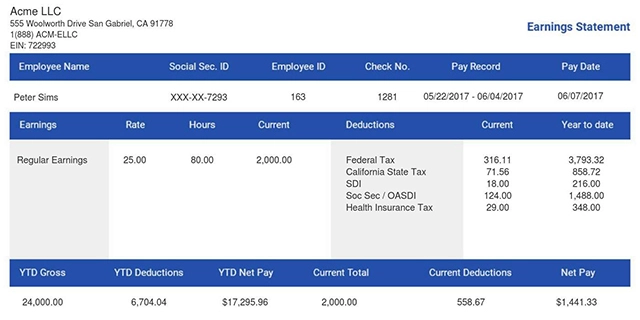
Need help creating accurate W-2 forms or professional pay stubs? Use our pay stub generator to create documents with built-in calculations and get your documentation ready fast.
- 1. Enter Your Information

- 2. Select Your Favorite Theme

- 3. Download Your Stub!


 By
By