

What Is Tax Withholding? Allowances, W-4, and Taxes Explained
 By
James Wilson
By
James Wilson Every payday, a portion of your earnings disappears before you ever see it. That's withholding at work.
In the United States, employers deduct federal, state, and local taxes from your paycheck before you receive it. Knowing how much tax is taken helps you avoid surprises at filing time, whether you manage your own W-4 or create pay stubs for your team.
This guide covers the basics, explains what withholding allowances are, and shows you how to set your withholding for the 2026 tax year.
Key Takeaways
- Withholding is money your employer takes from each paycheck to pre-pay federal, state, and local taxes on your behalf
- The old W-4 used "allowances" to set withholding; the IRS redesigned the W-4 in 2020 and removed allowances entirely
- More allowances used to mean less withheld per paycheck; today's W-4 uses dependent dollar amounts instead
- Under-withholding triggers a tax bill plus possible penalties. Over-withholding means giving the IRS an interest-free loan
- Use the IRS Tax Withholding Estimator to verify your W-4 is accurate before the filing season hits
What Is Tax Withholding?
Tax withholding is the portion of your paycheck your employer sends to the IRS, and often to your state, before it reaches you. Withholding tax works on a pay-as-you-go basis. It spreads your payments across each pay period so you never face one large bill at filing.
Your employer uses your Form W-4 to decide how much tax to take from your paycheck. The withheld amounts appear on your Form W-2 at year's end. Too much withheld means a refund. Too little means you owe the gap, plus any applicable penalties. Freelancers and the self-employed file estimated tax payments using Form 1040-ES instead.
What Are Withholding Allowances?
Withholding allowances were values used on the old Form W-4 to determine how much federal income tax your employer withheld from each paycheck. Each one was worth about $4,200 per year.
The IRS got rid of allowances in the 2020 W-4 redesign. Instead, the form now uses specific dollar amounts, such as $2,000 per child under 17 and $500 per other dependent.
The 2020 W-4 Redesign Eliminated Allowances
The current W-4 asks for filing status, dollar amounts for dependents, other income or deductions, and any extra withholding. No allowance counting is needed. Many state withholding forms still use the term "regular withholding allowances" on their version of the W-4.
Each allowance claimed still cuts how much state income tax is withheld. Pre-2020 W-4s remain valid for current employees, but a new one often gives better results.
Federal Tax Withholding: Income Tax, FICA, and More

Federal tax withholding covers three main buckets. Income tax withholding falls into your tax bracket (10% to 37% for 2026) based on filing status and W-4 choices.
Social Security and Medicare (FICA)
Every paycheck shows two separate FICA deductions. For 2026 rates:
- Social Security: 6.2% of wages up to $184,500
- Medicare: 1.45% on all wages, plus an extra 0.9% on earnings over $200,000
Employers match both halves. Together, these payroll tax amounts make up FICA. Self-employed workers pay the full 15.3% combined rate.
How Is Withholding Calculated?
Employers use IRS Publication 15-T to figure withholding. They pick either the wage bracket method or the percent method. The amount withheld from paycheck to paycheck depends on gross pay, pay frequency, and W-4 choices (filing status, dependents, extra income). Payroll software handles these steps for each worker.
For example, a single filer earning $60,000 per year and paid biweekly will see about $460 withheld per paycheck for federal income tax. FICA comes out on top of that.
What Happens If You Have Too Much or Too Little Withholding?

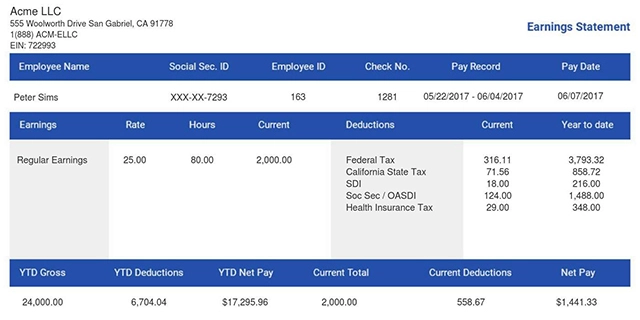
Getting withholding wrong has real costs. Too little withheld means a tax bill at filing time. You may also owe a penalty if you paid less than 90% of this year's tax or owe more than $1,000. Too much withheld means a refund, but you lent the IRS your money for free all year. Check your pay stubs regularly to catch any gaps before April.
How To Change Your Withholding
Submit a new Form W-4 to your employer. Retirees receiving pension income can use Form W-4P instead. Changes take effect within one to two pay cycles. Key reasons to update:
- Marriage, divorce, or a new dependent
- Starting a second job or side income
- A big change in investment, rental, or other income
- New deductions or credits affecting your 2026 tax liability
Use the IRS Tax Withholding Estimator at irs.gov/estimator before submitting. For more detailed rules, see IRS Publication 505, which covers withholding and estimated tax.
You Might Also Like
- How to Calculate Federal Tax Withholdings in 12 Steps
- Pay Stubs for Loan Applications: What You Need to Know
- Pay Stub Abbreviations and Acronyms: The Ultimate Guide
- Understanding Payroll Codes on Your Pay Stub
- Can't Wait for Your W-2? Calculate Wages With Your Paystub
Conclusion
Tax withholding keeps the U.S. income tax system running all year. Knowing how this works and what withholding allowances were before 2020 can help you avoid surprises and overpayments. An annual W-4 review is the simplest way to stay on track.
Need proof of income? ThePayStubs.com's pay stub generator helps workers and business owners create clean pay stubs for loans, rentals, and HR records.
- 1. Enter Your Information

- 2. Select Your Favorite Theme

- 3. Download Your Stub!

 By
By