

OASDI Tax: What It Means on Your Paycheck (2026 Guide)
 By
By
If you've noticed "OASDI" on your pay stub and wondered, "What's OASDI"?, you're not alone. It's the Social Security tax on every U.S. worker's paycheck. Most people have no idea what it stands for.
This guide covers the OASDI tax meaning and 2026 rates. You'll also understand how it appears on your paystub and whether you can opt out.
Key Takeaways
- OASDI stands for Old-Age, Survivors, and Disability Insurance, the official name for the Social Security tax
- The 2026 OASDI tax rate is 6.2% for employees and 6.2% for employers, applied to the first $184,500 in wages
- Self-employed individuals pay the full 12.4% OASDI tax through SECA
- OASDI is mandatory for most U.S. workers, with limited exceptions
- Key Takeaways
- What Is OASDI Tax?
- What Is OASDI on My Paycheck?
- OASDI Tax Rate and Wage Base Limit for 2026
- Is OASDI the Same as Social Security?
- OASDI Tax for Self-Employed Workers
- Is OASDI Tax Mandatory?
- Can You Get an OASDI Tax Refund?
- How OASDI Impacts Your Retirement Benefits
- You Might Also Like
- In Summary
What Is OASDI Tax?
OASDI stands for Old-Age, Survivors, and Disability Insurance. It's the formal name for the Social Security program run by the Social Security Administration (SSA). So, OASDI, what is it exactly? It's the federal payroll tax collected under FICA that funds three benefit types:
- Retirement Benefits: for workers who have reached the required 40 work credits
- Survivor Benefits: for families of deceased workers
- Disability Benefits: for workers who need to stop working because their medical condition meets eligibility criteria
In short, OASDI means Old-Age, Survivors, and Disability Insurance, and every working American contributes to it. You'll see it listed under various payroll codes on your paycheck.
What Is OASDI on My Paycheck?

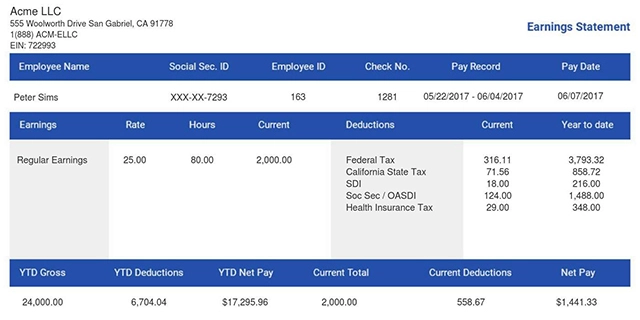
The "Fed OASDI/EE" line contains the answer to your question about "What is OASDI tax on my paycheck?'. The "/EE" stands for "employee." The fed OASDI/EE meaning represents your individual portion of Social Security tax obligations. It equals 6.2% of your gross wages up to $184,500 in 2026. You may also see OASDI on paycheck stubs listed under other labels.
Common abbreviations for this OASDI deduction on a paystub include (see our pay stub deduction codes guide for a full list):
- Fed OASDI/EE or OASDI/EE: Federal OASDI (federal), employee share
- FICA-SS or FICA-OASDI: FICA Social Security portion
- SS Tax or Soc Sec: Social Security tax
You should reach out to HR when you cannot find the OASDI withholding on your payroll statement. You may be classified as a 1099 contractor rather than a W-2 employee. That means OASDI isn't withheld, and you'll owe self-employment tax instead. For those asking, "What is OASDI on paystub?" or "What is OASDI on my paystub?", it's your Social Security contribution.
Need professional pay documentation? Our pay stub templates make it easy to create accurate records.
OASDI Tax Rate and Wage Base Limit for 2026
The OASDI tax rate consists of two parts that total 12.4%. Employees pay 6.2%, and their employers pay 6.2%. The total FICA rate, which employees must pay, amounts to 7.65% when combined with Medicare at 1.45%. If you're asking, "What is OASDI deduction on your check?", it's that 6.2%. This is separate from your FIT taxable wages, which cover federal income tax.
OASDI taxes only apply up to the wage base limit:
| Year | Wage Base Limit | Max Employee Contribution |
| 2024 | $168,600 | $10,453.20 |
| 2025 | $176,100 | $10,918.20 |
| 2026 | $184,500 | $11,439.00 |
Once your earnings pass $184,500 in 2026, you stop paying OASDI for the rest of the year. Medicare taxes have no income cap. For those wondering, "What is OASDI tax on paycheck stubs?", the FICA OASDI meaning is the Social Security portion of your total FICA withholding.
Is OASDI the Same as Social Security?

Yes, OASDI is the same as Social Security. Your paycheck might display "OASDI," "Social Security," or "Fed OASDI/EE." All three labels refer to the same tax going to the same program.
OASDI is different from Supplemental Security Income (SSI). OASDI is an earned benefit based on work credits. SSI is a need-based program for people with limited income. SSDI (Social Security Disability Insurance) is the disability part of the broader OASDI program.
OASDI Tax for Self-Employed Workers
Self-employed individuals pay the full 12.4% OASDI tax rate through SECA (Self-Employment Contributions Act). There's no employer to cover the matching half. You can deduct half of your SECA tax on Form 1040. If you need pay documentation as a freelancer, see our guide on pay stubs for the self-employed.
Is OASDI Tax Mandatory?
Yes, OASDI tax is mandatory for most U.S. workers. The self-employed, along with employers and employees, must make contributions according to federal regulations. Limited exemptions exist for certain religious groups (IRS Form 4029) and some non-resident aliens on F, J, M, or Q visas.
Students employed by their school and self-employed workers earning under $400 are also exempt. Unsure about your 1099 vs W-2 status? That determines how you pay OASDI.
Can You Get an OASDI Tax Refund?
Yes, you can get a refund if you overpaid. This typically happens when you work for two or more employers and combined wages exceed the wage base limit ($184,500 in 2026). You can claim the excess on IRS Schedule 3 with your Form 1040.
The employers operate independently of each other, so none of them knows your total wages. If you earned $120,000 at one job and $80,000 at another, your combined $200,000 exceeds the limit. You'd get a refund when you file your tax return.
How OASDI Impacts Your Retirement Benefits
The more you contribute over your career, the higher your future Social Security retirement benefits. The SSA uses your highest 35 years of earnings to calculate your monthly payment. Full retirement age is 67 for anyone born in 1960 or later. Claiming early at age 62 permanently reduces your monthly amount.
You can access your estimated benefits at any time through the ssa.gov/myaccount portal. This free tool shows your earnings history and projected benefits based on your contributions so far.
You Might Also Like
- How to Calculate W-2 Wages from a Pay Stub
- Pay Stubs and Employment Verification Documents
- W-2 vs 1099: How to File When You Have Both
- Do 1099 Employees Get Pay Stubs?
- What Does a W-2 Income Statement Look Like?
- What Is GTL on paystub?Group Term Life Explained
- is pto taxed? 2026 Tax Rates, Calculations & State Laws
- What Does Year to Date Mean? YTD on Your Paystub Explained
In Summary
OASDI is simply the Social Security tax under its official government name. Every paycheck, 6.2% of your gross wages funds retirement, disability, and survivor benefits through this federal program. Understanding the OASDI deduction on your paystub can help you make better financial decisions.
Need accurate pay documentation? Use a reliable pay stub generator to create professional pay stubs with correct tax calculations in minutes.
- 1. Enter Your Information

- 2. Select Your Favorite Theme

- 3. Download Your Stub!


 By
By